
[論文レビュー] Milky Way and Andromeda analogs from the TNG50 simulation
The paper defines and catalogs Milky Way- and Andromeda-like galaxies in the TNG50 simulation, providing a fiducial selection, data products, and comparisons to the real MW and M31.
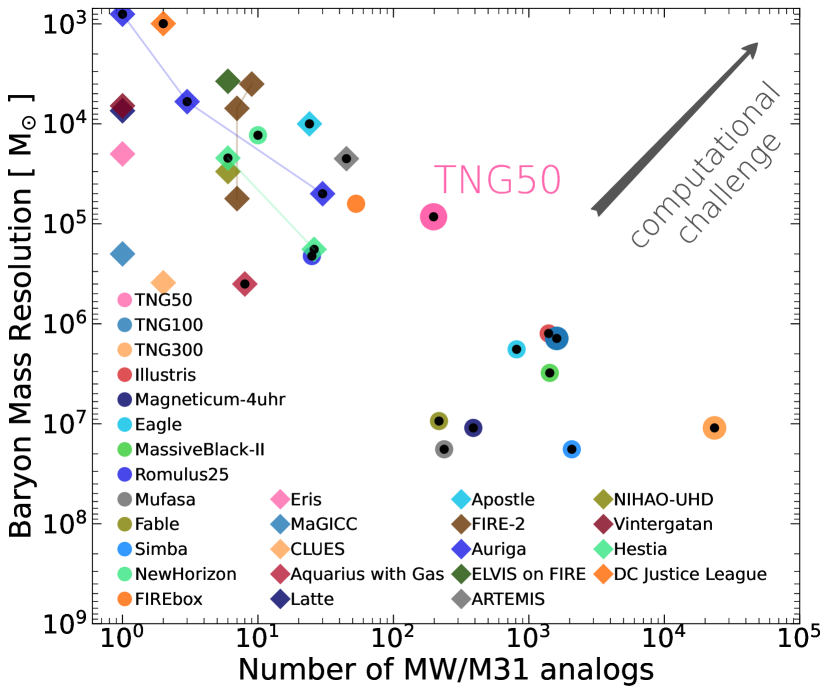
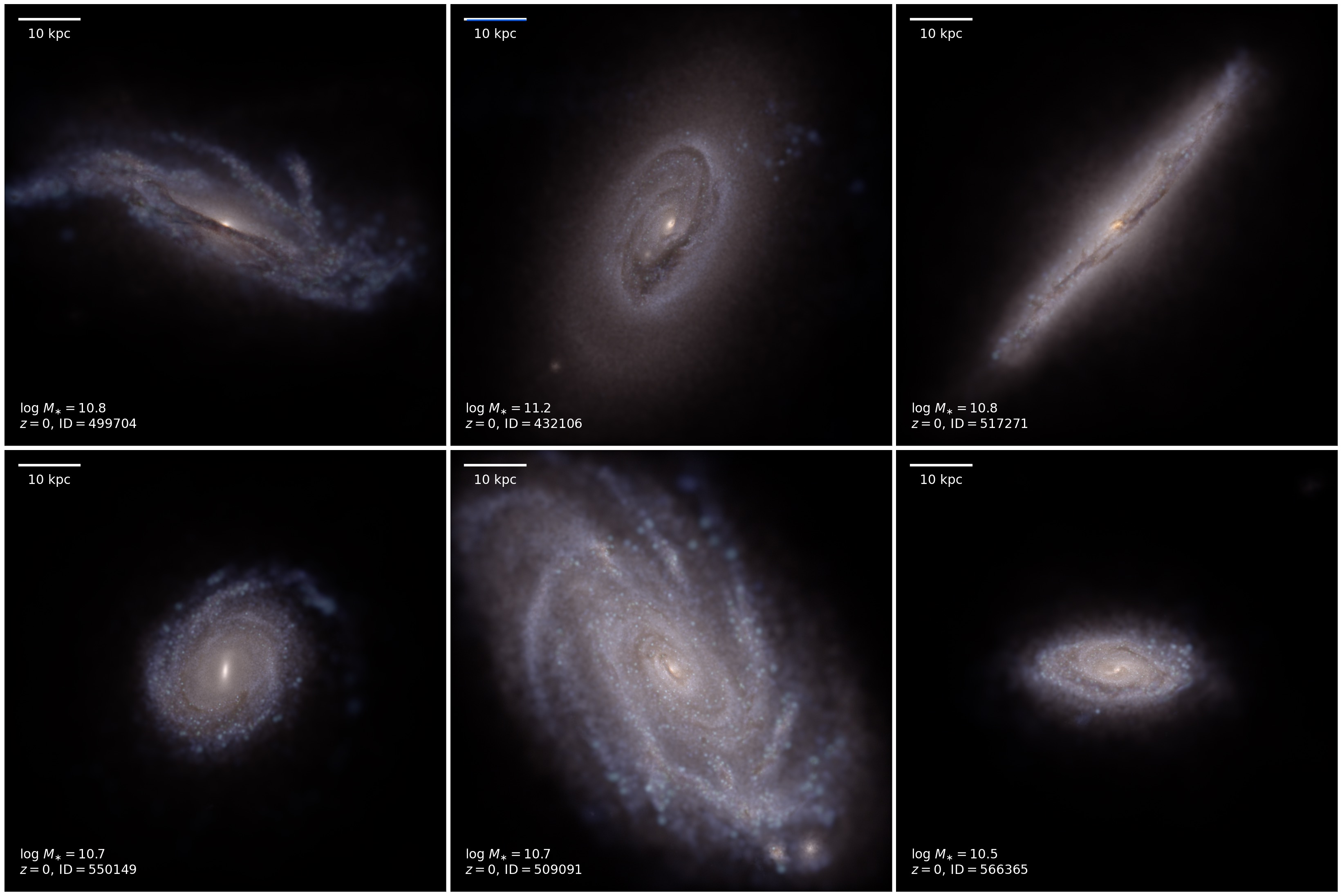
We present the properties of Milky Way- and Andromeda-like (MW/M31-like) galaxies simulated within TNG50, the highest-resolution run of the IllustrisTNG suite of $Λ$CDM magneto-hydrodynamical simulations. We introduce our fiducial selection for MW/M31 analogs, which we propose for direct usage as well as for reference in future analyses. TNG50 contains 198 MW/M31 analogs, i.e. galaxies with stellar disky morphology, with a stellar mass in the range of $M_* = 10^{10.5 - 11.2}$ Msun, and within a MW-like Mpc-scale environment at z=0. These are resolved with baryonic (dark matter) mass resolution of $8.5 imes10^4$ Msun ($4.5 imes10^5$ Msun) and $\sim150$ pc of average spatial resolution in the star-forming regions: we therefore expand by many factors (2 orders of magnitude) the sample size of cosmologically-simulated analogs with similar ($ imes 10$ better) numerical resolution. The majority of TNG50 MW/M31 analogs at $z=0$ exhibit a bar, 60 per cent are star-forming, the sample includes 3 Local Group (LG)-like systems, and a number of galaxies host one or more satellites as massive as e.g. the Magellanic Clouds. Even within such a relatively narrow selection, TNG50 reveals a great diversity in galaxy and halo properties, as well as in past histories. Within the TNG50 sample, it is possible to identify several simulated galaxies whose integral and structural properties are consistent, one or more at a time, with those measured for the Galaxy and Andromeda. With this paper, we document and release a series of broadly applicable data products that build upon the IllustrisTNG public release and aim to facilitate easy access and analysis by public users. These include datacubes across snapshots ($0 \le z \le 7$) for each TNG50 MW/M31-like galaxy, and a series of value-added catalogs that will be continually expanded to provide a convenient and up to date community resource.
研究の動機と目的
- TNG50 における MW/M31 アナログの fiducial かつ観測可能性に基づく選択を定義する。
- 宇宙論的体積における MW/M31 似た銀河の多様性と性質を定量化する。
- TNG50 の MW/M31 アナログが実際の銀河系とアンドロメダにどの程度一致するかを評価する。
- 公開利用と将来の分析を促進するデータ製品とカタログを提供する。
提案手法
- STAR: TNG50 宇宙論的 MHD シミュレーションを用い、星形成領域で ~150 pc の解像度と SMBH フィードバックを含む。
- z=0 での MW/M31 類似銀河を星質量、 disk ライクな形態、MW に似た環境基準で同定する。
- 質量、形態、環境制約を満たす 198 銀河の fiducial MW/M31 アナログサブセットを定義する。
- スナップショット全体(0≤z≤7)にわたるデータカーブを提供し、IllustrisTNG リリースを基にした付加価値カタログを構築する。
実験結果
リサーチクエスチョン
- RQ1宇宙論的シミュレーションで MW/M31 アナログを堅牢に選択できる観測可能性に基づく基準は何か。
- RQ2環境・構造・歴史の観点から、TNG50 における MW/M31 ライク銀河はどれほど多様か。
- RQ3TNG50 の MW/M31 アナログは、全体的および構造的特性の点で銀河系とアンドロメダにどの程度類似しているか。
- RQ4これらのアナログの公開分析を最も効果的に可能にするデータ製品とカタログは何か。
主な発見
- TNG50 には z=0 で M*>10^{10.5-11.2} Msun、ディスキーな形態、および MW に似た環境で定義された 198 個の MW/M31 アナログが含まれる。
- このサンプルは、環境的・全体的・構造的特性の多様性を示し、マゼラン雲級ほど大きな衛星を持つものもある。
- 大多数の MW/M31 アナログは星形成中であり、多くはバーをホストしており、比較的狭い星質量範囲内でも多様性があることを示す。
- いくつかのシミュレート銀河は銀河系とアンドロメダと異なる特性で一致しており、ターゲット比較に有用なアナログを示している。
この論文を読む
Nubintのビューアで原文を開き、読みながら気になる箇所をすぐに質問できます。
Nubintでこの論文を読むこのレビューはAIが論文の原文をもとに作成しました。引用する前に原文をご確認ください。