
[論文レビュー] Mitigating Accuracy-Robustness Trade-off via Balanced Multi-Teacher Adversarial Distillation
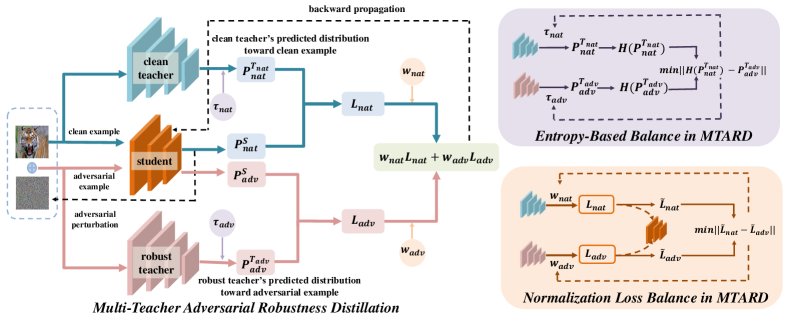
本論文は、クリーンな教師とロバストな教師を用いて、同時にモデルの正確性と敵対的ロバスト性を向上させる、新しい知識蒸留フレームワークであるMulti-Teacher Adversarial Robustness Distillation (MTARD)を提案する。エントロピーに基づく温度バランスと正規化損失重み付けを導入することで、正確性とロバスト性のトレードオフを緩和し、複数の敵対的攻撃下でCIFAR-10、CIFAR-100、Tiny-ImageNetで最先端の性能を達成した。
Adversarial Training is a practical approach for improving the robustness of deep neural networks against adversarial attacks. Although bringing reliable robustness, the performance towards clean examples is negatively affected after Adversarial Training, which means a trade-off exists between accuracy and robustness. Recently, some studies have tried to use knowledge distillation methods in Adversarial Training, achieving competitive performance in improving the robustness but the accuracy for clean samples is still limited. In this paper, to mitigate the accuracy-robustness trade-off, we introduce the Balanced Multi-Teacher Adversarial Robustness Distillation (B-MTARD) to guide the model's Adversarial Training process by applying a strong clean teacher and a strong robust teacher to handle the clean examples and adversarial examples, respectively. During the optimization process, to ensure that different teachers show similar knowledge scales, we design the Entropy-Based Balance algorithm to adjust the teacher's temperature and keep the teachers' information entropy consistent. Besides, to ensure that the student has a relatively consistent learning speed from multiple teachers, we propose the Normalization Loss Balance algorithm to adjust the learning weights of different types of knowledge. A series of experiments conducted on three public datasets demonstrate that B-MTARD outperforms the state-of-the-art methods against various adversarial attacks.
研究の動機と目的
- 敵対的訓練における持続的な正確性-ロバスト性トレードオフに取り組むこと。ここでは、ロバスト性が向上する一方でクリーンな正確性が低下する傾向がある。
- 単一教師の知識蒸留の限界を克服すること。これは、モデル固有のトレードオフが存在するため、クリーンな正確性とロバスト性の両方を同時に最適化できない。
- クリーンな例と敵対的例のための指導を分離することで、バランスの取れた学習を可能にする、マルチ教師蒸留フレームワークを開発すること。
- 教師間の知識スケールと学習の難易度の本質的な差を解消することで、複数の教師からのバランスの取れた知識移転を保証すること。
- 多様な敵対的攻撃下で、複数のベンチマークデータセットにおいて、クリーンな正確性とロバスト性の両面で最先端の性能を達成すること。
提案手法
- クリーンな教師(クリーンデータでの高い正確性)とロバストな教師(敵対的例での高いロバスト性)を備えた二重教師フレームワークを導入する。
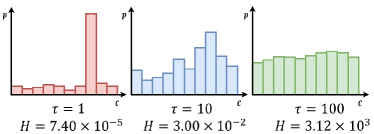
- 各教師のソフトラベルの温度を動的に調整することで、両教師間で一貫した情報エントロピーを保つ「エントロピーに基づくバランス法」を提案。これにより、知識スケールのバランスが取れる。
- 各教師からの蒸留損失の重みを動的に調整することで、学生が両方の知識をバランスよく学習できるようにする「正規化損失バランス法」を設計。
- 敵対的訓練と知識蒸留を組み合わせ、学生はクリーン入力に対してはクリーン教師を模倣し、敵対的入力に対してはロバスト教師を模倣するように訓練する。
- クリーンデータにおける交差エントロピー損失、敵対的損失、および両教師からの蒸留損失を組み合わせた損失関数を適用。適応的重み付けにより、一方の教師が優位になるのを防ぐ。
- 勾配推定とAutoAttack(PGDおよびSquare Attackを含む)を用いてロバスト性を評価し、「誤った勾配の遮断(obfuscated gradients)」に対する脆弱性がないことを確認する。
実験結果
リサーチクエスチョン
- RQ1マルチ教師蒸留フレームワークは、敵対的訓練における正確性-ロバスト性トレードオフを効果的に緩和できるか?
- RQ2クリーン教師とロバスト教師からの知識をどのようにバランスさせるか。これにより、一方の教師が学生の学習プロセスを支配するのを防げるか?
- RQ3クリーンと敵対的知識移転を分離することで、単一教師蒸留に比べ、クリーン正確性とロバスト性の両面でより優れた性能が得られるか?
- RQ4エントロピーに基づく温度スケーリングは、本質的に異なる性能プロファイルを持つ二つの教師の知識スケールを効果的に一致させられるか?
- RQ5提案手法は、強力なブラックボックスおよびホワイトボックスの敵対的攻撃、特に勾配推定攻撃に対してもロバスト性を保つことができるか?
主な発見
- MTARDは、ResNet-18において、CIFAR-10、CIFAR-100、Tiny-ImageNetで複数の攻撃下で、既存の敵対的訓練および蒸留手法を上回る最先端のロバスト正確性を達成した。
- MobileNet-v2では、CIFAR-10でベースライン手法比5.56%、CIFAR-100で4.78%、Tiny-ImageNetで3.31%のクリーン正確性向上を達成した。
- 強力な敵対的攻撃に対しても耐性がある:AutoAttack(PGDおよびSquare Attack)下でのCIFAR-10のロバスト正確性は60%を超え、CIFAR-100では30%を超え、優れた一般化性能を示した。
- MTARD保護下のResNet-18に対する勾配推定攻撃(GE)では、CIFAR-10で60.34%のロバスト正確性を達成し、『誤った勾配の遮断』に脆弱でないことが確認された。
- 驚くべきことに、より小さな教師モデル(例:ResNet-56やWideResNet-34-10)が、より大きなモデル(例:WideResNet-70-16)よりも学生の指導において優れた性能を示した。これは、モデルサイズが蒸留効果の唯一の決定要因ではないことを示している。
- 学生の性能は、教師のパラメータ数や原始的な性能に厳密に束縛されていない。これは、適切に選ばれた小さな教師でも、効果的な蒸留が可能であることを示している。
この論文を読む
Nubintのビューアで原文を開き、読みながら気になる箇所をすぐに質問できます。
Nubintでこの論文を読むこのレビューはAIが論文の原文をもとに作成しました。引用する前に原文をご確認ください。