
[論文レビュー] Mitigating the Alignment Tax of RLHF
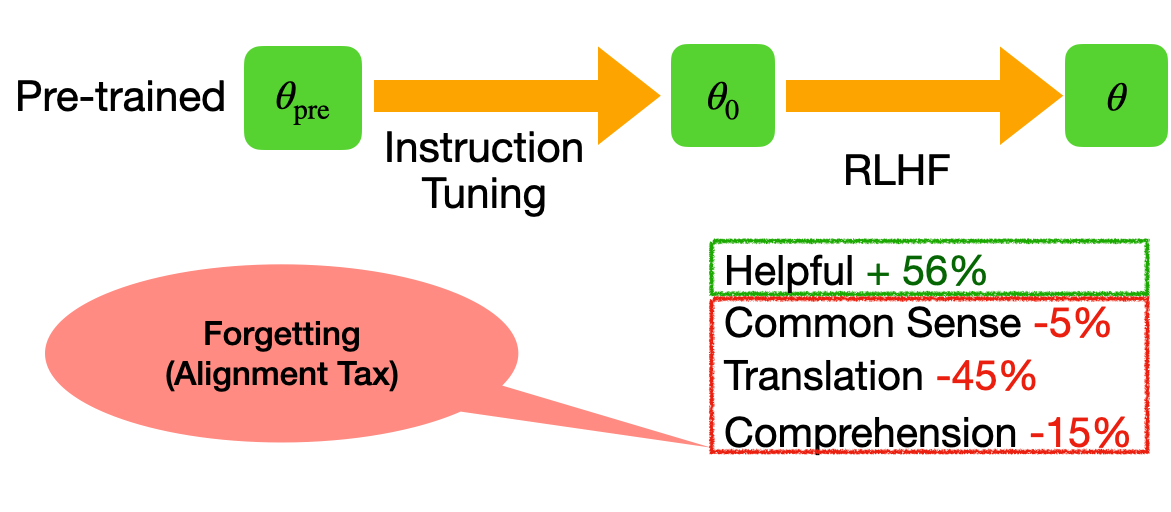
本論文は大規模言語モデル(LLM)における RLHF による alignment tax を調査し、特に Adaptive Model Averaging (AMA) が他の RLHF 手法やモデル(OpenLLaMA-3B、Mistral-7B など)に対して報酬-忘却の Pareto front を向上させることを示す。
LLMs acquire a wide range of abilities during pre-training, but aligning LLMs under Reinforcement Learning with Human Feedback (RLHF) can lead to forgetting pretrained abilities, which is also known as the alignment tax. To investigate alignment tax, we conducted experiments with existing RLHF algorithms using OpenLLaMA-3B, which revealed a pronounced alignment tax in NLP tasks. Whereas, despite various techniques to mitigate forgetting, they are often at odds with the RLHF performance, leading to a trade-off between alignment performance and forgetting mitigation, leading to an alignment-forgetting trade-off. In this paper we show that model averaging, which simply interpolates between pre and post RLHF model weights, surprisingly achieves the most strongest alignment-forgetting Pareto front among a wide range of competing methods. To understand its effectiveness, we offer theoretical insights into model averaging, revealing that it enhances performance Pareto front by increasing feature diversity on the layers where tasks share overlapped feature spaces. Empirical evidence corroborates our analysis by showing the benefits of averaging low-level transformer layers. Building on the analysis and the observation that averaging different layers of the transformer leads to significantly different alignment-forgetting trade-offs, we propose Heterogeneous Model Averaging (HMA) to Heterogeneously find various combination ratios of model layers. HMA seeks to maximize the alignment performance while incurring minimal alignment tax. Moreover, we validate HMA's performance across a range of RLHF algorithms over OpenLLaMA-3B and further extend our findings to Mistral-7B which is evaluated by open-sourced preference model and GPT4. Code available here: https://github.com/avalonstrel/Mitigating-the-Alignment-Tax-of-RLHF.git.
研究の動機と目的
- RLHF 全体における NLP ベンチマークでの alignment tax 現象の特徴づけ。
- 事前学習データアクセスなしで忘却低減手法を評価。
- alignment 報酬と忘却のバランス(報酾税のトレードオフ)を最適化する最も有効なアプローチを特定。
- 層ごとのモデル平均化比を最適化する Adaptive Model Averaging (AMA) を開発・検証。
- AMA が RLHF アルゴリズムとモデルサイズ間で一般化することを実証。
提案手法
- OpenLLaMA-3B に対して複数の NLP ベンチマーク(常識 QA、読解、翻訳)で RLHF の alignment tax を評価。
- 早期停止、L1/L2 ペナルティ、LoRA、知識蒸馏、モデル平均化(MA)など忘却低減手法を比較。
- 経験再生(ER)と MA をデータベースベースのベースラインとして比較して事前学習能力の保持を検討。
- 報酬ペナルティ(KL)を組み込み RLHF を正則化し MA と比較。
- 簡略化した特徴空間フレームワークを用いたモデル平均化の理論的分析で Pareto-front の利得を説明。
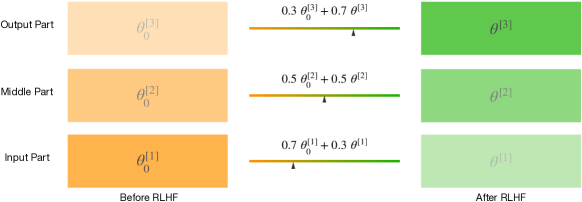
- 低レベルの Transformer 部分(入力/中間/出力)での平均化効果を実験的に検証し、低レベル層の利点を特定。
- Transformer を K 部分に分割して部ごとの平均化比を最適化し、固定平均比の下で報酬を最大化する AMA を提案。
- 追加の RLHF イテレーションなしで実践的に AMA を最適化する蒸留ベースの代理更新を提供。
実験結果
リサーチクエスチョン
- RQ1RLHF を OpenLLaMA-3B に適用した際、標準的な NLP ベンチマークで alignment tax はどれほど顕著か。
- RQ2報酬を犠牲にせず alignment tax を低減できる忘却低減手法はどれで、トレードオフはどうなるか。
- RQ3モデル平均化は他の忘却低減戦略よりも報酬-税 Pareto front の実現に優れているか。
- RQ4適応的な層ごとの平均化(AMA)は報酬-税のトレードオフをさらに改善できるか、RLHF アルゴリズムとモデルサイズを超えて一般化するか。
- RQ5低レベルの Transformer 層が alignment tax の低減に特に有効である理論的直感は何か。
主な発見
- モデル平均化は評価された忘却低減手法の中で最も効率的な報酬-税 Pareto front をもたらす。
- 経験再生(ER)はすべてのベンチマークとデータ制約において MA を一貫して上回らない。
- KL 報酬ペナルティは役立つが、Pareto front の改善にはモデル平均化の方が効果的。
- 低レベルの Transformer 層の平均化は一貫して alignment 報酬と NLP タスクの性能の両方を改善。
- Adaptive Model Averaging (AMA) は部位ごとの層平均化比を最適化することで Pareto front をさらに改善し、 RSF、DPO、PPO、および OpenLLaMA-3B および Mistral-7B ベースのモデルにも一般化する。
- AMA の利得は複数の RLHF アルゴリズムで実証され、K(分割数)の変動にも堅牢で、3 部分が高い性能を提供。
この論文を読む
Nubintのビューアで原文を開き、読みながら気になる箇所をすぐに質問できます。
Nubintでこの論文を読むこのレビューはAIが論文の原文をもとに作成しました。引用する前に原文をご確認ください。