
[論文レビュー] MixPro: Data Augmentation with MaskMix and Progressive Attention Labeling for Vision Transformer
MixProは、グローバルな文脈を保持する調整可能なパッチサイズのマスクを用いて画像を混合するMaskMixを導入することで、ビジョントランスフォーマー向けの新規データ拡張手法を提案する。さらに、信頼性の低い初期学習段階の注目マップに依存を減らすために、動的再重み付けを行うプログレッシブ注目ラベル付け(PAL)を導入する。この手法はDeiT-Tを用いてImageNetで73.8%のトップ1精度を達成し、複数のベンチマークでTransMixを上回り、セグメンテーションや検出などの下流タスクへの転移性も向上する。
The recently proposed data augmentation TransMix employs attention labels to help visual transformers (ViT) achieve better robustness and performance. However, TransMix is deficient in two aspects: 1) The image cropping method of TransMix may not be suitable for ViTs. 2) At the early stage of training, the model produces unreliable attention maps. TransMix uses unreliable attention maps to compute mixed attention labels that can affect the model. To address the aforementioned issues, we propose MaskMix and Progressive Attention Labeling (PAL) in image and label space, respectively. In detail, from the perspective of image space, we design MaskMix, which mixes two images based on a patch-like grid mask. In particular, the size of each mask patch is adjustable and is a multiple of the image patch size, which ensures each image patch comes from only one image and contains more global contents. From the perspective of label space, we design PAL, which utilizes a progressive factor to dynamically re-weight the attention weights of the mixed attention label. Finally, we combine MaskMix and Progressive Attention Labeling as our new data augmentation method, named MixPro. The experimental results show that our method can improve various ViT-based models at scales on ImageNet classification (73.8\% top-1 accuracy based on DeiT-T for 300 epochs). After being pre-trained with MixPro on ImageNet, the ViT-based models also demonstrate better transferability to semantic segmentation, object detection, and instance segmentation. Furthermore, compared to TransMix, MixPro also shows stronger robustness on several benchmarks. The code is available at https://github.com/fistyee/MixPro.
研究の動機と目的
- TransMixの限界、すなわちグローバルな文脈を損なう領域レベルのクロッピングと、初期学習段階における信頼性の低い注目マップに依存する点を是正すること。
- より効果的なデータ拡張により、ビジョントランスフォーマー(ViT)の一般化性能とロバスト性を向上させること。
- グローバルな画像構造を保持し、初期学習段階における混合ラベルのノイズを低減するデータ拡張戦略を設計すること。
- セマンティックセグメンテーション、オブジェクト検出、インスタンスセグメンテーションなどの下流タスクにおけるViTベースモデルの転移学習性能を向上させること。
提案手法
- MaskMixは、各マスクパッチが入力画像のパッチサイズの倍数であるパッチ型グリッドマスクを用いて混合画像を構築し、出力パッチが常に1つの元画像からのみ生成されることを保証する。
- マスクサイズは調整可能であり、パッチレベルでの画像間混合を避けることで、グローバルな画像構造を維持するように設計されている。
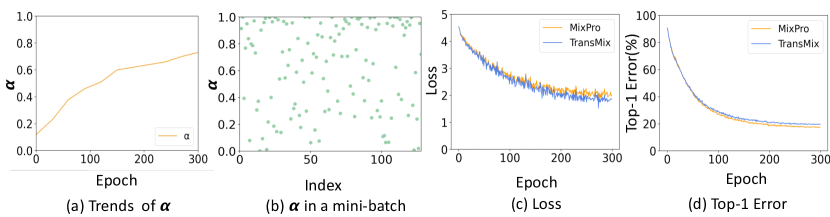
- プログレッシブ注目ラベル付け(PAL)は、進行要因αを用いて注目ベースのラベル信頼度を動的再重み付けすることで、信頼性の低い初期学習段階の注目マップへの依存を低減する。
- 進行要因αは学習過程で徐々に増加し、注目マップの信頼性が向上するにつれてモデルがそれらに依存するようになる。
- MixProはMaskMixとPALを統合した一貫したデータ拡張パイプラインを構築し、画像レベルおよびラベルレベルの両方の混合を向上させる。
- この手法はImageNetでの事前学習時に適用され、分類、検出、セグメンテーション、ロバストネスベンチマークで評価される。

実験結果
リサーチクエスチョン
- RQ1MaskMixは、TransMixの領域ベースクロッピングと比較して、ビジョントランスフォーマーにおける画像混合をどのように改善するか?
- RQ2進行的注目ラベル付けは、注目マップが信頼性の低い初期学習段階で、混合ラベルのノイズを低減できるか?
- RQ3MixProは、ImageNetおよび下流タスクにおけるViTベースモデルの一般化性能とロバスト性を向上させるか?
- RQ4遮蔽耐性、分布外検出の観点から、MixProはTransMixと比較して精度、ロバストネスに優れているか?
- RQ5性能を最大化するための最適なマスクパッチスケールと進行要因戦略は何か?
主な発見
- DeiT-Tを用いた300エポックの学習で、MixProはImageNetで73.8%のトップ1精度を達成し、TransMixおよびヴァニラViTを上回る。
- DeiT-Sでは、ImageNet-Aの自然な敵対的攻撃に対して、トップ1精度が1.3%向上し、22.4%に達した(TransMixは21.1%)。
- ImageNet-AにおけるAURRACは32.4%で、TransMix-DeiT-Sの28.8%を上回り、不確実性推定の精度が向上している。
- ImageNet-Oにおける分布外検出では、MixPro-DeiT-Sが23.1%のAUPRCを達成し、TransMix-DeiT-S(21.9%)より1.2%高く、ヴァニラDeiT-S(20.9%)より2.2%高い。
- MixProで学習されたモデルは、セマンティックセグメンテーション、オブジェクト検出、インスタンスセグメンテーションなどの下流タスクで優れた転移性能を示す。
- アブレーションスタディにより、MaskMixとPALの両方が性能向上に顕著に寄与しており、最適なマスクパッチスケールと進行要因戦略がロバストネスと精度を向上させていることが確認された。
この論文を読む
Nubintのビューアで原文を開き、読みながら気になる箇所をすぐに質問できます。
Nubintでこの論文を読むこのレビューはAIが論文の原文をもとに作成しました。引用する前に原文をご確認ください。