
[論文レビュー] Morphological Prototyping for Unsupervised Slide Representation Learning in Computational Pathology
この論文では、全スライド画像(WSI)の表現学習のための、プロトタイプに基づく非教師あり表現学習フレームワーク「Panther」を提案する。このフレームワークは、パッチ埋め込みから形態的プロトタイプを特定するためのガウス・ミックス・モデル(GMM)を活用している。EMを用いて混合成分のパラメータを推定することで、コンactで解釈可能なスライド表現を生成し、13のデータセットにおいてサブタイピングおよび生存予測のタスクで教師ありMILベースラインを上回る性能を示す。さらに、事後確率マップにより各プロトタイプの解釈可能性を実現している。
Representation learning of pathology whole-slide images (WSIs) has been has primarily relied on weak supervision with Multiple Instance Learning (MIL). However, the slide representations resulting from this approach are highly tailored to specific clinical tasks, which limits their expressivity and generalization, particularly in scenarios with limited data. Instead, we hypothesize that morphological redundancy in tissue can be leveraged to build a task-agnostic slide representation in an unsupervised fashion. To this end, we introduce PANTHER, a prototype-based approach rooted in the Gaussian mixture model that summarizes the set of WSI patches into a much smaller set of morphological prototypes. Specifically, each patch is assumed to have been generated from a mixture distribution, where each mixture component represents a morphological exemplar. Utilizing the estimated mixture parameters, we then construct a compact slide representation that can be readily used for a wide range of downstream tasks. By performing an extensive evaluation of PANTHER on subtyping and survival tasks using 13 datasets, we show that 1) PANTHER outperforms or is on par with supervised MIL baselines and 2) the analysis of morphological prototypes brings new qualitative and quantitative insights into model interpretability.
研究の動機と目的
- 全スライド画像表現学習における、タスク特化的で弱教師ありMIL手法の一般化性と表現力の限界を是正すること。
- 組織内の形態的再帰性と混合パターンを捉える、非教師ありでタスクに依存しないフレームワークの開発。
- 形態的プロトタイプの特定と定量的評価を通じて、解釈可能なスライド表現の実現。
- 13のデータセットを対象に、サブタイピングおよび生存予測を含む多様な下流タスクにおけるフレームワークの評価。
- 事後確率マップと形態的アノテーションを通じて、各プロトタイプごとの解釈可能性の提供。
提案手法
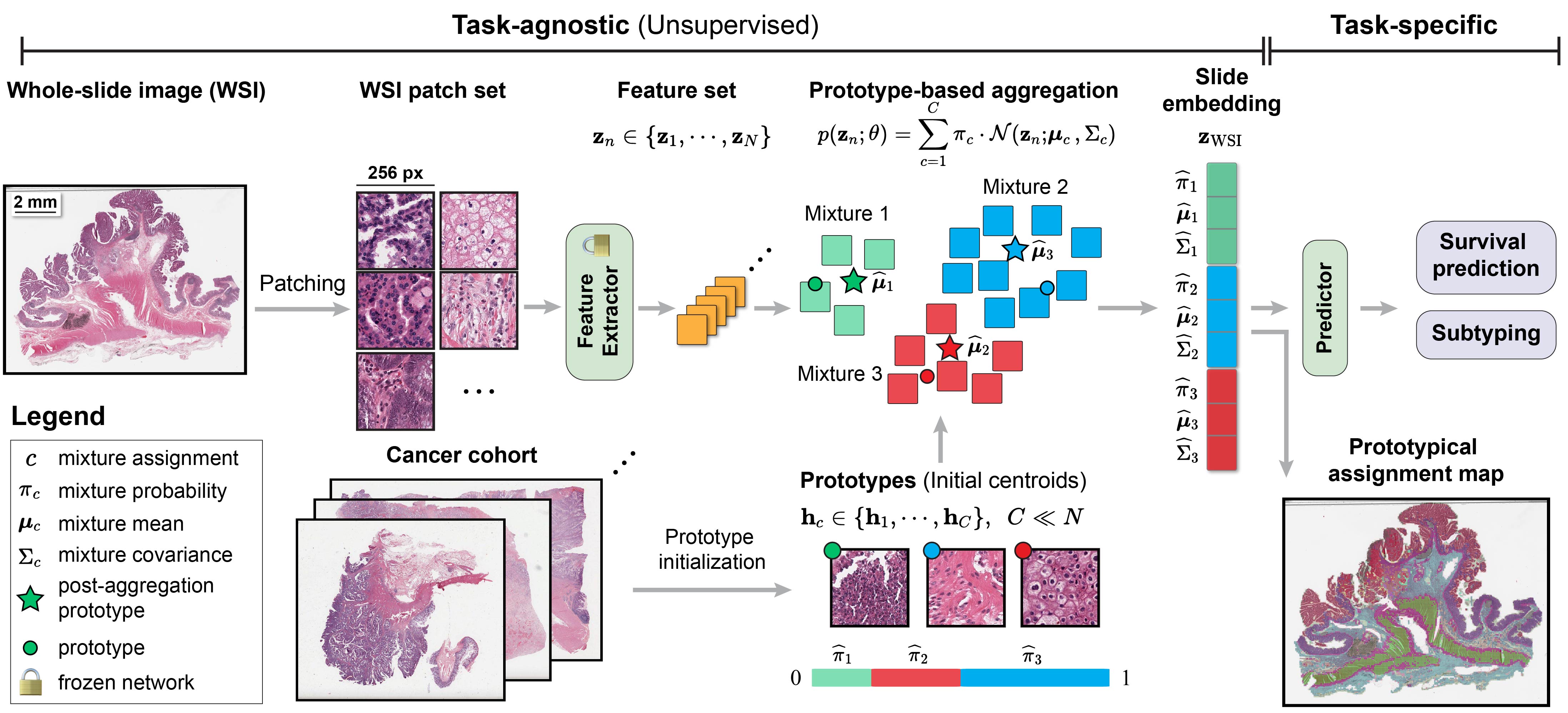
- WSIパッチ埋め込みを、各混合成分が形態的プロトタイプに対応するガウス・ミックス・モデル(GMM)から生成されたものとしてモデル化する。
- 期待値最大化(EM)アルゴリズムを用いてGMMパラメータを推定する:混合割合(基数)、平均(プロトタイプ表現)、共分散(ばらつき)。
- 全プロトタイプにおける推定されたGMMパラメータを連結することで、スライドレベルの表現を構築する。
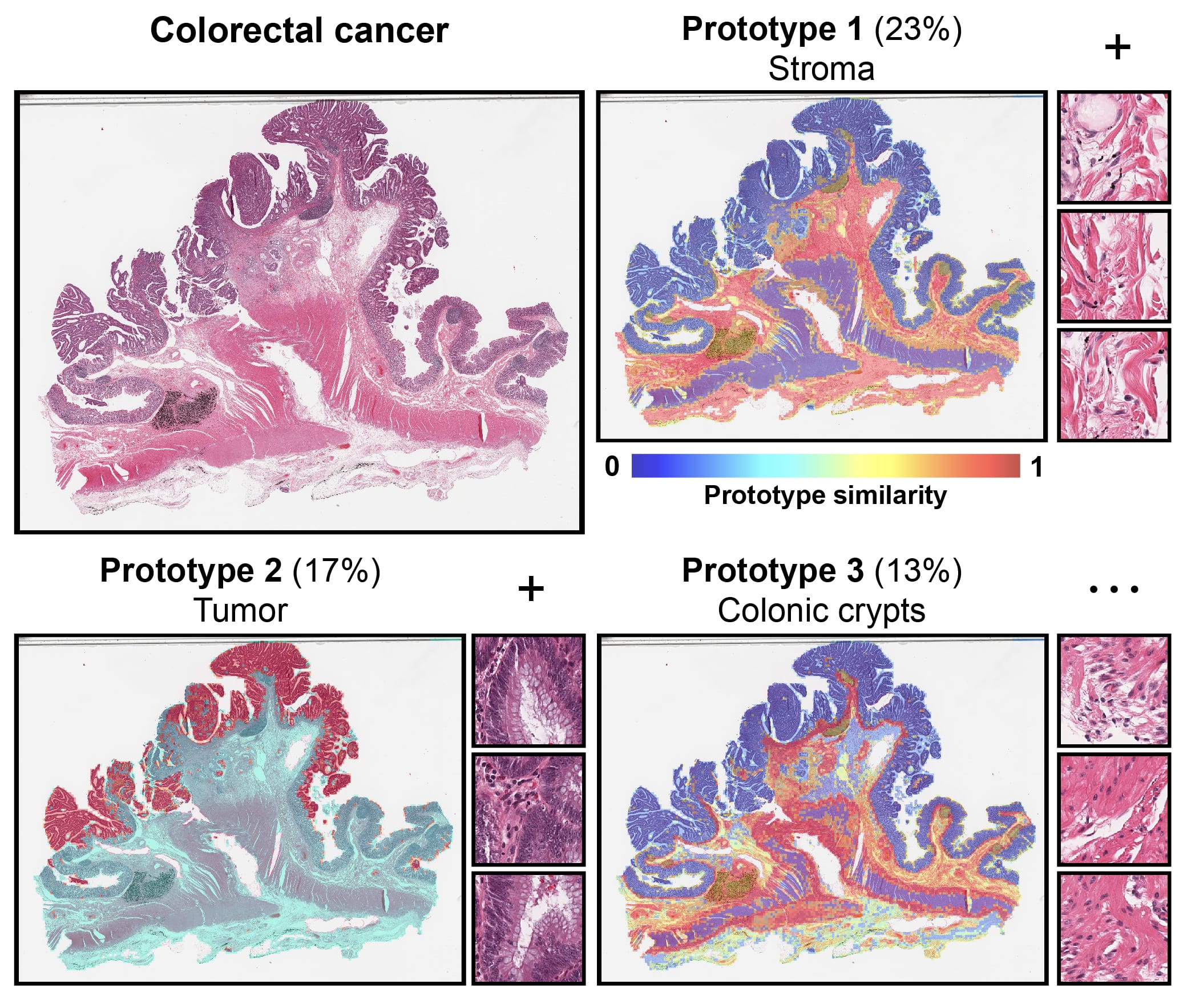
- パッチを事後確率によりプロトタイプに割り当てることで、プロトタイプに依存する解釈とヒートマップ可視化を可能にする。
- 事前学習済みのビジョンエンコーダーから得られるパッチ埋め込みのみを用いて、非教師学習でフレームワークを訓練する。
- 学習された表現を、分類および生存予測のためのシンプルな線形ヘッドまたはMLPを用いた下流タスクに応用する。
実験結果
リサーチクエスチョン
- RQ1全スライド画像における形態的再帰性を活用することで、タスクに依存しない非教師ありスライド表現を学習可能か?
- RQ2プロトタイプに基づくGMMアプローチは、既存の非教師ありおよび教師ありMILベースラインを下回らないか?
- RQ3特定された形態的プロトタイプは、スライドレベル表現の定性的および定量的解釈可能性を提供できるか?
- RQ4プロトタイプの分布と割り当ては、既知のヒストパスロジカルパターンおよび臨床的結果とどのように相関するか?
- RQ5このフレームワークは、多様ながん種類およびスライドの特徴にわたってどれほど一般化可能か?
主な発見
- Pantherは、サブタイピングおよび生存予測の両タスクにおいて13のデータセットで教師ありMILベースラインを上回るか同等の性能を示し、強力な一般化性を示した。
- 生存予測(Cox)では平均AUCが0.671 ± 0.09、サブタイピングでは0.651 ± 0.04を達成し、OT や ProtoCounts などの非教師ありベースラインを上回った。
- プロトタイプベースのヒートマップ解釈は、監視付きパッチレベル分類器と強い一致を示し、BLCA、BRCA、KIRCにおいて形態的関連性が妥当であることを検証した。
- 各スライドごとのプロトタイプ分布 $π_c$ は、病理医によるアノテーションで確認された生物学的に意味のある組織割合を捉えていた。
- 事後確率の可視化により、腫瘍領域、好酸球浸潤、間質成分と一致する空間的パターンが明らかになった。
- このフレームワークは、各プロトタイプにおける非線形モデリングと解釈を可能にし、組織微小環境の複雑性に関する新たな知見を提供した。
この論文を読む
Nubintのビューアで原文を開き、読みながら気になる箇所をすぐに質問できます。
Nubintでこの論文を読むこのレビューはAIが論文の原文をもとに作成しました。引用する前に原文をご確認ください。