
[論文レビュー] MuLTI: Efficient Video-and-Language Understanding with Text-Guided MultiWay-Sampler and Multiple Choice Modeling
MuLTIは、メモリ効率の良い注意メカニズムに基づく特徴抽出と、低GPUコストで浅い特徴を微調整するための注意メカニズムベースのアダプタを用いた、動画と言語の理解を効率化するフレームワークを提案する。さらに、事前学習と下流の動画QAタスクのギャップを埋めるために、複数選択モデリングを新たな事前学習タスクとして導入し、7つのベンチマークで最先端の性能を達成するとともに、メモリ使用量を削減した。
Video-and-language understanding has a variety of applications in the industry, such as video question answering, text-video retrieval, and multi-label classification. Existing video-and-language understanding methods generally adopt heavy multi-modal encoders and feature fusion modules, which consume high computational costs. Specially, they have difficulty dealing with dense video frames or long text prevalent in industrial applications. This paper proposes MuLTI, a highly accurate and efficient video-and-language understanding model that achieves efficient and effective feature fusion and rapid adaptation to downstream tasks. Specifically, we design a Text-Guided MultiWay-Sampler based on adapt-pooling residual mapping and self-attention modules to sample long sequences and fuse multi-modal features, which reduces the computational costs and addresses performance degradation caused by previous samplers. Therefore, MuLTI can handle longer sequences with limited computational costs. Then, to further enhance the model's performance and fill in the lack of pretraining tasks in the video question answering, we propose a new pretraining task named Multiple Choice Modeling. This task bridges the gap between pretraining and downstream tasks and improves the model's ability to align video and text features. Benefiting from the efficient feature fusion module and the new pretraining task, MuLTI achieves state-of-the-art performance on multiple datasets. Implementation and pretrained models will be released.
研究の動機と目的
- 全パラメータの微調整と長いシーケンス処理によって引き起こされるGPUメモリ消費量の増大を解消すること。
- パフォーマンスを損なわせることなく、動画とテキストのモダリティ間の特徴抽出の効率性と有効性を向上させること。
- 新たな事前学習目的を導入することで、事前学習と下流の動画QAタスクの間のタスクギャップを縮小すること。
- 注意メカニズムベースのアダプタを用いて、最小限のメモリオーバーヘッドで浅い特徴を効果的に微調整できること。
- 制限されたGPUメモリ内で、長文とスパースな動画フレームを効率的に処理できること。
提案手法
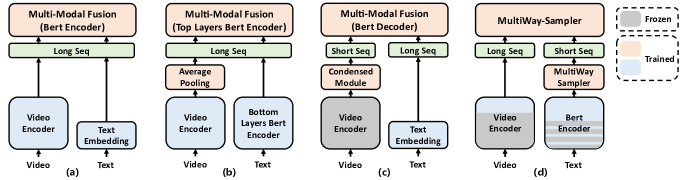
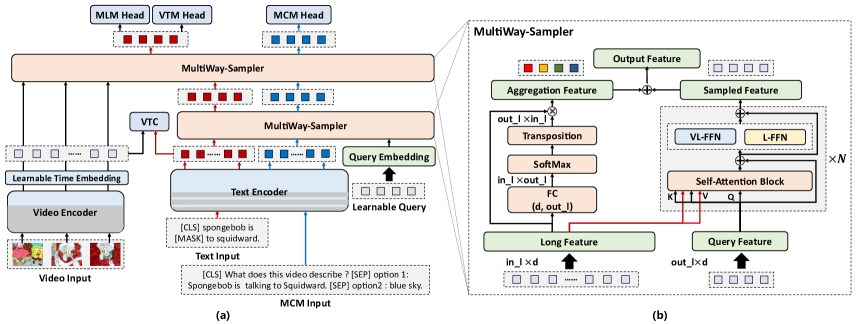
- MultiWay-Samplerは、学習可能なクエリベクトルと自己注意機構を用いてテキスト特徴をサンプリング・凝縮し、その後、注意メカニズムに基づく残差アグリゲーションを適用して重要な情報を保持する。
- このサンプラーは共有の自己注意モジュールを用いるが、動画とテキスト特徴を別々に処理するためのモダリティ固有のフィードフォワードネットワークを活用する。
- 注意メカニズムベースのアダプタはエンコーダーに挿入され、全微調整と比較してメモリコストを削減しながら浅い特徴を微調整する。
- 部分的に凍結されたエンコーダー(PFE)戦略では、一部のエンコーダーレイヤーを凍結することで、学習効率を向上させ、過学習を緩和する。
- 複数選択モデリング(MCM)は、与えられた動画に対して最適なテキスト記述を選択するタスクとして事前学習タスクとして導入され、マルチモーダルな整合性を向上させる。
- 本モデルは、MultiWay-Sampler、注意アダプタ、およびMCM事前学習を組み合わせることで、低メモリ消費量で高いパフォーマンスを達成する。
実験結果
リサーチクエスチョン
- RQ1マルチモーダル特徴抽出モジュールは、GPUメモリ使用量を削減しながらも、動画と言語のタスクにおけるパフォーマンスを維持または向上させることができるか?
- RQ2注意メカニズムベースのアダプタは、全微調整と比較して、動画と言語のモデルにおけるパフォーマンスとメモリ効率の面でどのように異なるか?
- RQ3複数選択モデリング(MCM)という新たな事前学習タスクを導入することで、下流の動画QAおよびリtrievalタスクのパフォーマンスはどの程度向上するか?
- RQ4本モデルは、顕著なパフォーマンス低下を伴わずに、長文やスパースな動画フレームを効果的に処理できるか?
- RQ5特徴サンプリング、選択的微調整、および新たな事前学習タスクを組み合わせることで、多様な動画と言語のベンチマークで最先端の結果が得られるか?
主な発見
- MuLTIは、MSRVTT-QA(45.71%の正確度)およびMSVD-QA(50.63%の正確度)を含む7つの動画と言語のタスクで最先端の性能を達成し、先行手法を上回った。
- 注意メカニズムベースのアダプタは、ベースラインモデルと比較して、MSVD-QAで0.82%、MSRVTT-QAで0.17%のパフォーマンス向上を達成した。
- 注意メカニズムに基づく残差アグリゲーションを併用したMultiWay-Samplerは、アグリゲーションなしのベースラインと比較して、MSRVTT-QAで0.38%の正確度向上を実現した。
- 部分的に凍結されたエンコーダー戦略により、GPUメモリ使用量は6109 MBから10283 MBに増加したが、全微調整と比較してMSVD-QAの正確度は3.03%向上した。
- 複数選択モデリング(MCM)は、事前学習と下流タスクの間のタスクギャップを縮小することで、動画QAおよびリtrievalタスクのパフォーマンスを顕著に向上させた。
- MultiWay-Sampler、注意アダプタ、およびMCM事前学習の組み合わせにより、評価されたすべてのデータセットおよびタスクで一貫した性能向上が得られた。
この論文を読む
Nubintのビューアで原文を開き、読みながら気になる箇所をすぐに質問できます。
Nubintでこの論文を読むこのレビューはAIが論文の原文をもとに作成しました。引用する前に原文をご確認ください。