
[論文レビュー] Multi-objective generative AI for designing novel brain-targeting small molecules
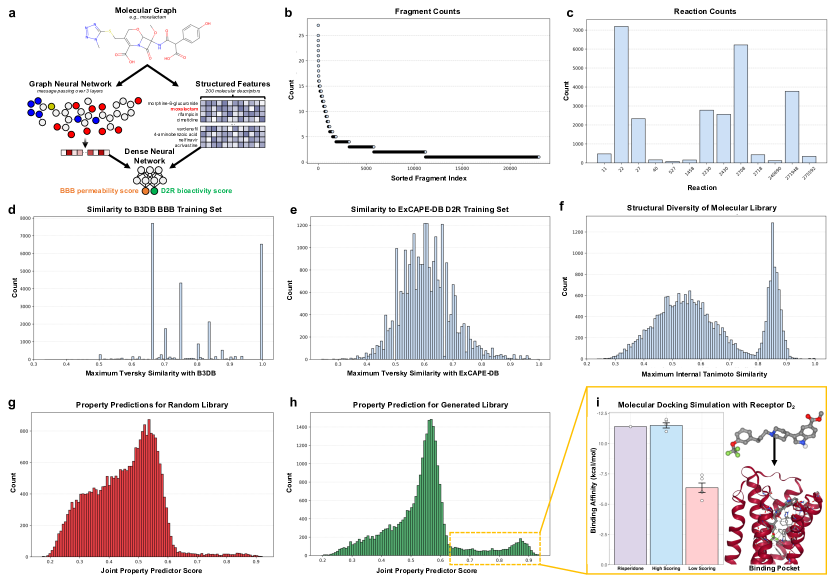
本研究では、モンテカルロ木探索(MCTS)を用いたマルチオブジェクティブな生成AIフレームワークを提案し、血液脳関門(BBB)透過性が高く、ドーパミンD2受容体(D2R)への予測結合親和性が強く、良好な安全性プロファイルを有する新規で合成可能な低分子を設計する。この手法は、BBB透過性、D2Rバイオアクティビティ、ADME-Toxの各プロパティを予測するグラフニューラルネットワークベースの予測器を統合し、リスペリドン(臨床的に使用されている抗精神病薬)と同等のドッキング親和性を示すトップ候補が得られる26,581種の分子からなる多様なライブラリを生成した。
The strict selectivity of the blood-brain barrier (BBB) represents one of the most formidable challenges to successful central nervous system (CNS) drug delivery. Computational methods to generate BBB permeable drugs in silico may be valuable tools in the CNS drug design pipeline. However, in real-world applications, BBB penetration alone is insufficient; rather, after transiting the BBB, molecules must bind to a specific target or receptor in the brain and must also be safe and non-toxic. To discover small molecules that concurrently satisfy these constraints, we use multi-objective generative AI to synthesize drug-like BBB-permeable small molecules. Specifically, we computationally synthesize molecules with predicted binding affinity against dopamine receptor D2, the primary target for many clinically effective antipsychotic drugs. After training several graph neural network-based property predictors, we adapt SyntheMol (Swanson et al., 2024), a recently developed Monte Carlo Tree Search-based algorithm for antibiotic design, to perform a multi-objective guided traversal over an easily synthesizable molecular space. We design a library of 26,581 novel and diverse small molecules containing hits with high predicted BBB permeability and favorable predicted safety and toxicity profiles, and that could readily be synthesized for experimental validation in the wet lab. We also validate top scoring molecules with molecular docking simulation against the D2 receptor and demonstrate predicted binding affinity on par with risperidone, a clinically prescribed D2-targeting antipsychotic. In the future, the SyntheMol-based computational approach described here may enable the discovery of novel neurotherapeutics for currently intractable disorders of the CNS.
研究の動機と目的
- 中枢神経系(CNS)薬物開発における血液脳関門(BBB)透過性の欠如という主な課題に対処すること。これは神経変性疾患や精神疾患の有効な治療を制限する要因である。
- BBB透過性を有するだけでなく、抗精神病薬の主要標的であるドーパミンD2受容体(D2R)への高い予測結合親和性を有する低分子を設計すること。
- ADME-Toxの予測された安全性および毒性プロファイルを分子設計プロセスに統合することで、治療的妥当性を確保すること。
- 実験的検証に適した、多様で合成可能な新規化合物のライブラリを生成すること。
- 現在治療が困難とされるCNS疾患の神経治療薬の発見に、マルチオブジェクティブにガイドされた分子生成が実現可能であることを示すこと。
提案手法
- 化学的に妥当な分子空間を探索するために、変更を加えたSyntheMolアルゴリズム(MCTSベースの生成フレームワーク)を採用した。
- BBB透過性、D2Rバイオアクティビティ、ADME-Toxプロファイルの各予測に、グラフニューラルネットワーク(GNN)ベースの予測器を統合した。
- MCTSのロールアウト中に探索と活用のバランスを図るために、BBB透過性、D2R結合親和性、毒性の各予測値を正規化し平均化したマルチオブジェクティブスコア関数P(N)を用いた。
- 132,479種の分子ブロックと13種の化学反応を用い、探索ツリーの各ノードが潜在的な分子構造を表す形で、段階的に分子を構築した。
- トレーニングデータからの類似性を評価するため、タンニトおよびターヴェスキー類似度指標を用い、構造的新規性を保証した。
- D2受容体に対する結合親和性をin silicoで評価するため、トップ候補を分子ドッキングシミュレーションで検証した。
実験結果
リサーチクエスチョン
- RQ1マルチオブジェクティブな生成AIは、同時に高いBBB透過性、強力なD2R結合親和性、良好な安全性プロファイルを達成する低分子を効果的に設計できるか?
- RQ2BBB、D2R、ADME-Toxの複数のプロパティ予測器を統合することで、制限された分子空間内での生成分子の質と多様性にどのような影響を与えるか?
- RQ3生成された分子はトレーニングデータと比較して、どの程度構造的新規性と多様性を示すか?
- RQ4トップ候補の予測結合親和性は、リスペリドン(臨床的に使用されている抗精神病薬)と同等か?
- RQ5マルチオブジェクティブスコアを用いたMCTSガイドド生成により、実験室での検証に適した高い合成可能性を有する分子が得られるか?
主な発見
- 本手法により、予測された高いBBB透過性と良好なADME-Toxプロファイルを有する26,581種の新規で構造的に多様な低分子のライブラリが生成された。
- トップパフォーマンスを示した分子は、分子ドッキングシミュレーションにより、臨床的に処方されている抗精神病薬リスペリドンと同等のD2受容体への予測結合親和性を示した。
- マルチオブジェクティブスコア関数は、探索と活用のバランスを効果的に図り、結合プロパティスコアの合計値においてランダムサンプリングベースラインを上回る性能を示した分子を生成した。
- 最大内部タンニトおよびターヴェスキー類似度指標を用いた分子多様性の確認により、トレーニング化合物との類似度が低く、構造的高次元の新規性が確認された。
- プロパティ予測器は優れた一般化性能を示し、10分割交差検証においてBBB透過性およびD2Rバイオアクティビティの両方でAUC-ROC値が0.85以上であった。
- 本手法により、BBB透過性、標的結合、安全性の複数の治療的制約を満たす分子が効果的に同定され、実験的検証の強力な候補となった。
この論文を読む
Nubintのビューアで原文を開き、読みながら気になる箇所をすぐに質問できます。
Nubintでこの論文を読むこのレビューはAIが論文の原文をもとに作成しました。引用する前に原文をご確認ください。