
[論文レビュー] MV-Swin-T: Mammogram Classification with Multi-view Swin Transformer
本稿では、メディオラテラル・オブリクス(MLO)およびクラニアル・カウダリス(CC)視野からの特徴を統合するために、新規のマルチヘッド・ダイナミックアテンション(MDA)ブロックを採用した、純粋なトランスフォーマー基盤の多視野ネットワーク、MV-Swin-Tを提案する。シフトされたウィンドウ構成を用いた動的アテンションにより、視野間の相互情報を利用することで、CBIS-DDSMおよびVinDr-Mammoデータセットにおいて最先端の性能を達成し、単一視野のSwin-Tベースライン比でAUCが最大11.11%向上した。
Traditional deep learning approaches for breast cancer classification has predominantly concentrated on single-view analysis. In clinical practice, however, radiologists concurrently examine all views within a mammography exam, leveraging the inherent correlations in these views to effectively detect tumors. Acknowledging the significance of multi-view analysis, some studies have introduced methods that independently process mammogram views, either through distinct convolutional branches or simple fusion strategies, inadvertently leading to a loss of crucial inter-view correlations. In this paper, we propose an innovative multi-view network exclusively based on transformers to address challenges in mammographic image classification. Our approach introduces a novel shifted window-based dynamic attention block, facilitating the effective integration of multi-view information and promoting the coherent transfer of this information between views at the spatial feature map level. Furthermore, we conduct a comprehensive comparative analysis of the performance and effectiveness of transformer-based models under diverse settings, employing the CBIS-DDSM and Vin-Dr Mammo datasets. Our code is publicly available at https://github.com/prithuls/MV-Swin-T
研究の動機と目的
- 単一視野の深層学習モデルの限界を克服するため、多視野分析を活用すること。
- 分離された畳み込みブランチや単純な統合に依存する既存の多視野手法が示す視野間相関の損失を是正すること。
- 長距離依存性と視野間関係を効果的に捉えることができる、純粋なトランスフォーマー基盤アーキテクチャの開発。
- CCおよびMLO視野の両方からの情報を新規のアテンション機構を用いて統合することで、診断精度の向上を図ること。
- CBIS-DDSMおよびVinDr-Mammoを含む公開データセット上で、多様な設定下でのモデル性能の妥当性を検証すること。
提案手法
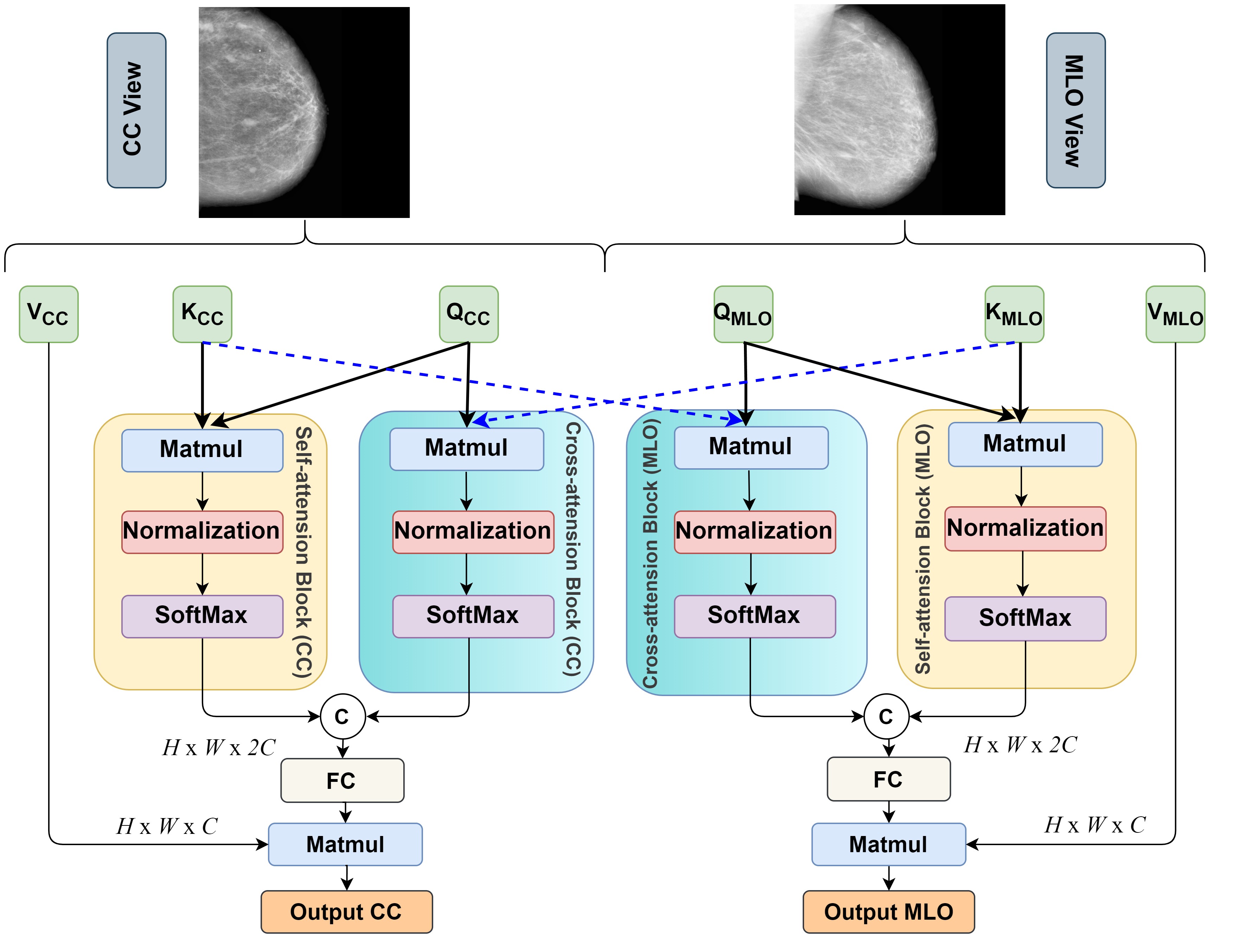
- 固定およびシフトされたウィンドウ構成を用いて、CCおよびMLO視野間の自己アテンションとクロスアテンションを統合する新規のマルチヘッド・ダイナミックアテンション(MDA)ブロックを提案。
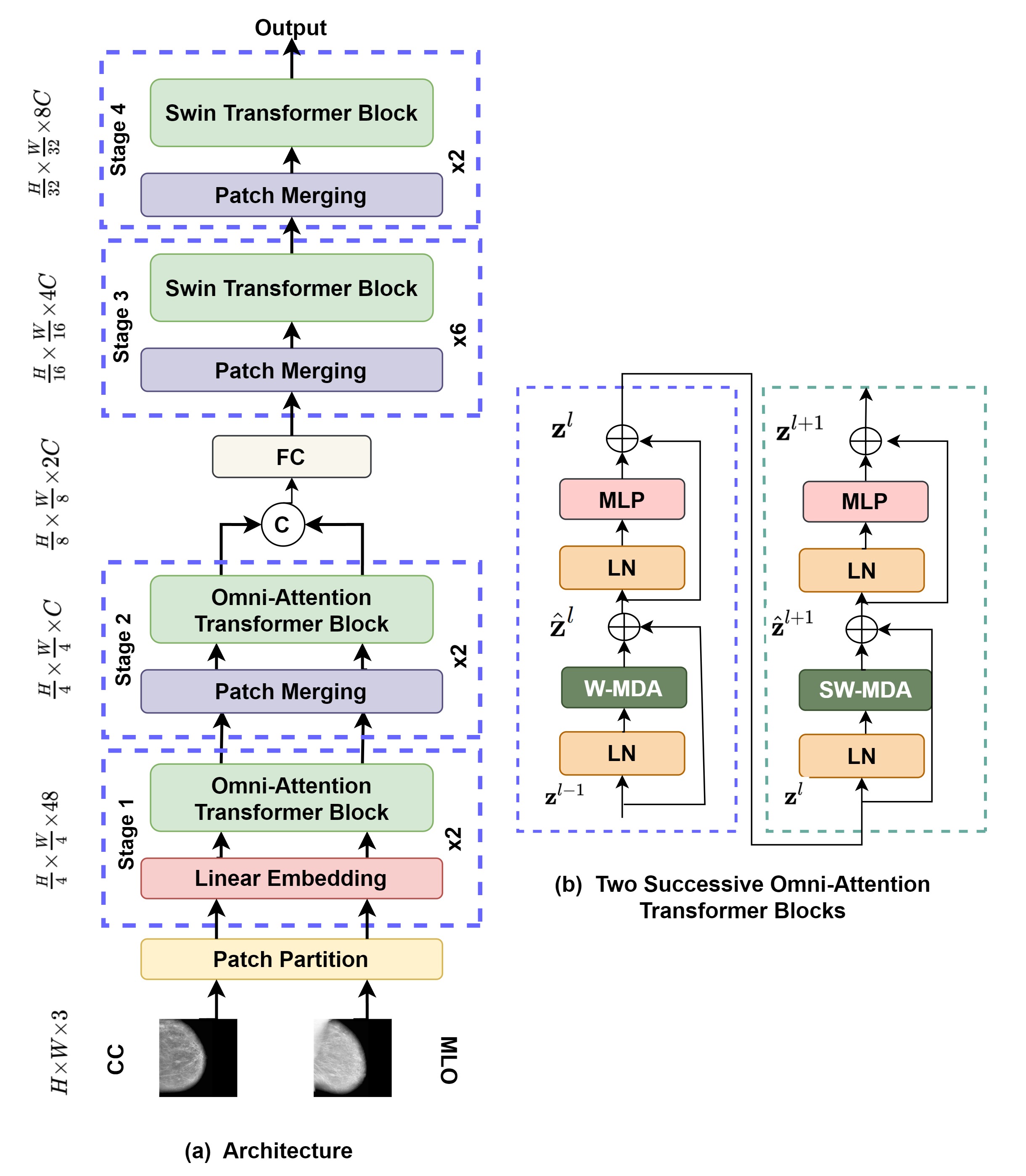
- シフトされたウィンドウを用いたSwinトランスフォーマーのアーキテクチャを適応し、局所的およびグローバルな特徴学習を可能にするとともに、計算複雑度を低減。
- ネットワークの2番目の段階後に多視野特徴を早期統合することで、文脈的一致性を保持し、表現学習を強化。
- 重み付き加算および連結戦略を用いて両視野のアテンションマップを統合し、連結が最良のパフォーマンスを示した。
- 224×224および384×384の画像解像度でモデルを学習し、より大きな入力サイズが境界局所化および分類精度を向上させることを確認。
- アーキテクチャ的要因(アテンション統合戦略、入力解像度など)がモデルパフォーマンスに与える影響を評価するアブレーションスタディを実施。
実験結果
リサーチクエスチョン
- RQ1純粋なトランスフォーマー基盤アーキテクチャは、単一視野モデルおよびハイブリッドCNN-Transformerモデルを上回る性能を示せるか?
- RQ2提案されたマルチヘッド・ダイナミックアテンション(MDA)ブロックは、CCおよびMLO視野間のクロスビュー情報統合においてどれほど効果的か?
- RQ3入力画像解像度(224×224 対 384×384)は、腫瘍の局所化および分類能力にどのような影響を及えるか?
- RQ4多視野特徴の早期統合は、分類性能において遅延統合や中間段階の統合を上回るか?
- RQ5CBIS-DDSMおよびVinDr-Mammoのような、画像品質やデータサイズが異なる複数のデータセットにおいて、モデルの性能はどのように変動するか?
主な発見
- CBIS-DDSMにおける腫瘍分類タスクにおいて、MV-Swin-TはAUC 71.37%、精度68.63%を達成し、単一視野のSwin-Tベースライン(AUC 60.26%)比でAUCが11.11%向上した。
- 腫瘍および石灰化を含むCBIS-DDSMデータセット全体では、MV-Swin-TはAUC 66.43%、精度65.37%を達成し、単一視野のSwin-T(AUC: 61.28%, 精度: 60.46%)を上回った。
- VinDr-Mammoデータセットでは、MV-Swin-TはAUC 96.08%、精度95.50%を達成し、単一視野のSwin-T(AUC: 95.88%, 精度: 95.50%)をわずかに上回り、高品質・大規模データセットでも堅牢性を示した。
- 連結ベースのアテンション統合戦略は重み付き加算を上回り、後者は同じ視野とクロスビューの比率が0.9:0.1のときに最良の結果を示した。
- 入力解像度を224×224から384×384に引き上げることでモデル性能が向上し、高解像度が境界局所化および特徴表現を強化することを示した。
- VinDr-Mammoにおけるモデルの優れた性能は、その大規模さと高品質な画像に起因し、データ規模と品質がトランスフォーマー基盤モデルの一般化性能に顕著に影響することを示唆した。
この論文を読む
Nubintのビューアで原文を開き、読みながら気になる箇所をすぐに質問できます。
Nubintでこの論文を読むこのレビューはAIが論文の原文をもとに作成しました。引用する前に原文をご確認ください。