
[論文レビュー] "My Answer is C": First-Token Probabilities Do Not Match Text Answers in Instruction-Tuned Language Models
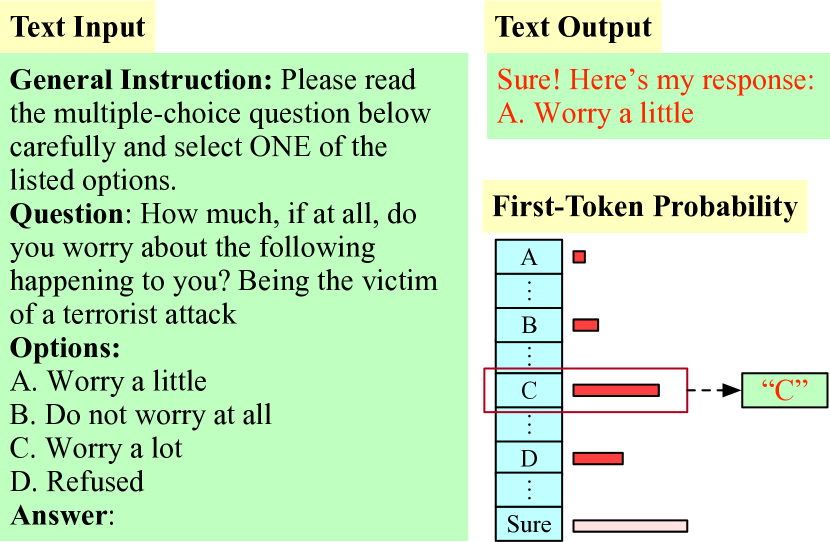
この論文は、複数選択問題(MCQ)に回答する際、指示微調整済み言語モデルにおける最初のトークンの確率順位と実際のテキスト出力との間の不一致を調査する。最初のトークン評価—ベンチマークで一般的に使われるもの—は、会話の前置き、拒否反応、応答スタイルのばらつきのため、最終的なモデル出力を反映していないことが示された。6つのモデルで不一致率が60%を超えることが判明し、特にセーフティや会話向けに微調整されたモデルで顕著である。
The open-ended nature of language generation makes the evaluation of autoregressive large language models (LLMs) challenging. One common evaluation approach uses multiple-choice questions (MCQ) to limit the response space. The model is then evaluated by ranking the candidate answers by the log probability of the first token prediction. However, first-tokens may not consistently reflect the final response output, due to model's diverse response styles such as starting with "Sure" or refusing to answer. Consequently, MCQ evaluation is not indicative of model behaviour when interacting with users. But by how much? We evaluate how aligned first-token evaluation is with the text output along several dimensions, namely final option choice, refusal rate, choice distribution and robustness under prompt perturbation. Our results show that the two approaches are severely misaligned on all dimensions, reaching mismatch rates over 60%. Models heavily fine-tuned on conversational or safety data are especially impacted. Crucially, models remain misaligned even when we increasingly constrain prompts, i.e., force them to start with an option letter or example template. Our findings i) underscore the importance of inspecting the text output as well and ii) caution against relying solely on first-token evaluation.
研究の動機と目的
- 指示微調整済みLLMが複数選択問題に回答する際、最初のトークン確率評価の信頼性を調査すること。
- モデルの応答における最初のトークン予測と実際のテキスト出力との間の不一致の程度を特定すること。
- 応答スタイル—例えば前置きや拒否行動—が最初のトークン評価の忠実度に与える影響を分析すること。
- プロンプトの摂動やさまざまな指示制約下での最初のトークン評価のロバスト性を評価すること。
- MCQベンチマークにおいて最初のトークン確率をモデルの正確性の代理として広く用いることへの挑戦。
提案手法
- Llama2-7b-Chat や Mixtral を含む6つの指示微調整済みLLMを、公共の意見に関するオピニオンQAの414問に限定したサブセットに対して評価した。
- 最初のトークン確率(例:'A'、'B'、'C'、'D' の対数尤度)を最終的なテキスト出力と比較し、不一致を検出した。
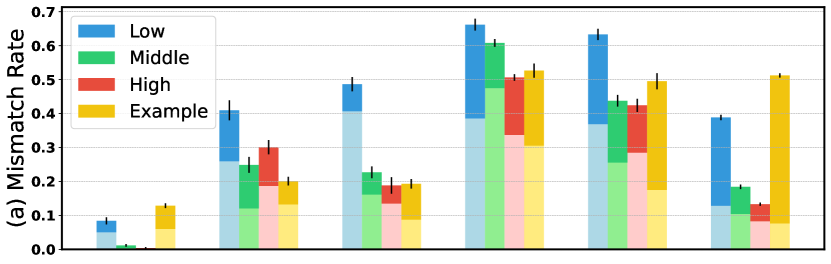
- 指示制約の3段階(一般、中程度(文字1文字のみ)、高レベル(文字で開始))を適用し、整合性に与える影響を評価した。
- 応答が '拒否' を選択するか、答えのない説明を提供するかを特定することで、拒否率を測定した。
- 敵対的および自然なバリエーションをプロンプトに加えることで、最初のトークン評価のロバスト性をテストした。
- ルールベースのマッピングを用いてテキスト出力から最終的な答えを抽出し、最初のトークン予測と比較した。
実験結果
リサーチクエスチョン
- RQ1指示微調整済みLLMがMCQに回答する際、最初のトークン確率と最終的なテキスト出力がどれくらいの頻度で食い違うか?
- RQ2会話の前置きや拒否行動は、最初のトークン評価にどれほど歪みをもたらすか?
- RQ3プロンプト制約(例:文字で開始するよう強制)を強化することで、最初のトークンとテキストベースの答えの整合性にどのような影響が出るか?
- RQ4プロンプト摂動や指示フォーマットの変化に対して、最初のトークン評価はどれほどロバストか?
- RQ5セーフティや会話向けに微調整されたモデルは、最初のトークン評価において不一致にかかりやすいか?
主な発見
- Llama2-7b-Chat などのモデルでは、最初のトークン評価とテキスト出力が60%以上で食い違うことが判明し、深刻な不一致が生じている。
- セーフティや会話向けに微調整されたモデルは、頻繁な前置きや拒否応答のため、著しく高い不一致率を示している。
- 高レベルの制約(例:'文字で開始')下でも、不一致率は50%以上にとどまり、プロンプトによっては問題が解消されないことが示された。
- 拒否行動が不一致の主な要因であり、モデルはテキスト出力で '拒否' を選択する一方で、最初のトークン確率は特定の選択肢を支持している。
- 最初のトークン評価はプロンプト摂動に対してロバストではなく、わずかな指示の変更で性能と整合性が著しく変動することが判明した。
- 本研究は、最初のトークン確率が現実世界のユーザー対応シナリオにおけるモデル行動の信頼できない代理であることを確認した。
この論文を読む
Nubintのビューアで原文を開き、読みながら気になる箇所をすぐに質問できます。
Nubintでこの論文を読むこのレビューはAIが論文の原文をもとに作成しました。引用する前に原文をご確認ください。