
[論文レビュー] NANOGrav signal from axion inflation
本論文は、疑似スカラーのインフラション体が質量を持つU(1)ゲージ場へのChern-Simons結合を介して、パリティを破る青く傾斜した重力波スペクトルを生み出せることを示しており、NANOGravのナノヘルツ信号を説明できる可能性がある一方で宇宙論的制約と整合する。
Several pulsar timing arrays including NANOGrav, EPTA, PPTA, and CPTA have recently reported the observation of a stochastic background of gravitational wave spectrum in the nano-Hz frequencies. An inflationary interpretation of this observation is challenging from various aspects. We report that such a signal can arise from the Chern-Simons coupling in axion inflation, where a pseudoscalar inflaton couples to a (massive) $U(1)$ gauge field, leading to efficient production of a transverse gauge mode. Such tachyonic particle production during inflation exponentially enhances the primordial perturbations and leads to a unique parity-violating gravitational wave spectrum, that remains flat near the CMB scales but becomes blue-tilted at smaller scales. We identify the parameter space consistent with various cosmological constraints and show that the resultant gravitational wave signals can provide extra contribution on top of the standard astrophysical contribution from inspiraling supermassive black hole binaries towards explaining the observed excess at NANOGrav. The parity-violating nature of the signal can be probed in future interferometers, distinguishing it from most other new physics signals attempting to explain the NANOGrav result.
研究の動機と目的
- NANOGrav SGWBを SMBHBs以外の初期宇宙物理学の潜在的信号として動機付ける。
- Chern-Simons結合を介した質量を持つU(1)ゲージ場を重力波の源として用いた軸子インフレーションを調査する。
- 宇宙論的・観測的制約と整合するパラメータ空間を特定する。
- 得られたGW信号がSMBHBの寄与を補完してNANOGravデータを説明できることを実証する。
- 将来の検出器で検証可能な独自のパリティ破壊的GW署名を強調する。
提案手法
- 準-デ-Sitter空間でU(1)ゲージ場へのChern-Simons結合をもつ軸子様インフレーション体を定式化する。
- ゲージ場のモード方程式を導出し;A+偏波のタキオン性生成を同定する(Eq. 2.6)。
- ゲージ場の後方反応を含むスカラー・テンソル摂動を計算し、CMBスケールのスペクトルを決定するとともに非ガウシアン性とrを制約する(Eqs. 2.3–2.4, 2.8, 2.13–2.15)。
- 時刻変数Nを用いてCMBスケールを超える系を進化させ、後方反応を捉える(Eqs. 3.1–3.2)。
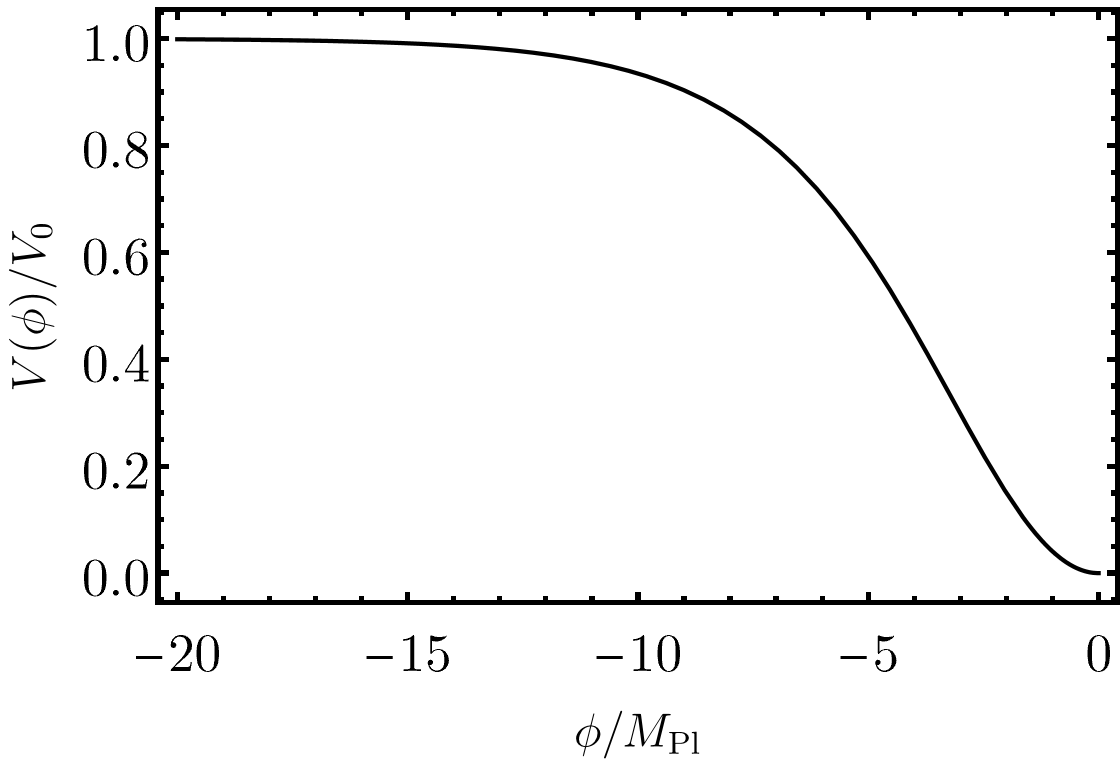
- T-modelポテンシャル V(phi)=V0 tanh^2(phi/√(6αT) Mpl) を採用し、ベンチマーク点についてξ(N)および mA/H(N) を計算する(Eq. 3.3)。
- 今日の GWスペクトル ΩGW(f) を予測し、パリティ破壊寄与を含めてNANOGravおよびLVKの制約と比較する(Eq. 4.1, 4.2, 4.3)。
![Figure 1 : Shaded regions denote exclusion of the gauge boson’s parameter space from various constraints. Tensor-to-scalar ratio bound is drawn for $H/M_{\rm Pl}=10^{-5}$ . For $f_{\rm NL}^{\rm eq}<-25\pm 47$ [ 156 ] , the left (right) part corresponds to the positive (negative) bound.](https://ar5iv.labs.arxiv.org/html/2307.01192/assets/Allconstraints.png)
実験結果
リサーチクエスチョン
- RQ1φ F tilde F結合を持つ軸子インフレーションはNanoHz周波数でNANOGravと整合する確率論的重力波背景を生成できるか?
- RQ2パラメータ空間のどの領域(ξ, mA/H)がCMB制約・非ガウシアン性・LVK境界を満たしつつ、PTAスケールで観測可能なGW信号を生み出すか?
- RQ3モデルは将来の検出器で検証可能なパリティ破壊的GWスペクトルを予測するか?
- RQ4選択されたインフレーションポテンシャル(T-model)がξの進化と後方反応、および得られるGW信号にどのような影響を与えるか?
- RQ5GW背景からの追加ΔNeffはBBN/CMBの制約内か?
主な発見
- ゲージ場生成はパリティを破るGWスペクトルを生み出し、CMBスケールではフラットだが小さなスケールで青く傾く。
- ゲージ場の後方反応が成長を制御し、LVK境界と適合しつつナノヘルツ周波数で検出可能なPW信号を生み出す。
- T-modelポテンシャルでは、3つのベンチマーク点がSMBHB背景よりNANOGravデータに適合するGW信号を生み出す。
- 予測される ΩGW(f) は後方反応のため LVKスケールで従属的であり、パリティ破壊的署名は独自の実験的手掛かりを提供する。
- GW背景からの追加ΔNeffは小さく(≈0.013)BBN/CMBの制約内に十分収まる。
- モデルは将来のET-CEやLISA-Taijiネットワークなどの検出器で検証可能なパリティ破壊的署名を示唆している。
より良い研究を、今すぐ始めましょう
論文設計から論文執筆まで、研究時間を劇的に削減しましょう。
クレジットカード登録不要
このレビューはAIが作成し、人間の編集者が確認しました。