
[論文レビュー] NASDM: Nuclei-Aware Semantic Histopathology Image Generation Using Diffusion Models
NASDM は、最大6種類の核タイプのセマンティックマスクを条件として、高精細なヒストパスロジー組織パッチを合成する画期的な拡散ベースの生成モデルであり、ピクセル単位の核の局所化を可能にしている。コロニー組織データにおいて、FID 15.7、IS 2.7 の最先端の性能を達成しており、既存の GAN や拡散ベースの手法を上回っている。
In recent years, computational pathology has seen tremendous progress driven by deep learning methods in segmentation and classification tasks aiding prognostic and diagnostic settings. Nuclei segmentation, for instance, is an important task for diagnosing different cancers. However, training deep learning models for nuclei segmentation requires large amounts of annotated data, which is expensive to collect and label. This necessitates explorations into generative modeling of histopathological images. In this work, we use recent advances in conditional diffusion modeling to formulate a first-of-its-kind nuclei-aware semantic tissue generation framework (NASDM) which can synthesize realistic tissue samples given a semantic instance mask of up to six different nuclei types, enabling pixel-perfect nuclei localization in generated samples. These synthetic images are useful in applications in pathology pedagogy, validation of models, and supplementation of existing nuclei segmentation datasets. We demonstrate that NASDM is able to synthesize high-quality histopathology images of the colon with superior quality and semantic controllability over existing generative methods.
研究の動機と目的
- 核のセグメンテーションに必要なアノテート済みヒストパスロジー画像の不足に応じ、リアルな合成組織パッチを生成すること。
- 初めての核認識型セマンティック拡散モデルを構築し、ヒストパスロジー画像の正確かつ条件付きの生成を可能にすること。
- 条件付き拡散モデリングを用いて、ヒストパスロジー画像生成におけるモデルの忠実度とセマンティック制御性を向上させること。
- 高品質な合成データを用いた病理学教育、モデル検証、データ拡張の応用を可能にすること。
- 分類器フリーのガイドラインとマルチスケール学習の有効性を検証すること。
提案手法
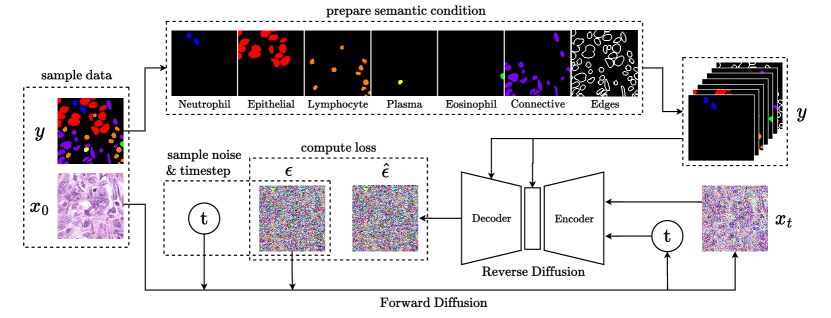
- 6種類の核タイプのセマンティックラベルマップを条件として、組織パッチを生成する条件付きノイズ除去拡散確率的モデル(DDPM)を活用する。
- 核セグメンテーションマスクを条件として、U-Netアーキテクチャを用いてピクセル単位の画像生成をガイドする。
- サンプリング段階で分類器フリーのガイドラインを適用し、忠実度と条件マスクへの適合性のバランスを取る。
- Lizard データセットに対して染色正規化を実施し、学習と生成の両方で一貫した色の分布を確保する。
- 10× および 20× のオブジェクティブマグニフィケーションパッチの両方でモデルを学習し、スケール依存の性能を評価する。
- 既存の生成モデルとの定量的評価として、Fréchet Inception Distance (FID) と Inception Score (IS) を用いる。
実験結果
リサーチクエスチョン
- RQ1複数の核タイプのセマンティックマスクを条件として与えた場合、拡散モデルは正確でピクセル単位の核の局所化を実現するリアルなヒストパスロジー組織パッチを生成できるか?
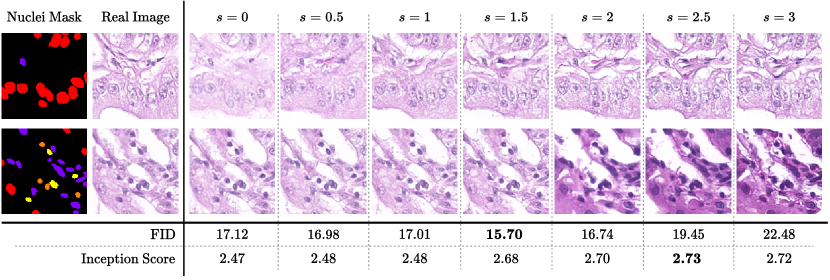
- RQ2分類器フリーのガイドラインは、生成されたヒストパスロジー画像の品質およびセマンティックの一貫性にどのように影響するか?
- RQ3より高いマグニフィケーション(20×)で学習させると、低マグニフィケーション(10×)よりも優れた生成性能が得られるか?
- RQ4FID および IS の観点から、NASDM は既存の GAN ベースおよび拡散ベースのヒストパスロジー生成モデルと比較してどのように差をつけるか?
- RQ5モデルは生物学的に妥当な核の形態、例えば明確なクロマチンパターンや核対胞質比を生成できるか?
主な発見
- NASDM はコロニー組織データセットにおいて、Fréchet Inception Distance (FID) 15.7、Inception Score (IS) 2.7 を達成し、既存の GAN ベースおよび拡散ベースの手法を上回っている。
- 分類器フリーのガイドラインは、ガイドラインスケールが 10 まで画像品質を向上させるが、それ以上になると核や染色テクスチャに過剰に注目し、リアルさが低下する。
- 20× マグニフィケーションで学習したモデルは、10×(FID: 38.1、IS: 2.3)よりも優れた FID(15.7)と IS(2.7)を達成しており、高解像度での表現力の優位性が示された。
- 定性的な結果から、明確に区別できる核の形態の正確な生成が確認された:円形のリンパ球、葉状の好中球および好酸球、特徴的なクロマチンパターンを持つ正しく構造化された上皮細胞。
- 核対胞質比や組織構造を正確に模倣しており、強力なセマンティック制御性と生物学的妥当性を示している。
- NASDM は、核認識型でセマンティックマスク条件付きのヒストパスロジー画像生成を可能にする最初のフレームワークであり、条件付き組織合成分野の新たな基準を確立した。
この論文を読む
Nubintのビューアで原文を開き、読みながら気になる箇所をすぐに質問できます。
Nubintでこの論文を読むこのレビューはAIが論文の原文をもとに作成しました。引用する前に原文をご確認ください。