
[論文レビュー] Near-term $n$ to $k$ distillation protocols using graph codes
本稿は、二局所 Clifford 操作を用いた近位の低コストな $n$ から $k$ へのもつれ蒸留プロトコルを設計するためのグラフ理論的枠組みを導入する。安定化子コードと蒸留プロトコルの間の一対一対応を確立することで、$n \leq 10$ において証明可能な最適な回路合成が可能となり、特に $k > 1$ の場合、先行手法よりも高い保証精度と低いリソースコストを達成する。この手法は、グラフ同値類に対する全列挙とブラックボックス最適化を組み合わせており、二量子ビットゲート数と深さが最小となる回路を生成し、Steaneコードを用いた論理状態のトランスミッションにおいて優れた性能を示す。
Noisy hardware forms one of the main hurdles to the realization of a near-term quantum internet. Distillation protocols allows one to overcome this noise at the cost of an increased overhead. We consider here an experimentally relevant class of distillation protocols, which distill $n$ to $k$ end-to-end entangled pairs using bilocal Clifford operations, a single round of communication and a possible final local operation depending on the observed measurement outcomes. In the case of permutationally invariant depolarizing noise on the input states, we find a correspondence between these distillation protocols and graph codes. We leverage this correspondence to find provably optimal distillation protocols in this class for several tasks important for the quantum internet. This correspondence allows us to investigate use cases for so-called non-trivial measurement syndromes. Furthermore, we detail a recipe to construct the circuit used for the distillation protocol given a graph code. We use this to find circuits of short depth and small number of two-qubit gates. Additionally, we develop a black-box circuit optimization algorithm, and find that both approaches yield comparable circuits. Finally, we investigate the teleportation of encoded states and find protocols which jointly improve the rate and fidelities with respect to prior art.
研究の動機と目的
- 近位の量子ネットワークにおける実験的実装可能で低コストな $n$ から $k$ へのもつれ蒸留プロトコルの設計を目的とする。
- 蒸留プロトコルをグラフコードにマッピングすることで、同値類に対する全列挙が可能となるように、最適な二局所 Clifford 蒸留プロトコルの探索空間を縮小する。
- 体系的なレシピを用いて、グラフコードから二量子ビットゲート数が最小で深さが小さい回路を構築する。
- ノイズありおよびノイズなしの環境下で、グラフ理論的列挙とブラックボックス最適化(遺伝的アルゴリズム)の性能を比較する。
- Steaneコードを用いて、特に $k > 1$ の場合に、$n$ から $k$ への蒸留が論理状態トランスミッションにおいてどの程度の性能を発揮するかを評価する。
提案手法
- 固定された Clifford 回路 $C$ を両設定で用いることで、二局所 Clifford 蒸留プロトコルと安定化子コードの間の一対一対応を確立する。
- 蒸留プロトコルを $n+k$ 頂点を持つ $(n,k)$-グラフにマッピングし、エッジが CZ ゲートを表すようにする。同値類を用いて探索空間を縮小する。
- グラフコードから物理的量子回路に変換する構成的レシピを開発し、二量子ビットゲート数が最小で深さが小さい回路を生成する。
- 置換不変デポラライジングノイズ下で、同値類に対する全列挙を実施し、証明可能な最適プロトコルを同定する。
- 遺伝的アルゴリズムを用いたブラックボックス最適化フレームワークを実装し、ノイズあり回路および任意のパウリノイズ環境を探索する。
- Steaneコードを用いて、$10\to7$ 蒸留と $2\to1$ DEJMPS および未蒸留ペアを比較することで、論理状態トランスミッションの性能を評価する。
実験結果
リサーチクエスチョン
- RQ1最適な $n$ から $k$ への蒸留プロトコルの探索は、取り扱い可能なグラフ理論的問題に縮小可能か?
- RQ2さまざまなノイズレベル下で、グラフ理論的列挙とブラックボックス最適化の両者を比較した場合、回路の品質はどのように異なるか?
- RQ3$k > 1$ の $n$ から $k$ への蒸留は、保証精度とリソース効率の観点から、繰り返し $2$ から $1$ への蒸留を上回るか?
- RQ4蒸留プロトコルにおける非自明な測定シンダムの影響は何か。また、それらは体系的に活用可能か?
- RQ5グラフベースの回路合成は、近位の量子ハードウェアに適した、二量子ビットゲート数と深さが最小の回路をどの程度まで得られるか?
主な発見
- グラフ理論的アプローチにより、$(n,k)$-グラフの同値類に対する全列挙が可能となり、置換不変デポラライジングノイズ下で証明可能な最適な蒸留プロトコルが得られる。
- 低ゲートノイズ環境では、グラフ列挙法がブラックボックス最適化を上回り、最高の保証精度と最小のゲート数を達成する回路を発見する。
- 高ノイズ環境では、ブラックボックス最適化法が優れた性能を示し、ゲートエラーに対して高い耐性を示す。
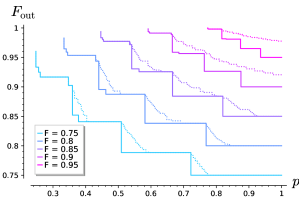
- グラフ列挙により発見された $10\to7$ 蒸留プロトコルは、入力保証精度が $\approx 0.85$ を超えると、7つの独立した $2\to1$ DEJMPS プロトコルよりも高い保証精度と低いリソースコストを達成する。
- 成功確率を考慮すると、入力保証精度が $\approx 0.95$ を超えると、$10\to7$ プロトコルは $2\to1$ アプローチよりも平均的に少ない初期ペアを必要とする。
- このフレームワークにより、グラフコードから体系的な回路構築が可能となり、深さが短く、二量子ビットゲート数が最小の回路が得られ、近位デバイスに適している。
より良い研究を、今すぐ始めましょう
論文の読解から最終レビューまで、研究時間を劇的に削減しましょう。
クレジットカード登録不要
このレビューはAIが作成し、人間の編集者が確認しました。