
[論文レビュー] Neuro-Symbolic World Models for Adapting to Open World Novelty
本稿では、前段階の未知状態の環境ダイナミクスの記号的ルールを学習し、変化を検出するとともに、未知状態後の遷移をシミュレートするためにそれらを用いることで、オープンワールドの未知要因に対する高速でサンプル効率の良い強化学習の適応を可能にする神経記号的ワールドモデル \sysname を提案する。本手法は、実際の相互作用と記号的ワールドモデルからの想像的ロールアウトを組み合わせることで、DreamerV2 を含む神経のみのベースラインと比較して、より少ないポリシー更新回数と環境相互作用回数で優れた適応効率を達成する。
Open-world novelty--a sudden change in the mechanics or properties of an environment--is a common occurrence in the real world. Novelty adaptation is an agent's ability to improve its policy performance post-novelty. Most reinforcement learning (RL) methods assume that the world is a closed, fixed process. Consequentially, RL policies adapt inefficiently to novelties. To address this, we introduce WorldCloner, an end-to-end trainable neuro-symbolic world model for rapid novelty adaptation. WorldCloner learns an efficient symbolic representation of the pre-novelty environment transitions, and uses this transition model to detect novelty and efficiently adapt to novelty in a single-shot fashion. Additionally, WorldCloner augments the policy learning process using imagination-based adaptation, where the world model simulates transitions of the post-novelty environment to help the policy adapt. By blending ''imagined'' transitions with interactions in the post-novelty environment, performance can be recovered with fewer total environment interactions. Using environments designed for studying novelty in sequential decision-making problems, we show that the symbolic world model helps its neural policy adapt more efficiently than model-based and model-based neural-only reinforcement learning methods.
研究の動機と目的
- 強化学習におけるオープンワールドの未知要因の課題に取り組むこと。ここでの未知要因とは、展開後に予期せず環境ダイナミクスが変化することを意味する。
- 未知要因発生後のポリシー適応におけるサンプル効率を向上させ、高価な実環境相互作用への依存を減らすこと。
- 記号的表現を用いて、未知要因の迅速な検出と未知要因後の遷移のシミュレーションが可能なワールドモデルを開発すること。
- 実世界の相互作用と想像的適応を統合することで、未知要因発生後のポリシー収束を加速すること。
- 記号的ワールドモデルが、完全に神経的なワールドモデルよりも適応速度と効率において優れていることを実証すること。
提案手法
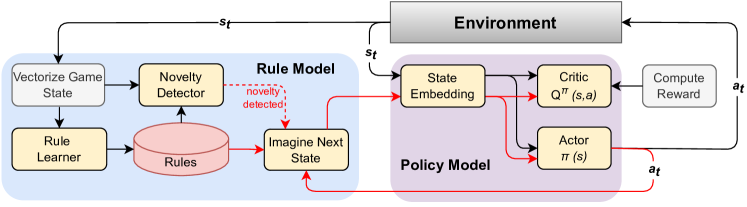
- 本システムは、1回の未知要因発生後の観測から更新されるルールラーナーを用いて、未知要因前の環境遷移の記号的ワールドモデルを学習する。
- 未知要因検出は、実環境遷移と記号的ワールドモデルからの予測を比較することで実施される。
- 未知要因検出後、ワールドモデルは未知要因後の環境の想像的ロールアウトを生成し、実データを補完する。
- ポリシー適応には、実環境相互作用と記号的ワールドモデルからの想像的遷移を組み合わせたハイブリッドトレーニングループが用いられる。
- バックプロパゲーションを用いて、実際の軌道と想像された軌道の両方を通じてポリシーを微調整することで、少ない更新回数で高速収束を実現する。
- 本システムはエンドツーエンドで訓練され、記号的ワールドモデルとポリシーが勾配降下法を用いて共同最適化される。
実験結果
リサーチクエスチョン
- RQ1記号的ワールドモデルは、神経のみのモデルと比較して、オープンワールドの未知要因をより効率的に検出できるか?
- RQ2記号的ワールドモデルを用いた想像的適応は、未知要因後のポリシー学習におけるサンプル効率をどのように向上させるか?
- RQ3記号的ワールドモデルは、DreamerV2 などの最先端の神経的ワールドモデルと比較して、より速い収束を実現できるか?
- RQ4実データと想像データをブレンドすることで、ポリシー更新の効率にどのような影響を与えるか?
- RQ5本システムは、元の最適パスにない未知要因の種類に対しても、多様な状況で効果的に動作するか?
主な発見
- 空の MiniGrid 環境において、記号的ワールドモデルは約 2,000 ステップの訓練でほぼ完璧な予測精度に収束し、急速でサンプル効率の良い学習を示した。
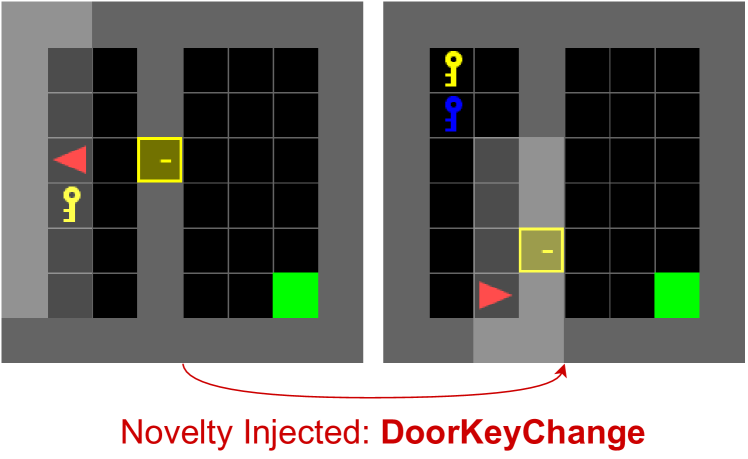
- 全テスト済みの未知要因において、\sysname は PPO や DreamerV2 と比較してはるかに少ないポリシー更新回数を要した。特に LavaHurts および DoorKeyChange 環境で最も少ない更新回数を記録した。
- 想像的データの注入率がたった 40% でも、\sysname は未知要因のすべての種別において、ワールドモデルを搭載しない神経的ポリシーを上回る適応効率を達成した。
- DreamerV2 と同等の適応効率を達成しながらも、はるかに少ないポリシー更新回数を要したため、優れたサンプル効率が示された。
- LavaHurts や DoorKeyChange のような状況では、\sysname は DreamerV2 よりも収束時間のばらつきが低く、より一貫した適応を示した。
- 結果から、記号的表現は、未知要因適応において、完全に神経的なワールドモデルよりも効果的な補完的手段であると考えられる。
この論文を読む
Nubintのビューアで原文を開き、読みながら気になる箇所をすぐに質問できます。
Nubintでこの論文を読むこのレビューはAIが論文の原文をもとに作成しました。引用する前に原文をご確認ください。