
[論文レビュー] NodeCoder: a graph-based machine learning platform to predict active sites of modeled protein structures
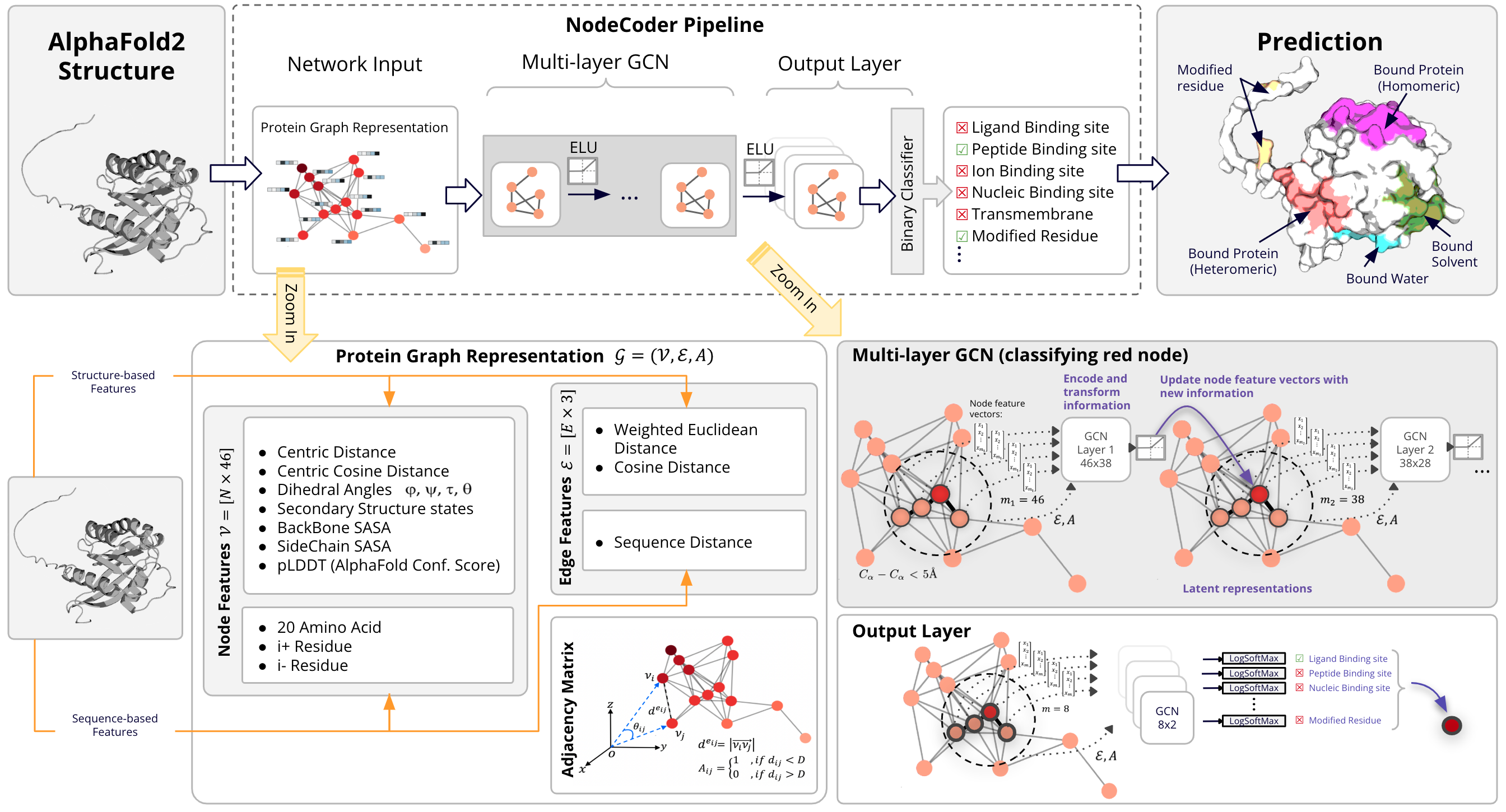
NodeCoder は、残基レベルのデータを AlphaFold2 が予測した 3D 構造にマッピングし、それらを接触ネットワークにエンコードした後、グラフ畳み込みネットワーク(GCN)を用いて残基分類を行う、グラフベースの機械学習プラットフォームです。リコンビナント結合部位の予測において P2Rank を上回り、1 つの再利用可能なフレームワークで 6 種類の多様な機能的タスクをサポートします。
While accurate protein structure predictions are now available for nearly every observed protein sequence, predicted structures lack much of the functional context offered by experimental structure determination. We address this gap with NodeCoder, a task-independent platform that maps residue-based datasets onto 3D protein structures, embeds the resulting structural feature into a contact network, and models residue classification tasks with a Graph Convolutional Network (GCN). We demonstrate the versatility of this strategy by modeling six separate tasks, with some labels derived from other experimental structure studies (ligand, peptide, ion, and nucleic acid binding sites) and other labels derived from annotation databases (post-translational modification and transmembrane regions). Moreover, A NodeCoder model trained to identify ligand binding site residues was able to outperform P2Rank, a widely-used software developed specifically for ligand binding site detection. NodeCoder is available as an open-source python package at https://pypi.org/project/NodeCoder/.
研究の動機と目的
- AlphaFold2 などのモデルから得られる高精度な予測タンパク質構造に機能的文脈が欠けているという問題に対処すること。
- リコンビナント、イオン、翻訳後修飾、膜貫通領域など、多様な機能的部位(例:リコンビナント、イオン、PTM、膜貫通)を予測可能な統合的でタスクに依存しないフレームワークを開発すること。
- 高分解能の実験的構造を必要とせず、構造的トポロジーと生物物理学的特徴を活用することで、正確な残基分類を可能にすること。
- リコンビナント結合部位予測を超えて、多様な計算生物学的応用をサポートするスケーラブルでオープンソースのプラットフォームを構築すること。
提案手法
- PDB やアノテーションデータベースからのラベルなどの残基レベルのラベルを、AlphaFold2 が予測したタンパク質の 3D 構造にマッピングする。
- 各残基をノードとし、残基間の空間的近接性(5Å 以内)をエッジとして持つ、残基接触ネットワークを構築する。
- 各残基について生物物理学的特徴(例:溶媒露出度、疎水性、静電ポテンシャル)を計算し、それらをノード特徴ベクトルに埋め込む。
- 接触グラフから階層的表現を学習するため、マルチレイヤーのグラフ畳み込みネットワーク(GCN)を適用し、ELU および LogSoftMax 活性化関数を用いる。
- 学習率 0.01 の固定値を用い、Adam 最適化アルゴリズムで交差エントロピー損失を最小化する形で GCN を学習し、10,000 エポックにわたり PR AUC を評価し、最良のモデルを選択する。
- 3,823 個のタンパク質からなるヒトプロテオームデータセットを用い、機能的アノテーションのないタンパク質を除外することで、クラスの不均衡バイアスを回避する 5 折交差検証を実施する。
実験結果
リサーチクエスチョン
- RQ1高分解能の実験的データに依存せず、予測されたタンパク質構造上で多様な機能的部位を効果的に予測できる、一様で汎用性の高いグラフベースのディープラーニングフレームワークは、本当に有効であるか?
- RQ2P2Rank のようなタスク特化型ツールと比較して、NodeCoder は AlphaFold2 が予測した構造上でリコンビナント結合部位をどれほど正確に予測できるか?
- RQ3翻訳後修飾、膜貫通領域、金属結合部位など、異なる機能的タスクにわたって、統一された GCN アーキテクチャがどの程度一般化可能であるか?
- RQ4クラスの不均衡が生じる機能的部位予測タスクにおいて、モデルのロバスト性はどの程度で、このような状況で性能を最も適切に反映する評価指標は何か?
主な発見
- NodeCoder は、広く使われている専用ツール P2Rank よりも優れた性能を示し、汎用的な GCN アプローチの有効性を実証した。
- リコンビナント、ペプチド、イオン、核酸、翻訳後修飾、膜貫通領域予測の 6 つの異なる機能的タスクにおいて、高い精度と再現率を達成した。
- 接触ネットワークの抽象化を用いることで、AlphaFold2 予測における側鎖コンformation の精度がやや低い場合でも、構造的トポロジーを効果的に捉えることができた。
- 交差検証の結果、5 つのフォールドすべてで一貫した性能を示し、モデルのロバスト性と一般化能力を評価する主な指標として PR AUC が使用された。
- 生物物理学的特徴とグラフ畳み込みを組み合わせることで、機能的部位予測に不可欠な複雑で長距離に及ぶ残基間相互作用を効果的にモデル化できた。
- NodeCoder が PyPI および GitHub を通じてオープンソースで公開されていることにより、計算生物学およびドラッグディスカバリ分野における新たな予測タスクへの広範な採用と拡張が可能になった。

より良い研究を、今すぐ始めましょう
論文の読解から最終レビューまで、研究時間を劇的に削減しましょう。
クレジットカード登録不要
このレビューはAIが作成し、人間の編集者が確認しました。