
[論文レビュー] Nonparametric Causal Decomposition of Group Disparities
本稿は、母集団の結果格差を、ベースライン結果の差、処置の普及率、平均処置効果、処置への差別的選択の4つのメカニズムに分解する非パラメトリック因果分解フレームワークを導入する。この手法は反事後的介入と効率的影響関数推定量を用い、√n-一貫性、漸近正規性、二重ロバスト性を満たす推定値を提供し、教育および収入における格差の新たな政策的関連性のあるメカニズムとして処置への選択が明らかになる。
We introduce a new nonparametric causal decomposition approach that identifies the mechanisms by which a treatment variable contributes to a group-based outcome disparity. Our approach distinguishes three mechanisms: group differences in 1) treatment prevalence, 2) average treatment effects, and 3) selection into treatment based on individual-level treatment effects. Our approach reformulates classic Kitagawa-Blinder-Oaxaca decompositions in causal and nonparametric terms, complements causal mediation analysis by explaining group disparities instead of group effects, and isolates conceptually distinct mechanisms conflated in recent random equalization decompositions. In contrast to all prior approaches, our framework uniquely identifies differential selection into treatment as a novel disparity-generating mechanism. Our approach can be used for both the retrospective causal explanation of disparities and the prospective planning of interventions to change disparities. We present both an unconditional and a conditional decomposition, where the latter quantifies the contributions of the treatment within levels of certain covariates. We develop nonparametric estimators that are $\sqrt{n}$-consistent, asymptotically normal, semiparametrically efficient, and multiply robust. We apply our approach to analyze the mechanisms by which college graduation causally contributes to intergenerational income persistence (the disparity in adult income between the children of high- vs low-income parents). Empirically, we demonstrate a previously undiscovered role played by the new selection component in intergenerational income persistence.
研究の動機と目的
- 既存手法の限界を克服して、中間処置変数を介した母集団の結果格差を因果的に分解するフレームワークを開発すること。
- 差別的処置選択が格差に寄与する独立したメカニズムとして形式的に同定し、その影響を推定すること。
- 政策に役立つように、変更可能な格差要因を分離する反事後的介入を提供すること。
- 因果中介分析を拡張し、母集団効果ではなく格差を説明することを目的とし、ランダム等化分解における概念的問題を解消すること。
提案手法
- 母集団格差を記述的に定義し、処置介入を反事後的に定義する反事後的分解フレームワークを提案する。
- 3つの主要な構成要素(ベースライン結果差、処置普及率効果、平均処置効果)に加え、差別的処置選択という画期的な第4の構成要素を導入する。
- 条件付き無視可能性を用いて、選択項を「処置スコアと、処置スコアを条件とした条件付き処置効果の共分散」として表現する。
- 効率的影響関数に基づく非パラメトリック推定量を開発し、√n-一貫性、漸近正規性、半パラメトリック効率性を保証する。
- 機械学習ベースの推定における有限標本性能を向上させるために、クロスフィットと重み安定化を適用する。
- 無条件分解と条件付き分解を区別し、共変量に条件するか否かにかかわらず介入を可能にする。
実験結果
リサーチクエスチョン
- RQ1低所得・高所得背景の母集団間における収入格差のうち、大学卒業の差別的普及率がどの程度寄与しているか。
- RQ2大学卒業の平均処置効果(ATE)の差が、収入格差のどの程度を占めているか。
- RQ3個々の処置効果に基づく大学卒業への差別的選択が、収入格差にどの程度寄与しているか。
- RQ4両親の教育水準や早期学力といった事前共変量に条件した場合、これらの寄与度はどのように変化するか。
- RQ5提案された分解フレームワークは、KBO やランダム等化分解といった既存手法よりも、より解釈可能で政策的関連性の高い知見を提供できるか。
主な発見
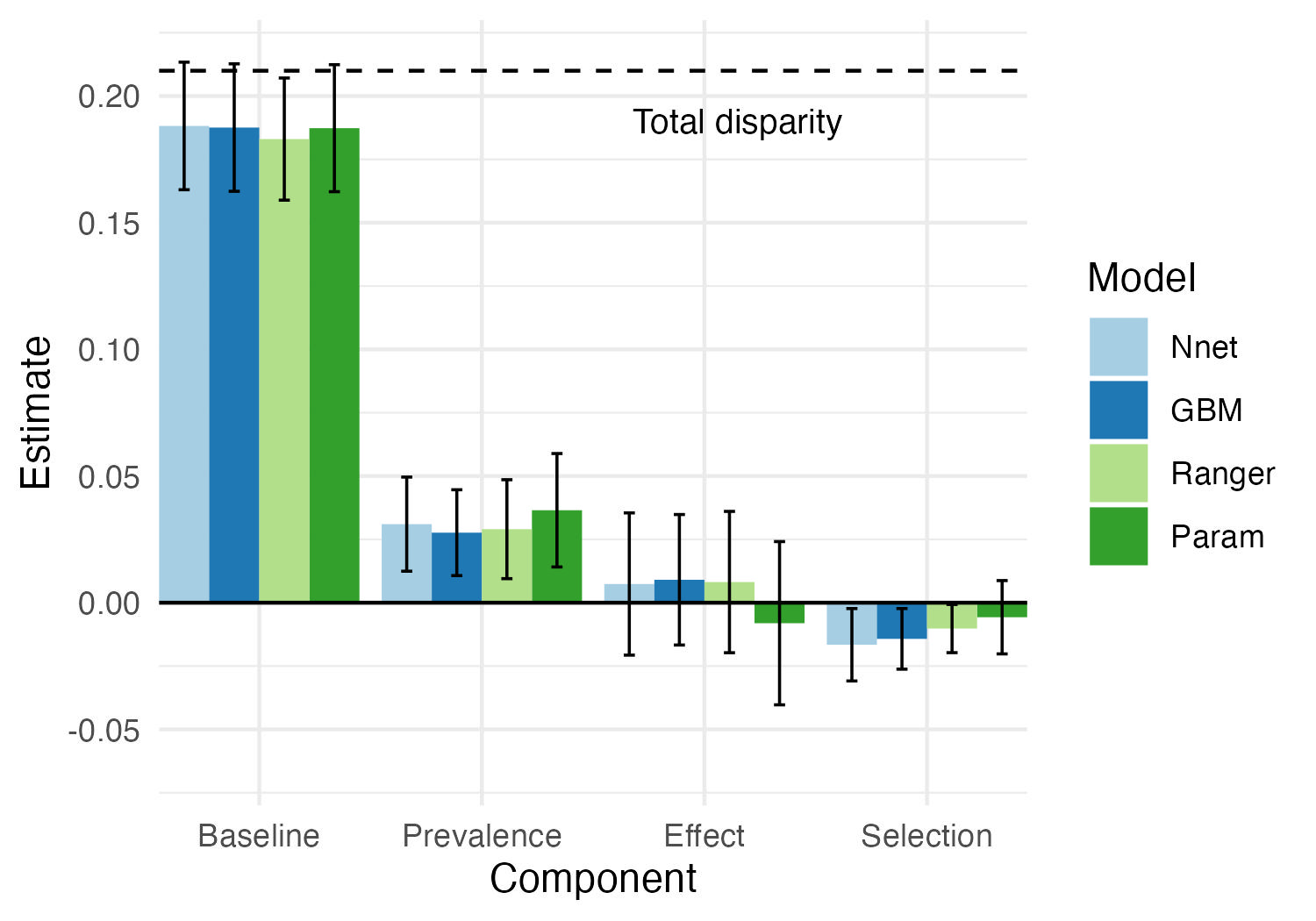
- 無条件分解において、大学卒業の差別的普及率は、全収入格差0.210のうち0.028~0.036を占める。
- 平均処置効果(ATE)の寄与は小さく、不正確で、-0.008~0.009の範囲にあり、信頼区間が広く、差別のATEの証拠は限定的である。
- 選択項(処置への差別的選択を表す)は-0.014~-0.017であり、格差を低減していることを示し、複数のモデルで統計的に有意である。
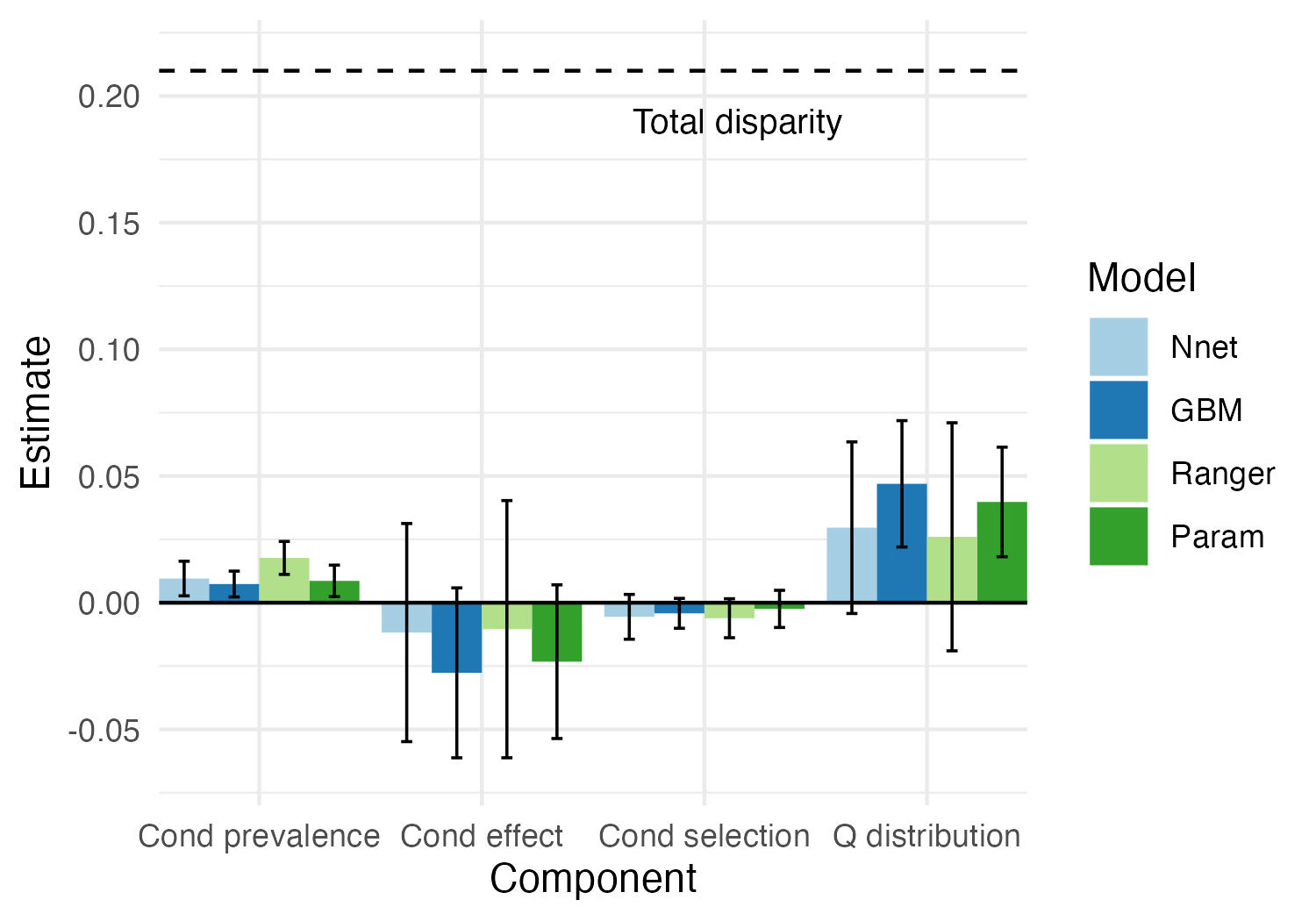
- 条件付き分解において、条件付き普及率効果は小さい(0.007~0.018)、一方で条件付き効果項は負の値(-0.028~-0.010)を示し、共変量に条件した後は高所得背景グループの処置効果が低くなる可能性がある。
- ジャクソン低減項(等化処置下での格差低減を表す)は正で有意(0.006~0.035)、すなわち処置を等化すれば格差が低減する可能性がある。
- このフレームワークは、処置への選択が独立した、定量的に測定可能なメカニズムとして明確に特定でき、複数の機械学習モデルおよび推定手法にわたって推定値が安定している。
この論文を読む
Nubintのビューアで原文を開き、読みながら気になる箇所をすぐに質問できます。
Nubintでこの論文を読むこのレビューはAIが論文の原文をもとに作成しました。引用する前に原文をご確認ください。