
[論文レビュー] Norm-based Generalization Bounds for Compositionally Sparse Neural Networks
本稿では、畳み込みニューラルネットワークやトランスフォーマー構造を含む構造的スパースな深層ニューラルネットワークの一般化境界を、重み行列ではなく個々のフィルタのフロベニウスノルムおよびスペクトルノルムに着目することで、ノルムに基づく一般化境界を導入する。提案された境界は、標準的なノルムに基づく境界よりも著しくタイトであり、実際の一般化ギャップと強い相関関係を示す。これは、パラメータ共有ではなく、構造的スパarsityが現代の深層ネットワークの成功の鍵であることを示唆している。
In this paper, we investigate the Rademacher complexity of deep sparse neural networks, where each neuron receives a small number of inputs. We prove generalization bounds for multilayered sparse ReLU neural networks, including convolutional neural networks. These bounds differ from previous ones, as they consider the norms of the convolutional filters instead of the norms of the associated Toeplitz matrices, independently of weight sharing between neurons. As we show theoretically, these bounds may be orders of magnitude better than standard norm-based generalization bounds and empirically, they are almost non-vacuous in estimating generalization in various simple classification problems. Taken together, these results suggest that compositional sparsity of the underlying target function is critical to the success of deep neural networks.
研究の動機と目的
- 畳み込み層やトランスフォーマー構造のような構造的スパースなアーキテクチャが、完全結合ネットワークよりも一般化性能に優れている理由を理解すること。
- 重み行列のノルムに依存する既存のノルムに基づく一般化境界が、アーキテクチャのインダクティブバイアスを捉えられていないという限界を解消すること。
- 深層学習における一般化性能の向上をもたらす主な要因がパラメータ共有か、構造的スパarsityかを特定すること。
- 現代のニューラルネットワークの構造的スパarsityを反映した理論的に妥当で、実験的にタイトな一般化境界を構築すること。
- スパースアーキテクチャにおいて、行列レベルのノルムよりもフィルタレベルのノルムが複雑さのより正確な指標であることを示すこと。
提案手法
- 重み行列の代わりに、個々の畳み込みフィルタのフロベニウスノルムを用いて、深層ReLUネットワークのラデマッハ複雑度境界を導出する。
- ネットワークの構造的スパarsityを捉えるために、$ \rho(w) = \|w^L\|_2 \cdot \prod_{l=1}^{L-1} \|w^l\|_F $ に比例する一般化境界を提案する。
- 重み正則化を用いて $ \prod_{l=1}^{L} \Vert w^l \Vert_F $ を制御し、最終層にのみ重み減衰を適用して $ \rho(w) $ を正則化する。
- 学習率スケジューリングにコサインスケジューリングを用い、MSE損失関数を用いて、サンプルサイズを変化させた合成CIFAR-5mデータ上でSGDによる学習を実行する。
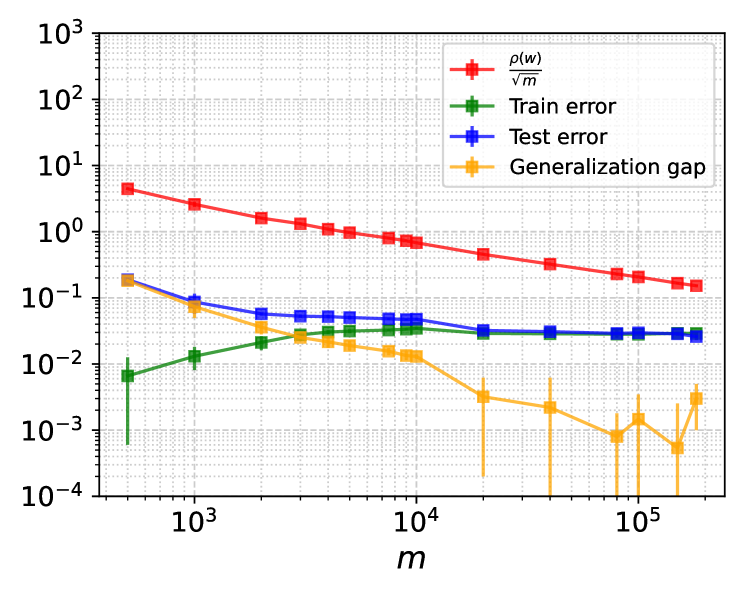
- 1000サンプル/クラスのテストセットを用いて一般化ギャップを推定し、$ \rho(w)/\sqrt{m} $ を実際の訓練・テスト誤差差分と比較する。
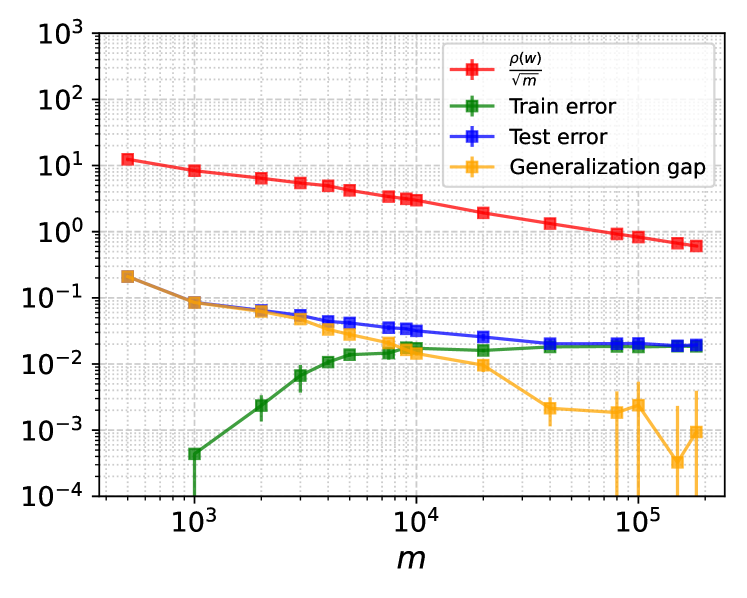
- モデル容量への感受性を評価するため、最終層が1層のネットワークと2層ヘッドを持つネットワークの2通りのアーキテクチャを分析する。
実験結果
リサーチクエスチョン
- RQ1畳み込み層やトランスフォーマー構造のような構造的スパースなアーキテクチャが、同程度の過パラメータ化を示しても、完全結合ネットワークよりも一般化性能に優れているのはなぜか?
- RQ2畳み込み層におけるパラメータ共有は、一般化性能の向上に必要なのか、それとも構造的スパarsityだけで十分なのか?
- RQ3行列レベルのノルムではなく、フィルタレベルのノルムに注目することで、ノルムに基づく一般化境界を著しく改善できるか?
- RQ4さまざまな訓練データサイズにおいて、提案された境界 $ \rho(w)/\sqrt{m} $ は、実際の一般化ギャップをどの程度タイトに推定できるか?
- RQ5訓練データサイズ $ m $ が増加する際、$ \rho(w) $ は有界のまま保たれるか?これは境界が $ \mathcal{O}(1/\sqrt{m}) $ の速度で減少することを示唆するか?
主な発見
- 提案された一般化境界 $ \rho(w)/\sqrt{m} $ は、実験的に非自明であり、さまざまな訓練データサイズにおいて、実際の一般化ギャップをタイトに推定している。
- $ m > 10,000 $ の場合、$ \rho(w)/\sqrt{m} < 1 $ となるため、過パラメータ化領域においても境界が意味を持つことが示された。
- $ m $ が増加する際、$ \rho(w) $ は有界のまま保たれるため、境界が $ \mathcal{O}(1/\sqrt{m}) $ の速度で減少することが示唆され、理論的期待と整合的である。
- 標準的なノルムに基づく境界(重み行列のスペクトルノルムやフロベニウスノルムの積に依存)と比較して、提案された境界は桁違いにタイトである。
- 結果から、各ニューロンが少数の入力のみを受ける構造的スパarsityが、パラメータ共有よりも深層ネットワークにおける一般化性能向上の鍵である可能性が示唆される。
- 理論は単純な分類タスク上で実験的に妥当性が確認され、境界が非自明であり、現実の性能トレンドを反映していることが示された。
この論文を読む
Nubintのビューアで原文を開き、読みながら気になる箇所をすぐに質問できます。
Nubintでこの論文を読むこのレビューはAIが論文の原文をもとに作成しました。引用する前に原文をご確認ください。