
[論文レビュー] Online Continual Learning Without the Storage Constraint
本稿では、固定で事前学習済みの特徴抽出器を用いた近似kNN分類器を活用することで、計算コストが低く、ストレージ制約のないオンライン継続的学習手法を提案する。kNNの特性である新規データへの即時適応性と、過去のすべての例を忘れない性質を活かし、CLOC(3900万枚の画像、712クラス)やCGLM(580万枚の画像、1万788クラス)といった大規模なベンチマークにおいて、最先端手法よりも20%以上の高い精度を達成するとともに、計算コストとストレージコストを著しく削減した。
Traditional online continual learning (OCL) research has primarily focused on mitigating catastrophic forgetting with fixed and limited storage allocation throughout an agent's lifetime. However, a broad range of real-world applications are primarily constrained by computational costs rather than storage limitations. In this paper, we target such applications, investigating the online continual learning problem under relaxed storage constraints and limited computational budgets. We contribute a simple algorithm, which updates a kNN classifier continually along with a fixed, pretrained feature extractor. We selected this algorithm due to its exceptional suitability for online continual learning. It can adapt to rapidly changing streams, has zero stability gap, operates within tiny computational budgets, has low storage requirements by only storing features, and has a consistency property: It never forgets previously seen data. These attributes yield significant improvements, allowing our proposed algorithm to outperform existing methods by over 20% in accuracy on two large-scale OCL datasets: Continual LOCalization (CLOC) with 39M images and 712 classes and Continual Google Landmarks V2 (CGLM) with 580K images and 10,788 classes, even when existing methods retain all previously seen images. Furthermore, we achieve this superior performance with considerably reduced computational and storage expenses. We provide code to reproduce our results at github.com/drimpossible/ACM.
研究の動機と目的
- 実世界のシステムにおいて主なボトル neck となる計算予算に注目し、ストレージ制約に焦点を当てたオンライン継続的学習研究のギャップを埋める。
- ストレージが制限されない場合に、特に計算リソースが制限される環境下でも、大規模なオンライン継続的学習が可能かどうかを調査する。
- 高い精度、迅速な適応、完全な記憶保持を実現する実用的でスケーラブルかつ効率的な継続的学習システムを構築する。
- 固定された事前学習済み特徴抽出器を用いた単純なkNN分類器が、大規模で長尾分布・概念変化が顕著なデータセットにおいて、複雑な勾配ベース手法を上回ることを示す。
- 長期間にわたる継続的データストリームにおいても、計算効率とリアルタイム推論が達成可能であることを示し、長期運用の可能性を裏付ける。
提案手法
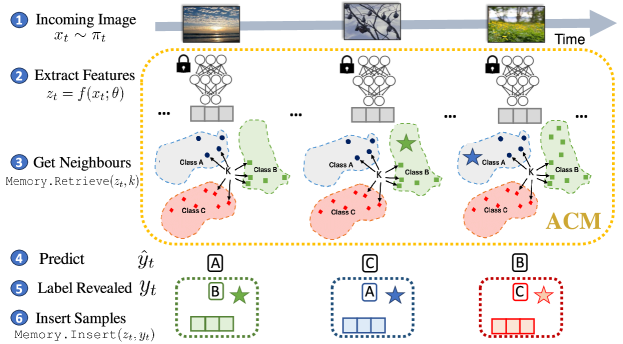
- すべての過去の特徴量とラベルを格納する近似kNN分類器(ACM)を用い、ゼロフォールディング(完全な記憶保持)と新規データへの即時適応を実現する。
- 微調整や再学習が不要な、固定された事前学習済みの深層ニューラルネットワーク(例:ResNet50)を特徴抽出器として統合する。
- 近似kNNアルゴリズム(例:FAISS)の対数的計算複雑度を活用し、膨大なデータストレージにもかかわらず、推論オーバーヘッドを低く抑える。
- 各入力サンプルに対して明示的な挿入および検索操作を用いて、kNNモデルを段階的に更新することで、個々のサンプルに対する適応を可能にする。
- kNNの内在的性質(安定性ギャップなし、忘却なし、計算量の対数的スケーリング)に依存することで、一貫性と安定性を確保する。
- 実際の計算予算下での評価を実施し、大規模なデータストリームにおけるリアルタイム実行可能性を検証するために、ウォールクロック時間の測定を用いる。
実験結果
リサーチクエスチョン
- RQ1ストレージが制限されない場合に、計算コストが主なボトル neck であるとすれば、オンライン継続的学習は著しく向上するのか?
- RQ2固定された特徴抽出器を用いた単純なkNN分類器は、大規模で長尾分布・概念変化が顕著なデータセットにおいて、複雑な勾配ベースの継続的学習手法をどの程度上回るのか?
- RQ3完全なデータストアを維持する際の計算オーバーヘッドは、データセットサイズに伴いどのようにスケーリングされるのか?また、長期にわたる運用期間においてもリアルタイム推論をサポートできるか?
- RQ4kNNベースのアプローチは、分布シフトや単一サンプル学習への迅速な適応を可能にするのか?これは、実世界の継続的学習にとって重要な要因である。
- RQ5すべてのデータを保存し、記憶を失わないシステムが、同じ計算予算下で、過去のすべてのデータを保持する手法と比較しても優れた性能を発揮できるのか?
主な発見
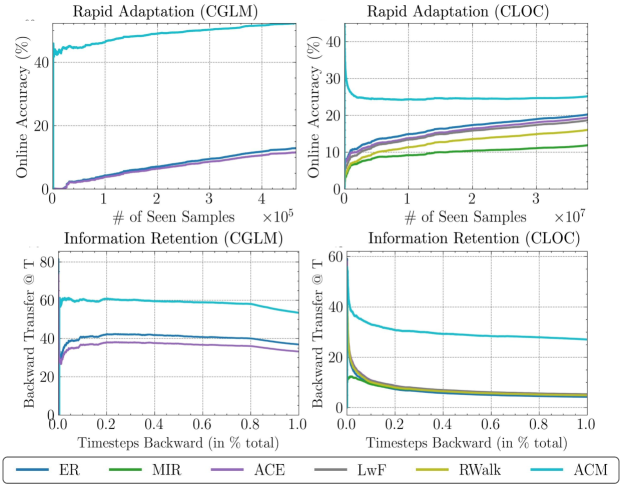
- 提案手法であるACMは、CLOC(3900万枚の画像、712クラス)およびCGLM(580万枚の画像、1万788クラス)ベンチマークにおいて、過去の最先端手法(すべての過去データを保存)でさえも20%以上の高い精度を達成した。
- 256次元の特徴量に対して、1サンプルあたりの最大推論オーバーヘッドはわずか5ミリ秒であり、16コアCPU上では1サンプルあたりの合計推論コストが約15ミリ秒にとどまり、リアルタイム30FPS動画処理と互換性がある。
- 1台の16コアCPUサーバーで、最大71年間のリアルタイム運用が可能であり、年間のストレージコストはたった20ドルと推定される。これにより、長期的な実用性が裏付けられた。
- アブレーションスタディの結果、kNN分類器を削除すると性能が10~30%低下することが確認され、kNNが迅速な適応と高い精度の主因であることが明らかになった。
- 異なるバックボーンアーキテクチャにおいても、一貫した性能を維持しており、kNNの利点が特定の特徴抽出器に依存しない堅牢性を示している。
- システムは完全な記憶保持を実現している:以前に学習済みのデータは一切忘れない。再クエリでも同じラベルが得られ、一貫性と安定性が保証される。
より良い研究を、今すぐ始めましょう
論文の読解から最終レビューまで、研究時間を劇的に削減しましょう。
クレジットカード登録不要
このレビューはAIが作成し、人間の編集者が確認しました。