
[論文レビュー] Open-World Pose Transfer via Sequential Test-Time Adaption
本稿では、推論時に分布外(OOD)の外見およびスケルトン信号を段階的に適応する新しいフレームワークであるSEquential Test-time Adaption(SETA)を提案する。自己教師付き増強を用いて外見テクスチャを抽出し、人物再識別(Re-ID)モデルを用いて非ユークリッド空間におけるポーズ類似度を計算することで、TikTok や SHHQ といった未学習データセット上でも一般化性能が向上し、ベースライン手法と比較して LPIPS を最大 76.8% 減少させる。
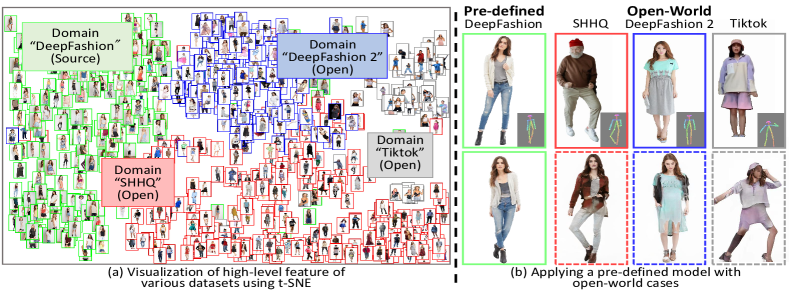
Pose transfer aims to transfer a given person into a specified posture, has recently attracted considerable attention. A typical pose transfer framework usually employs representative datasets to train a discriminative model, which is often violated by out-of-distribution (OOD) instances. Recently, test-time adaption (TTA) offers a feasible solution for OOD data by using a pre-trained model that learns essential features with self-supervision. However, those methods implicitly make an assumption that all test distributions have a unified signal that can be learned directly. In open-world conditions, the pose transfer task raises various independent signals: OOD appearance and skeleton, which need to be extracted and distributed in speciality. To address this point, we develop a SEquential Test-time Adaption (SETA). In the test-time phrase, SETA extracts and distributes external appearance texture by augmenting OOD data for self-supervised training. To make non-Euclidean similarity among different postures explicit, SETA uses the image representations derived from a person re-identification (Re-ID) model for similarity computation. By addressing implicit posture representation in the test-time sequentially, SETA greatly improves the generalization performance of current pose transfer models. In our experiment, we first show that pose transfer can be applied to open-world applications, including Tiktok reenactment and celebrity motion synthesis.
研究の動機と目的
- トレーニングデータと著しく異なるテストデータの分布を想定するオープンワールド設定において、ポーズ転送の一般化性能を向上させること。
- 複数の信号が重複する複雑な分布下で失敗する、OOD データに共通の信号を仮定する従来のテスト時適応(TTA)手法の限界を克服すること。
- 外見とスケルトン信号を別々に学習・統合することで、ポーズ転送の耐障害性と現実性を向上させる段階的適応戦略を開発すること。
- TikTok の再現や有名人のモーショングラフィックスなど、多様で未確認のデータが一般的な実世界の応用にポーズ転送を実用化できること。
提案手法
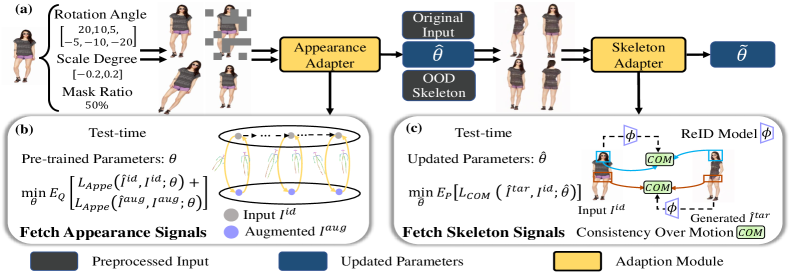
- SETA は、外部テストデータに対して自己教師付き増強を用いて OOD 外見信号に最初に適応する段階的テスト時適応パイプラインを採用する。
- 外見アダプタを導入し、増強された OOD サンプルから外部の外見テクスチャを抽出・分配することで、特徴ワープ処理の安定化を図る。
- その後、事前学習済みの人物再識別(Re-ID)モデルからの画像特徴を活用して、暗黙のポーズ表現を学習するスケルトンアダプタを適用する。
- Re-ID ベクトルを用いてポーズ間の非ユークリッド類似度をモデル化し、多様な OOD スケルトン間で一貫したモーション表現を実現する。
- 外見とスケルトン適応ステージを交互に切り替え、深刻な忘却を回避するとともに、安定した特徴学習を確保する。
- 1サンプルあたり固定回数の更新を繰り返す反復的テスト時学習を採用し、性能と推論効率のバランスを取る。
実験結果
リサーチクエスチョン
- RQ1複数の独立した OOD シグナル(外見とスケルトン)が共存するオープンワールドポーズ転送に、テスト時適応を効果的に拡張できるか?
- RQ2まず外見に、次にスケルトンに適応する段階的適応は、同時に適応するか、逆順に適応する場合と比較して一般化性能を向上させるか?
- RQ3教師なしのアノテーションで、増強された OOD データ上で自己教師付き学習を用いて分離された外見テクスチャを効果的に抽出できるか?
- RQ4Re-ID 特徴を用いることで、著しく変形しているか未確認のスケルトンにおいても非ユークリッド空間でのポーズ一貫性が向上するか?
- RQ5テスト時設定において、適応イテレーション数と性能向上の最適なトレードオフは何か?
主な発見
- スケルトンアダプタを用いることで、NTED では LPIPS が 41.66% 減少、CASD では 46.84% 減少し、視覚的品質の顕著な向上が確認された。
- 人間評価では、スケルトンアダプタを用いた場合、NTED の平均意見スコア(MOS)が 76.13、CASD が 72.17 となり、視覚的忠実性の向上とアーチファクトの低減が裏付けられた。
- 外見アダプタにより、全体的な外見の一貫性が向上し、スケルトンアダプタの安定した学習が可能になり、生成画像の歪みが低減した。
- 30 回のテスト時イテレーションを実行した場合が最良の性能を示し、SHHQ における NTED の LPIPS は 0.049 まで低下したが、推論時間は 28.48 秒に延長された。
- 段階的適応(まず外見、次にスケルトン)は、同時に適応するか、逆順に適応する場合よりも効果的であり、不安定性や深刻な忘却を回避した。
- 本フレームワークは、TikTok や SHHQ のような実世界のオープンワールドデータセット上でもポーズ転送を成功させ、ベースラインモデルが著しいねじれ模様やアーチファクトを示す状況を改善した。
この論文を読む
Nubintのビューアで原文を開き、読みながら気になる箇所をすぐに質問できます。
Nubintでこの論文を読むこのレビューはAIが論文の原文をもとに作成しました。引用する前に原文をご確認ください。