
[論文レビュー] OphGLM: Training an Ophthalmology Large Language-and-Vision Assistant based on Instructions and Dialogue
OphGLM は、眼底画像診断を眼科専門の大型言語モデルと統合し、20k+ instruction/dialogue datasetを用いて訓練された multimodal ophthalmic Q&A and guidance を提供します。
Large multimodal language models (LMMs) have achieved significant success in general domains. However, due to the significant differences between medical images and text and general web content, the performance of LMMs in medical scenarios is limited. In ophthalmology, clinical diagnosis relies on multiple modalities of medical images, but unfortunately, multimodal ophthalmic large language models have not been explored to date. In this paper, we study and construct an ophthalmic large multimodal model. Firstly, we use fundus images as an entry point to build a disease assessment and diagnosis pipeline to achieve common ophthalmic disease diagnosis and lesion segmentation. Then, we establish a new ophthalmic multimodal instruction-following and dialogue fine-tuning dataset based on disease-related knowledge data and publicly available real-world medical dialogue. We introduce visual ability into the large language model to complete the ophthalmic large language and vision assistant (OphGLM). Our experimental results demonstrate that the OphGLM model performs exceptionally well, and it has the potential to revolutionize clinical applications in ophthalmology. The dataset, code, and models will be made publicly available at https://github.com/ML-AILab/OphGLM.
研究の動機と目的
- 眼科に焦点を当てた大規模言語とビジョンのアシスタント(OphGLM)を開発し、眼底画像を受け取り、指示追従型の対話を行えるようにする。
- 一般的な眼科疾患の眼底ベース診断と病変セグメンテーションのパイプラインを構築する。
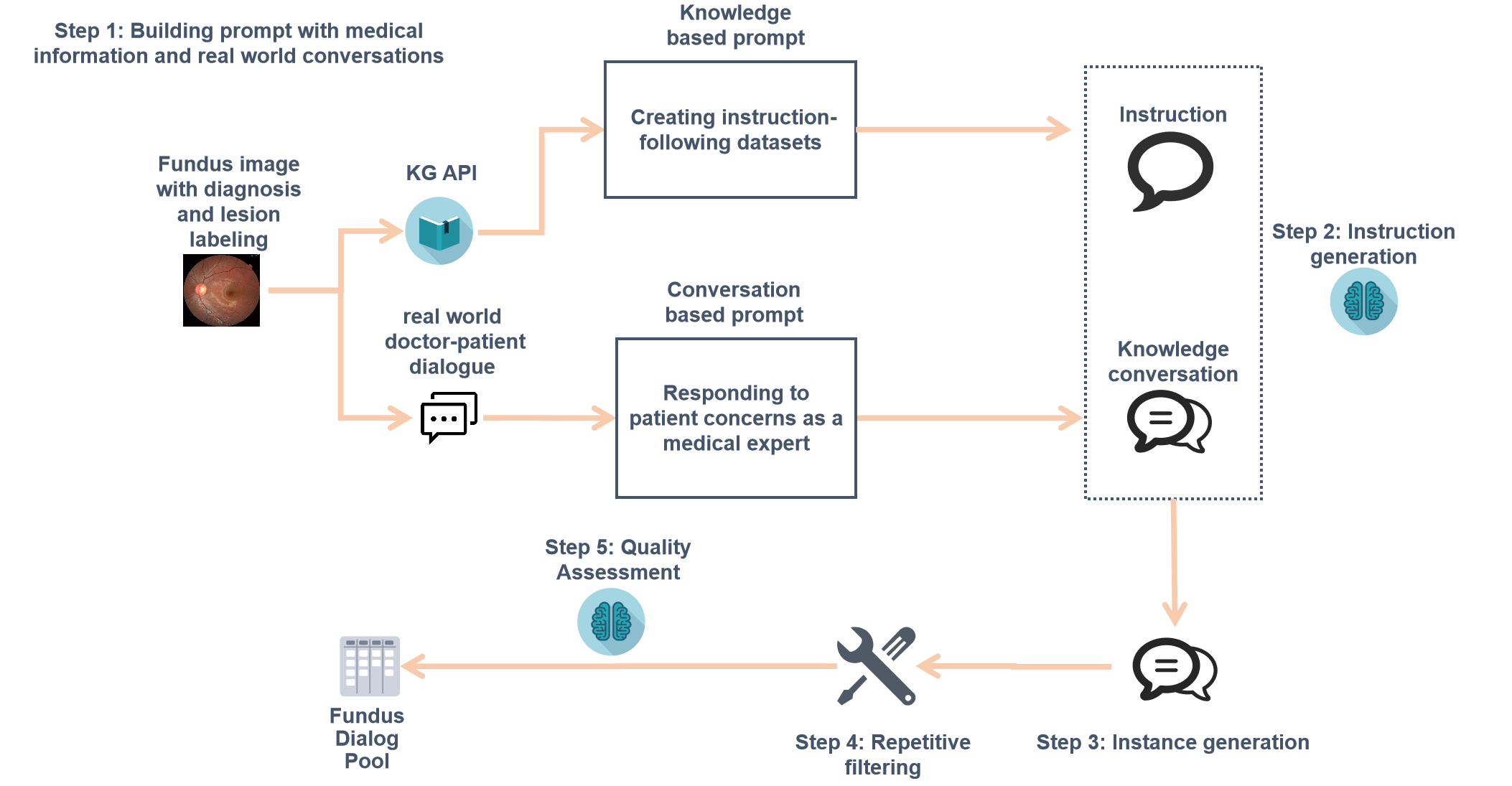
- 実世界の対話と知識グラフを活用した眼科知識に基づく指示調整と対話データセットを構築する。
- 眼科の眼底対話データで ChatGLM をファインチューニングして、医療QAと患者向け対話の品質を高める。
- モデルの有効性を示し、他の画像モダリティや疾患への拡張計画を概説する。
提案手法
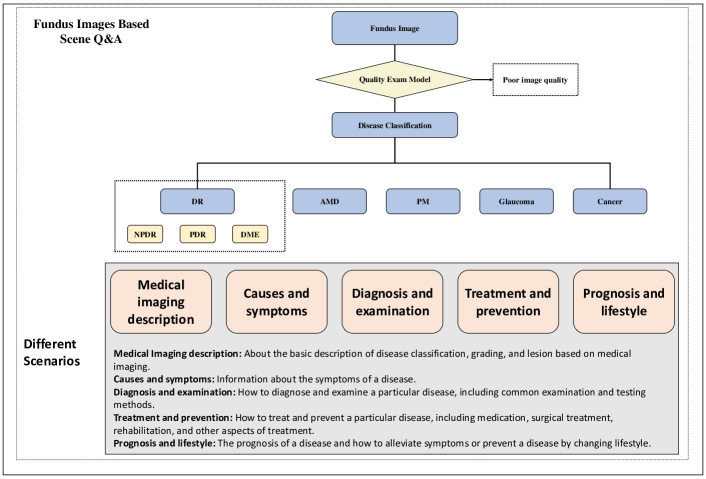
- 五つの疾患分類器(DR grading、AMD、glaucoma、pathological myopia、fundus tumor)と EX、SE、MA、HE の病変セグメンテーションを含む眼底診断パイプラインを開発する。
- 分類/セグメンテーションの出力をあらかじめ定義されたテキストテンプレートに統合して診断レポートを作成する。
- 眼底診断レポートをユーザー対話と組み合わせて OphGLM のプロンプトを形成し、マルチモーダル応答を可能にする。
- 知識グラフと現実の医師-患者対話(MedDialog)を用いた Instr-および Dialog-ベースのファインチューニングデータセット( >20k instances )を ChatGPT で構築する。
- 眼科の眼底対話データセットで ChatGLM(6.2B parameters)をファインチューニングして OphGLM を形成する。
- 分類とセグメンテーションのタスクで標準的な精度と Dice 指標を用いてモデル性能を評価する。
実験結果
リサーチクエスチョン
- RQ1OphGLM は眼底画像から一般的な眼科疾患を正確に診断できるか。
- RQ2 jointly image-text dialogue のファインチューニングは、テキストのみのベースラインと比較して眼科の質問応答と信頼性をどのように改善するか。
- RQ3DR、AMD、glaucoma、pathological myopia、および fundus tumors の各疾患に対して眼底診断パイプラインはどの程度の性能か。
- RQ4EX、SE、MA、HE 病変に対する病変セグメンテーションはどれほど良いか。
- RQ5OphGLM は実臨床の説明と一致する、ユーザーフレンドリーで医学的に正確な対話を提供できるか。
主な発見
- DR_class_model は 0.970 accuracy を達成。
- Glaucoma_class_model は 0.940 accuracy を達成。
- PALM_class_model は 0.998 accuracy を達成。
- AMD_class_model は 0.984 accuracy を達成。
- Tumor_class_model は 0.999 accuracy を達成。
- EX_seg_model は 0.854 Dice を達成。
- HE_seg_model は 0.805 Dice を達成。
- MA_seg_model は 0.699 Dice を達成。
- SE_seg_model は 0.812 Dice を達成。
この論文を読む
Nubintのビューアで原文を開き、読みながら気になる箇所をすぐに質問できます。
Nubintでこの論文を読むこのレビューはAIが論文の原文をもとに作成しました。引用する前に原文をご確認ください。