
[論文レビュー] Optimizing Inventory Placement for a Downstream Online Matching Problem
本稿では、eコマースにおけるオンラインマッチング問題の在庫配置最適化を、オフラインの代替関数を用いることで提案している。この手法により、在庫配置と受注処理の統合問題に対して、(1−(1−1/d)^d)/2-近似解が得られる。この手法は確率的ラウンドリングを用いて、(1−(1−1/d)^d)-近似解を達成し、実世界のJD.comのデータを用いた実験により、ミオピックおよびフラッド配置手法を上回る優れた性能を示している。
We study the inventory placement problem of splitting $Q$ units of a single item across warehouses in advance of a downstream online matching problem that represents the dynamic fulfillment decisions of an e-commerce retailer. This is a challenging problem both theoretically, due to the computational complexity of the downstream matching problem, and practically, as the fulfillment team continuously updates its algorithm while the placement team lacks direct evaluation of placement decisions. We compare the performance of three placement procedures based on optimizing surrogate functions that have been studied and applied: Offline, Myopic, and Fluid placement. On the theory side, we show that optimizing inventory placement for the Offline surrogate leads to an $α(1-(1-1/d)^d)$-approximation for the joint placement and fulfillment problem under any demand model that admits an $α$-competitive fulfillment policy. We assume $d$ is an upper bound on how many warehouses can serve any demand location. The crux of our theoretical contribution is to use randomized rounding to derive a tight $(1-(1-1/d)^d)$-approximation for the integer programming problem of optimizing the Offline surrogate. We further show how to extend this result to a multi-SKU setting, improving upon the best known approximation of $1/2$. We use statistical learning to show that rounding after optimizing a sample-average Offline surrogate, which is necessary due to the exponentially-sized support, indeed has vanishing loss. On the experimental side, we evaluate how different combinations of placement and fulfillment procedures perform on a wide array of synthetic instances. When coupled with a good fulfillment procedure, optimizing the Offline surrogate performs best even compared to computationally-intensive simulation procedures, corroborating our theory.
研究の動機と目的
- eコマースにおける上流の在庫配置と下流のオンライン受注処理意思決定の調整の課題に取り組む。
- 在庫配置と受注処理の統合問題における性能を評価・比較するため、3つの代替関数に基づく配置手法(オフライン、ミオピック、フラッド)を検討する。
- 需要の時間的または空間的独立性のもとで、オフライン代替関数を最適化する際の近似保証を理論的に分析する。
- JD.comの実際の注文シーケンスを用いて、提案手法の実証的妥当性を検証する。
- 下流の受注処理ポリシーの完全な知識がなくても、オフライン代替関数を最適化することで、頑健かつ高パフォーマンスな在庫配置が達成されることを示す。
提案手法
- 著者らは、オフライン代替関数を最適化する整数計画問題に対して、確率的ラウンドリングを用いて、(1−(1−1/d)^d)-近似解を導出する。
- 統計的学習を適用することで、サンプル平均のオフライン代替関数を最適化した後、ラウンドングを行うと、指数的サイズのサポートを持つにもかかわらず、損失が消失することを示している。
- 本手法は、任意の需要場所を処理するための倉庫数dが上限であると仮定し、需要の到着が時間的または空間的に独立していると仮定している。
- 本手法は、3つの配置手法を比較する:オフライン(最適な受注報酬の代替関数を最適化)、ミオピック(シミュレーションと局所探索に基づく)、フラッド(決定的フラッド緩和を用いる)。
- 配置手法の性能を分離して評価するために、高品質な受注処理ポリシー(S-SP+リソルビング)を固定する。
- JD.comの実際の注文データを用いて、異なる配置手法と受注処理手法の組み合わせの競合比を評価する。
実験結果
リサーチクエスチョン
- RQ1オフライン代替関数を最適化することで、在庫配置とオンライン受注処理の統合問題に対して、証明可能な良い近似解が得られるか?
- RQ2現実的な需要パターン下で、オフライン配置手法はミオピックおよびフラッド配置手法と比較して、どのように性能を発揮するか?
- RQ3到着順序の情報を一切持たないにもかかわらず、代替関数に基づく手法(オフライン)が、シミュレーションに基づくミオピック手法を上回る性能を示せるか?
- RQ4需要負荷やローカル処理とスプライシング処理の報酬比が変化する状況でも、オフライン配置手法はどれほど頑健か?
- RQ5サンプル平均のオフライン代替関数に対して確率的ラウンドングを適用することで、実際の問題において近似的に最適な解が得られるか?
主な発見
- 需要の時間的または空間的独立性のもとで、オフライン代替関数を最適化すると、在庫配置と受注処理の統合問題に対して、(1−(1−1/d)^d)/2-近似解が得られる。
- 確率的ラウンドング手法により、整数計画問題に対して、(1−(1−1/d)^d)-近似解が達成され、定数倍の理論的最適性が保証される。
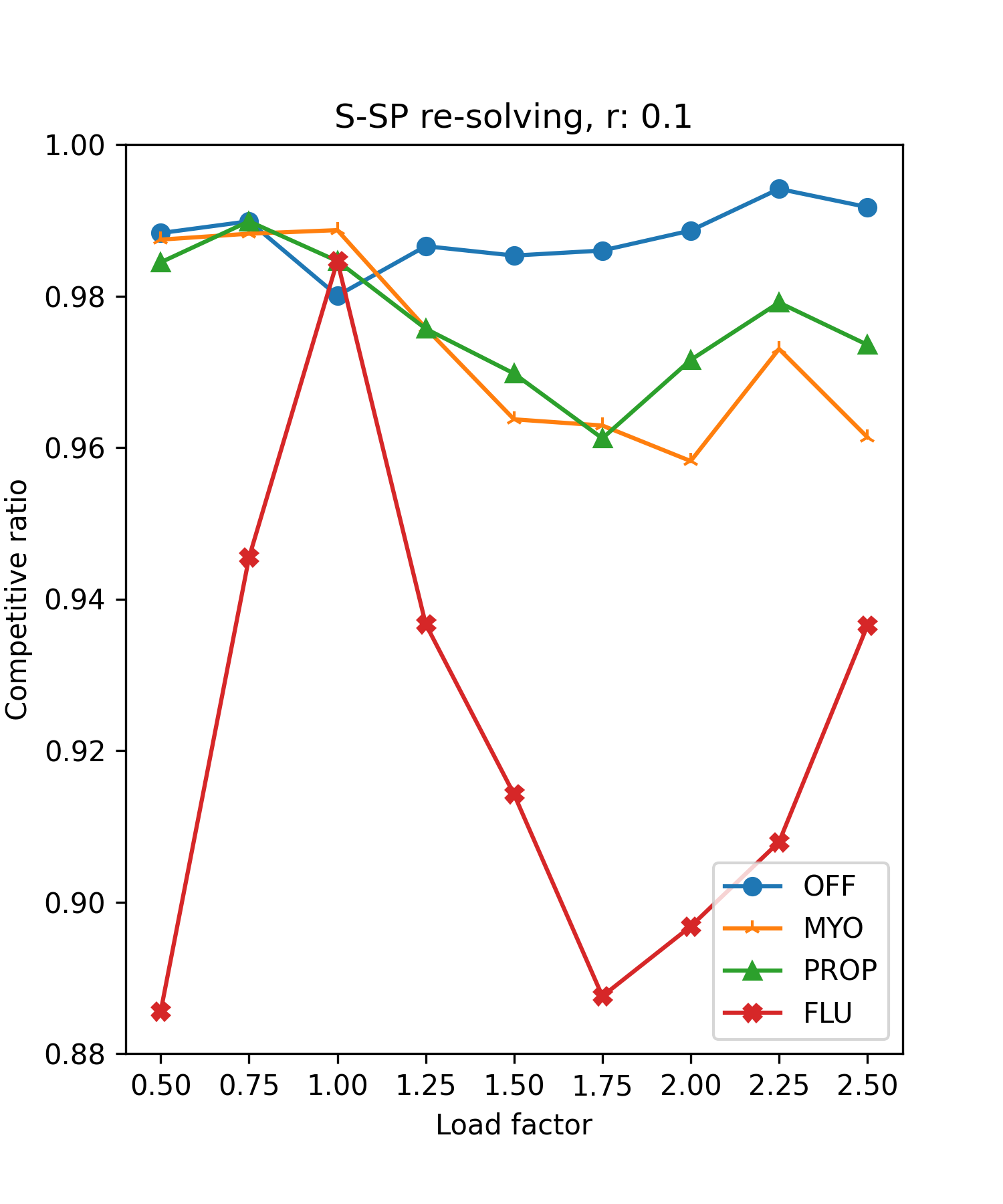
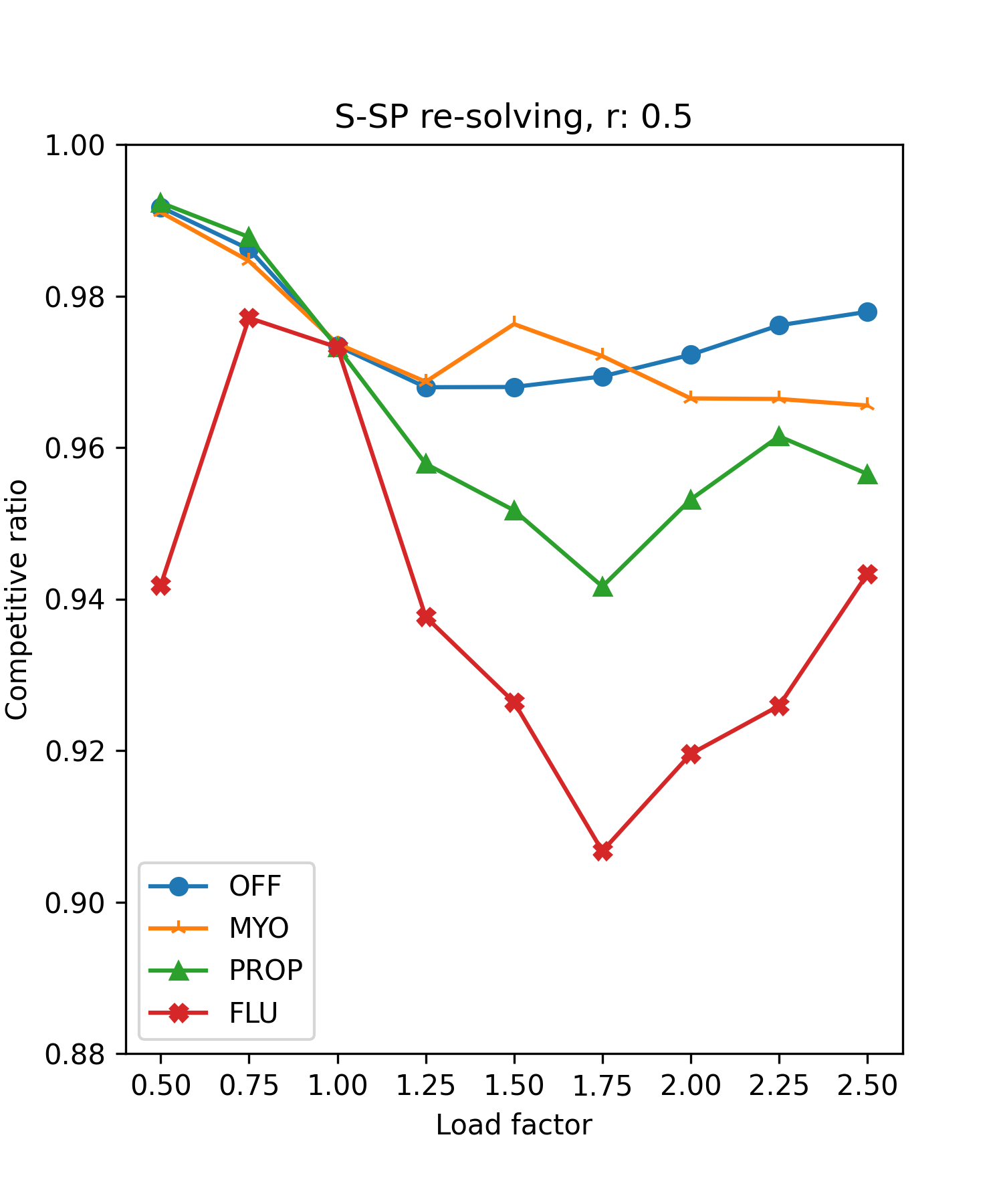
- 到着順序の情報を使用しないにもかかわらず、理論的および実践的両面で、オフライン配置手法はミオピック配置手法を上回る。特に、負荷係数が1.25以上でr=0.1のとき顕著な優位性を示す。
- S-SP+リソルビングは、すべての設定において最高または第二位の競合比を達成し、最も頑健な受注処理ポリシーであることが判明した。
- フラッド配置手法は、複数の最適解による不安定性と、RDC(リージョナル・デリバリー・センタ)に強く偏る傾向のため、性能が著しく劣る。特に、タイブレークがRDCに有利に働く場合に顕著である。
- 高品質な受注処理ポリシーと組み合わせた場合、オフライン配置手法は、rや負荷係数が変化する状況においても、ミオピックおよびフラッド配置手法を上回る、最も頑健な配置手法である。
この論文を読む
Nubintのビューアで原文を開き、読みながら気になる箇所をすぐに質問できます。
Nubintでこの論文を読むこのレビューはAIが論文の原文をもとに作成しました。引用する前に原文をご確認ください。