
[論文レビュー] PaLM2-VAdapter: Progressively Aligned Language Model Makes a Strong Vision-language Adapter
この論文では、固定された視覚エンコーダーと大規模言語モデルを整合化するために、段階的に訓練された小さなPaLM-2言語モデルを用いた視覚言語アダプタ、PaLM2-VAdapterを提案する。2段階の訓練戦略(最初にデコーダーとして、次にパーセーバー・リサンプラーを備えたアダプタとして)を採用することで、先行手法に比べて収束が速く、性能が高く、スケーラビリティに優れている。VQAおよびキャプションタスクにおいて、SOTAの結果を達成し、パrameterを30–80%も削減した。
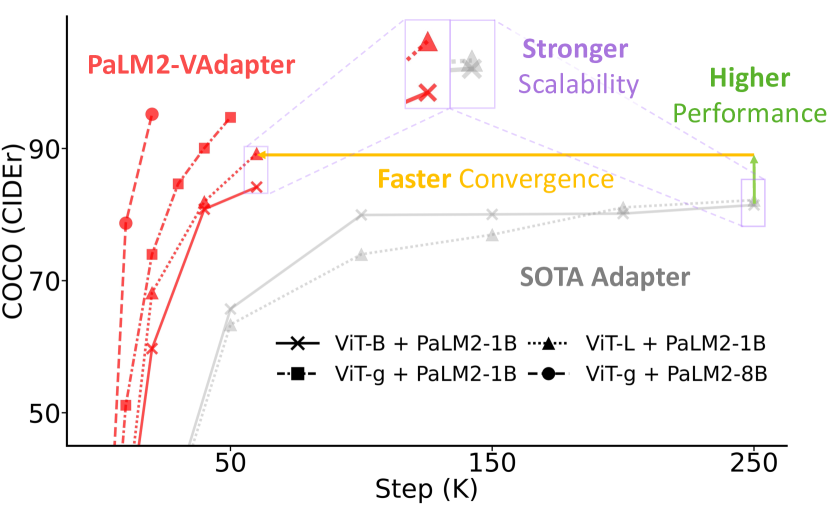
This paper demonstrates that a progressively aligned language model can effectively bridge frozen vision encoders and large language models (LLMs). While the fundamental architecture and pre-training methods of vision encoders and LLMs have been extensively studied, the architecture and training strategy of vision-language adapters vary significantly across recent works. Our research undertakes a thorough exploration of the state-of-the-art perceiver resampler architecture and builds a strong baseline. However, we observe that the vision-language alignment with perceiver resampler exhibits slow convergence and limited scalability with a lack of direct supervision. To address this issue, we propose PaLM2-VAdapter, employing a progressively aligned language model as the vision-language adapter. Compared to the strong baseline with perceiver resampler, our method empirically shows faster convergence, higher performance, and stronger scalability. Extensive experiments across various Visual Question Answering (VQA) and captioning tasks on both images and videos demonstrate that our model exhibits state-of-the-art visual understanding and multi-modal reasoning capabilities. Notably, our method achieves these advancements with 30~70% fewer parameters than the state-of-the-art large vision-language models, marking a significant efficiency improvement.
研究の動機と目的
- 既存の視覚言語アダプタ、特にパーセーバー・リサンプラー構造に基づくものにおける収束の遅さとスケーラビリティの限界を解決すること。
- 段階的に訓練された言語モデルが、固定された視覚エンコーダーと大規模言語モデルを整合化するためのより効果的なアダプタとして機能するかを検討すること。
- パラメータ数とトレーニングコストを削減しながら、視覚言語ベンチマークでの性能を維持または向上させること。
- 大規模なLLMへのゼロショット転送を可能にするスケーラブルで効率的な視覚言語整合フレームワークを確立すること。
提案手法
- 2段階のトレーニング戦略:まず、小さなPaLM-2モデル(108Mパラメータ)を言語モデルのデコーダーとして事前学習し、次にパーセーバー・リサンプラーを備えたアダプタとして微調整する。
- アダプタは、視覚エンコーダーからの視覚的特徴量と言語モデルの隠れ状態を、クロスアテンション機構を用いて整合化する。
- 段階的整合化により、言語モデリングを最初に学習することで最適化が向上する。
- アダプタは画像・テキストペアを用いてエンドツーエンドでトレーニングされ、事前学習済みPaLM-2モデルの強いインダクティブバイアスを活用する。
- 視覚的埋め込みがLLMの語彙トークンに直接マッピング可能かどうかを評価するため、Gumbel-softmaxベースの量子化研究を実施する。
- 本手法は、COCO、MSVD-QA、MSRVTT-QA、iVQAを含む、画像および動画ベースのVQAおよびキャプションベンチマークで評価される。
実験結果
リサーチクエスチョン
- RQ1標準的なパーセーバー・リサンプラー構造に比べ、段階的に訓練された言語モデルが、より効果的な視覚言語アダプタとして機能できるか?
- RQ2段階的トレーニングは、視覚言語整合において収束速度とスケーラビリティを向上させるか?
- RQ3小さな言語モデルが、既存の大規模視覚言語モデルに比べて顕著に少ないパラメータでSOTAのパフォーマンスを達成できるか?
- RQ4視覚的埋め込みをLLMの語彙トークンに量子化することで、大規模モデルへのゼロショット転送が可能か?
主な発見
- PaLM2-VAdapterは、COCOキャプションの44.1 CIDErおよびMSVD-QAの75.6%の正答率を達成し、画像および動画ベースのVQAおよびキャプションベンチマークでSOTAのパフォーマンスを実現した。
- MSVD-QAベンチマークでは、10.8Bパラメータ(Flamingoベースラインの80Bパラメータの14%)を用いながらも、75.6%の正答率を達成し、Flamingoを上回った。
- iVQAデータセットでは72.1%の正答率を達成し、強力なマルチモodal推論能力を示した。
- SOTAモデルに比べて30–80%のパラメータ削減を達成しながら、性能を維持または向上させた。
- Gumbel-softmax量子化実験ではCOCOでわずか15.3 CIDErにとどまり、視覚的埋め込みが単純なマッチングでLLM語彙トークンに効果的にマッピングできないことが示された。
- 段階的トレーニング戦略により、収束が速く、特に視覚エンコーダーのスケーリング時に優れたスケーラビリティが得られた。

この論文を読む
Nubintのビューアで原文を開き、読みながら気になる箇所をすぐに質問できます。
Nubintでこの論文を読むこのレビューはAIが論文の原文をもとに作成しました。引用する前に原文をご確認ください。