
[論文レビュー] PanoOcc: Unified Occupancy Representation for Camera-based 3D Panoptic Segmentation
PanoOccは、カメラベースの3Dパンタピックセグメンテーションのための統一的オカペイシティ表現を提案し、粗いから細かい段階への学習スキームを用いてボクセルクエリを活用することで、複数フレーム・複数視点の画像特徴を1つの効率的な3Dオカペイシティ予測に統合する。この手法は、nuScenesで71.7 mIoUおよび0.324 NDSの最先端性能を達成するとともに、活性でないボクセルを削除するオカペイシティスパース化モジュールを導入し、メモリ使用量を5%にまで削減する。
Comprehensive modeling of the surrounding 3D world is key to the success of autonomous driving. However, existing perception tasks like object detection, road structure segmentation, depth & elevation estimation, and open-set object localization each only focus on a small facet of the holistic 3D scene understanding task. This divide-and-conquer strategy simplifies the algorithm development procedure at the cost of losing an end-to-end unified solution to the problem. In this work, we address this limitation by studying camera-based 3D panoptic segmentation, aiming to achieve a unified occupancy representation for camera-only 3D scene understanding. To achieve this, we introduce a novel method called PanoOcc, which utilizes voxel queries to aggregate spatiotemporal information from multi-frame and multi-view images in a coarse-to-fine scheme, integrating feature learning and scene representation into a unified occupancy representation. We have conducted extensive ablation studies to verify the effectiveness and efficiency of the proposed method. Our approach achieves new state-of-the-art results for camera-based semantic segmentation and panoptic segmentation on the nuScenes dataset. Furthermore, our method can be easily extended to dense occupancy prediction and has shown promising performance on the Occ3D benchmark. The code will be released at https://github.com/Robertwyq/PanoOcc.
研究の動機と目的
- 現在の3D認識タスク(例:検出、セグメンテーション)の断片的な性質を解消し、単一の3Dオカペイシティ表現の下で統合すること。
- LiDARに依存せずに、単眼・複数視点のカメラ入力からの包括的3Dシーン理解を可能にすること。
- 3Dオカペイシティ学習におけるメモリ非効率性を克服し、スパarsityを導入した粗いから細かいボクセルクエリメカニズムを提案すること。
- 統一的オカペイシティ予測フレームワーク内で、オブジェクト検出とセマンティックセグメンテーションを同時に最適化すること。
提案手法
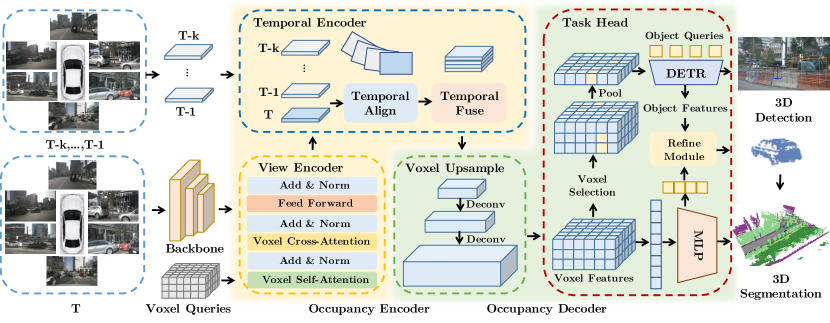
- PanoOccは、粗いから細かい段階へのアプローチを用いて、複数フレーム・複数視点の画像から空間的・時間的特徴をボクセルクエリに集約し、効率的な3D特徴学習を実現する。
- モデルはトランスフォーマーに基づくアーキテクチャを用いて、視点および時間軸に跨る特徴に注目し、段階的にオカペイシティ表現を精緻化する。
- オカペイシティスパース化モジュールを導入し、アップサンプリング段階で非活性ボクセルを削除することで、最大95%(元の5%に留まる)のメモリ消費量削減を実現する。
- マルチタスク損失(ファーコン損失、Lovász-Softmax、およびトゥイング・スペシフィック損失)を用いて、検出、セマンティックセグメンテーション、オカペイシティ予測を同時に最適化する。
- 空間的効率を維持しながら幾何的詳細を保持するため、アップサンプリングパスでスパースデコンボリューションを活用する。
- ボクセル表現の教師付き学習として、スパースLiDARポイントラベルをエンドツーエンドで用いる。

実験結果
リサーチクエスチョン
- RQ1複数視点のカメラ入力からオブジェクト検出とセマンティックセグメンテーションを統一的3Dオカペイシティ表現で効果的に統合できるか?
- RQ2性能を損なわず、3Dオカペイシティ予測におけるメモリ効率をどのように向上させられるか?
- RQ3時間的モデリングは、オートバイやトレーラーのような隠蔽されたオブジェクトの検出・セグメンテーションにどの程度向上効果をもたらすか?
- RQ4粗いから細かいボクセルクエリメカニズムは、従来の3Dボクセルグリッドやトライプレーン表現に比べ、精度および効率性で優れているか?
- RQ5提案されたスパース化戦略は、3Dオカペイシティ学習におけるメモリフットプリントを大幅に削減しながらも、高い性能を維持できるか?
主な発見
- PanoOccは、nuScenesデータセットで71.7%のmIoUおよび0.324のNDSという、これまでにない最先端の性能を達成し、TPVFormer-Baseを上回った。
- 推論時のメモリ使用量を24G(推論時)および6.0G(推論時)にまで削減し、TPVFormer-Baseの33.5Gを下回った。また、推論遅延も20%高速化され、203ms(PanoOcc)対268ms(TPVFormer-Base)となった。
- オカペイシティスパース化モジュールにより、活性ボクセル数が元の5%にまで削減され、性能に劣化を来さずに顕著なメモリ効率向上が達成された。
- 時間的モデリングにより、オートバイのmIoUが11.7ポイント、トレーラーのmIoUが8.2ポイント向上し、特に隠蔽されたオブジェクトの認識性能が顕著に向上した。
- アブレーションスタディにより、Lovász-Softmax損失が極めて重要であることが確認され、その除去によりmIoUが65.6から59.6に低下した。
- 最適な損失重み設定はλ₁=10.0、λ₂=10.0、λ₃=5.0であり、これによりmIoU(66.1%)およびNDS(0.324)が最高値を記録した。
より良い研究を、今すぐ始めましょう
論文の読解から最終レビューまで、研究時間を劇的に削減しましょう。
クレジットカード登録不要
このレビューはAIが作成し、人間の編集者が確認しました。