
[論文レビュー] Parameter-Efficient Fine-Tuning Design Spaces
本論文はパラメータ効率の高い微調整(PEFT)のデザイン空間を提案し、普遍的なデザインパターンを発見し、複数のバックボーンとNLPタスクにおいて既存戦略を上回る新しいPEFT手法を示す。
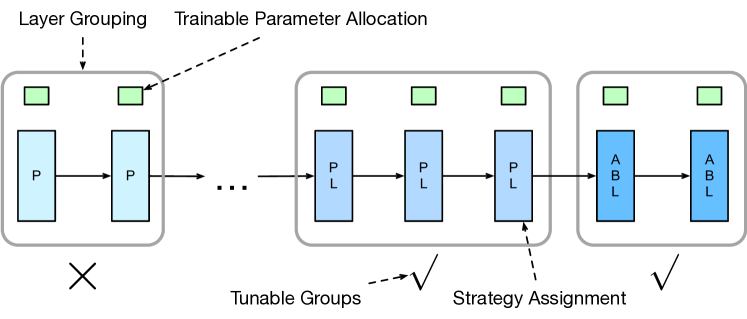
Parameter-efficient fine-tuning aims to achieve performance comparable to fine-tuning, using fewer trainable parameters. Several strategies (e.g., Adapters, prefix tuning, BitFit, and LoRA) have been proposed. However, their designs are hand-crafted separately, and it remains unclear whether certain design patterns exist for parameter-efficient fine-tuning. Thus, we present a parameter-efficient fine-tuning design paradigm and discover design patterns that are applicable to different experimental settings. Instead of focusing on designing another individual tuning strategy, we introduce parameter-efficient fine-tuning design spaces that parameterize tuning structures and tuning strategies. Specifically, any design space is characterized by four components: layer grouping, trainable parameter allocation, tunable groups, and strategy assignment. Starting from an initial design space, we progressively refine the space based on the model quality of each design choice and make greedy selection at each stage over these four components. We discover the following design patterns: (i) group layers in a spindle pattern; (ii) allocate the number of trainable parameters to layers uniformly; (iii) tune all the groups; (iv) assign proper tuning strategies to different groups. These design patterns result in new parameter-efficient fine-tuning methods. We show experimentally that these methods consistently and significantly outperform investigated parameter-efficient fine-tuning strategies across different backbone models and different tasks in natural language processing.
研究の動機と目的
- 手作業で設計された個別戦略を超えるPEFTの包括的なデザインパターンが存在するかどうかを理解する。
- 層のグルーピング、パラメータ割り当て、調整可能なグループ、戦略割り当てをパラメータ化するデザイン空間フレームワークを提案する。
- バックボーン(T5、RoBERTa、BART)およびタスク(GLUE、生成)全体で一般化するデザインパターンを実証的に特定する。
- 発見されたパターンから派生した新しいPEFT手法を示し、低パラメータ予算下で既存のPEFT手法を上回る。
提案手法
- 層のグルーピング、学習可能パラメータ割り当て、調整可能なグループ、戦略割り当ての4要素からなるPEFTデザイン空間を定義する。
- 制約を課し、GLUEでのランダムサンプリングと低エポック微調整を用いてモデル品質を評価することで、制約のないデザイン空間を段階的に洗練させる。
- パターンを横断して一貫して性能を向上させるデザインパターンを特定する(例:スピンドル型の層グルーピング、層間のパラメータ割り当てを均等化、全グループのチューニング、グループごとに多様な戦略を割り当てる)。
- 発見したパターンを組み込んだ新しいPEFT手法を実装し、複数のバックボーンにわたりAdapter、Prefix、BitFit、LoRAと比較する。
- 複数のバックボーン(T5-base、T5-3b、RoBERTa-base/large、BART-base/large)とGLUEおよび生成を含むタスクでパターンを検証する。
実験結果
リサーチクエスチョン
- RQ1さまざまなバックボーンに対してPEFTで最良の性能をもたらすデザイン空間パターンは何か?
- RQ2層グルーピング、パラメータ割り当て、調整可能なグループ、戦略割り当ては相互作用して、移植可能なデザイン原理を生み出すのか?
- RQ3発見したデザインパターンは、多様なNLPタスクで既存の戦略を上回る新しいPEFT手法につながるのか?
- RQ4特定されたパターンは理解タスク(GLUE)と生成タスク(要約、翻訳)の両方で頑健か?
主な発見
- T5-baseを用いたGLUEでの層グルーピングのスピンドルパターンは、他のグルーピングを一貫して上回る。
- 層間で学習可能パラメータを均等に割り当てることが、探索空間で最も高いGLUE平均をもたらす。
- すべての層グループをチューニングすることは性能向上に有益である。
- 異なるグループに異なるチューニング戦略を割り当てると、均一な戦略割り当てより改善が得られる。
- これらのパターンから構築されたPEFT手法(S4-model、S4-3b-model)は強力なベースラインを上回り、低パラメータ予算下では全微調整を超える場面もある。
- パターン由来の手法はバックボーン(T5、RoBERTa、BART)およびNLPタスク(分類、生成)全体に一般化する。

この論文を読む
Nubintのビューアで原文を開き、読みながら気になる箇所をすぐに質問できます。
Nubintでこの論文を読むこのレビューはAIが論文の原文をもとに作成しました。引用する前に原文をご確認ください。