
[論文レビュー] PastNet: Introducing Physical Inductive Biases for Spatio-temporal Video Prediction
PastNet は、スペクトル畳み込みをフーリエ領域で活用することで、時間的空間的動的法則を反映した物理的帰納的バイアスを、動的映像予測に組み込む。また、内部次元性推定を用いたメモリバンクにより計算コストを低減する。この手法は、特に高解像度動画において、予測品質と学習効率の両面で最先端の性能を達成し、MovingMNIST で 100 エポックの学習にわずか 4.16 時間で、従来手法と比較して優れた MSE、SSIM、PSNR スコアを達成する。
In this paper, we investigate the challenge of spatio-temporal video prediction task, which involves generating future video frames based on historical spatio-temporal observation streams. Existing approaches typically utilize external information such as semantic maps to improve video prediction accuracy, which often neglect the inherent physical knowledge embedded within videos. Worse still, their high computational costs could impede their applications for high-resolution videos. To address these constraints, we introduce a novel framework called \underline{P}hysics-\underline{a}ssisted \underline{S}patio-\underline{t}emporal \underline{Net}work (PastNet) for high-quality video prediction. The core of PastNet lies in incorporating a spectral convolution operator in the Fourier domain, which efficiently introduces inductive biases from the underlying physical laws. Additionally, we employ a memory bank with the estimated intrinsic dimensionality to discretize local features during the processing of complex spatio-temporal signals, thereby reducing computational costs and facilitating efficient high-resolution video prediction. Extensive experiments on various widely-used spatio-temporal video benchmarks demonstrate the effectiveness and efficiency of the proposed PastNet compared with a range of state-of-the-art methods, particularly in high-resolution scenarios.
研究の動機と目的
- 時間的空間的ダイナミクスを支配する物理法則を無視する既存の動画予測モデルの限界を是正すること。
- 正確性を損なわずに高解像度動画予測の計算複雑性を低減すること。
- セマンティックマップやオプティカルフローなどの外部入力に依存せずに、動画データから直接物理的帰納的バイアスを統合すること。
- フーリエ領域における学習可能なスペクトル畳み込み機構を用いて、効率的でスケーラブルかつ高品質な動画予測を実現すること。
- Navier-Stokes 方程式や浅水域方程式などの偏微分方程式(PDE)を動画予測設定で解く能力を示すこと。
提案手法
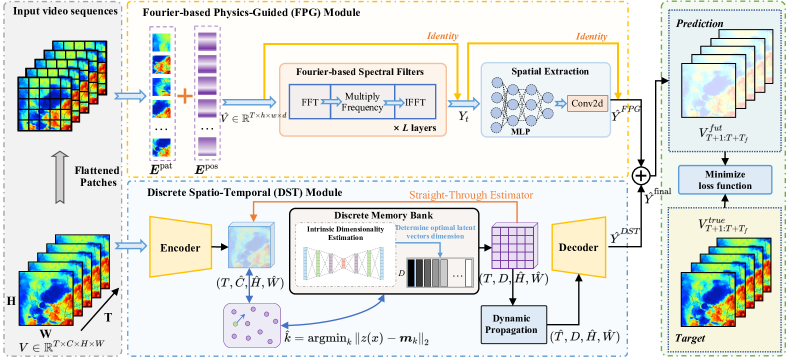
- データそのものから得られる物理的帰納的バイアスを埋め込むために、フーリエ領域におけるスペクトル畳み込み演算子を導入する。
- スペクトル畳み込みの後に逆フーリエ変換を適用し、空間領域における出力フレームを再構築する。
- 内部次元性を推定する離散的時間的空間的モジュールを採用し、局所的特徴をメモリバンクで離散化することで、計算負荷を低減する。
- 異なるデータセットに適応可能な特徴表現を強化するため、学習可能な特徴投影ゲート(FPG)モジュールを用いる。
- 局所的特徴をコンactな学習済み表現に置き換えることで、効率性を向上させるメモリバンク機構を統合する。
- 外部の監視信号や補助信号を必要とせず、標準的な動画予測損失関数を用いてエンドツーエンドで学習する。
実験結果
リサーチクエスチョン
- RQ1フーリエ領域におけるスペクトル畳み込みは、生の動画データから物理的帰納的バイアスを効果的に符号化できるか?
- RQ2内部次元性推定とメモリバンクの統合は、高い予測品質を維持しつつ計算コストを顕著に低減できるか?
- RQ3PastNet は自然現象や合成動画ベンチマークを含む多様なデータセットに一般化可能で、一貫した性能を示せるか?
- RQ4PastNet は Navier-Stokes 方程式や浅水域方程式といった複雑な PDE を、動画予測設定でどの程度解けるか?
- RQ5高解像度動画予測タスクにおいて、最先端モデルと比較して、PastNet の学習速度と収束速度はどの程度優れているか?
主な発見
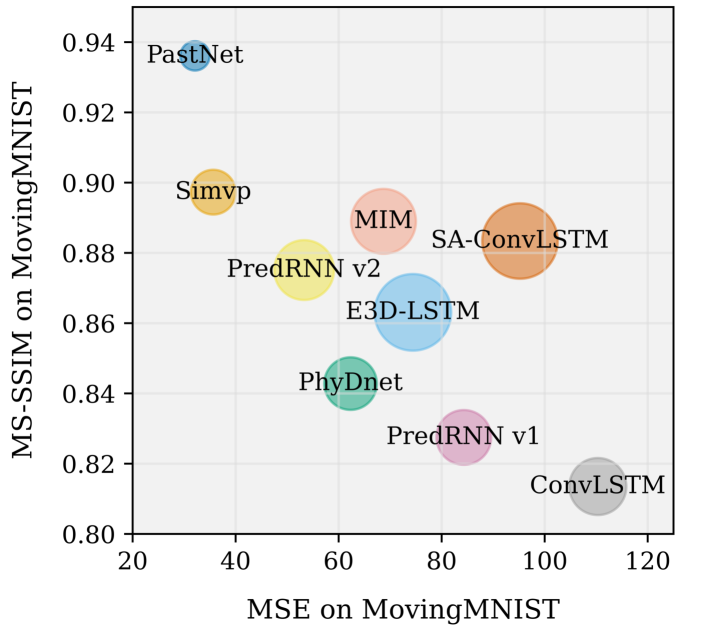
- 100 エポック経過後の MovingMNIST において、PastNet は最小の MSE と最大の MS-SSIM を達成し、学習時間はわずか 4.16 時間で、競合モデルと比べて顕著に高速である。
- 自然現象データセットでは、FPG モジュールを搭載した PastNet が最良の性能を示し、UNet を代替モジュールとして使用しても強力な結果が得られ、柔軟性が裏付けられる。
- 60 エポックで SSIM 約 0.92 を達成するが、他のモデルは 0.85 未満にとどまるため、収束速度が著しく速いことが示された。
- 100 エポック後、PastNet は PSNR 約 38 を達成し、他のモデルと比較して画像品質が顕著に優れている。
- PastNet は PDE の解法において強い潜在能力を示しており、Navier-Stokes 方程式(NSE)よりも浅水域方程式(SWE)でより低い MSE と MAE を達成し、1 エポックあたりの学習時間も同程度である。
- アブレーションスタディにより、FPG と DST モジュールの両方が重要であることが確認された。FPG を削除すると性能が低下し、DST を削除すると学習が遅くなるため、それぞれ精度と効率性の役割が明確に示された。
より良い研究を、今すぐ始めましょう
論文の読解から最終レビューまで、研究時間を劇的に削減しましょう。
クレジットカード登録不要
このレビューはAIが作成し、人間の編集者が確認しました。