
[論文レビュー] Pay Attention to What You Read: Non-recurrent Handwritten Text-Line Recognition
この論文は、再帰的でない、トランスフォーマーに基づくアプローチを初めて提示し、視覚的段階および言語的段階の両方でマルチヘッド自己注意機構を活用することで、再帰性を排除したまま文字認識と言語モデリングを統合的に実行する。IAMデータセットにおいて最先端の性能を達成しており、少データ学習の結果も強く、事前定義された語彙に依存しないOoV語のサポートも可能である。語彙に依存しないエンド・トゥ・エンドの文字レベルでの学習により、事前定義された語彙を必要としない。
The advent of recurrent neural networks for handwriting recognition marked an important milestone reaching impressive recognition accuracies despite the great variability that we observe across different writing styles. Sequential architectures are a perfect fit to model text lines, not only because of the inherent temporal aspect of text, but also to learn probability distributions over sequences of characters and words. However, using such recurrent paradigms comes at a cost at training stage, since their sequential pipelines prevent parallelization. In this work, we introduce a non-recurrent approach to recognize handwritten text by the use of transformer models. We propose a novel method that bypasses any recurrence. By using multi-head self-attention layers both at the visual and textual stages, we are able to tackle character recognition as well as to learn language-related dependencies of the character sequences to be decoded. Our model is unconstrained to any predefined vocabulary, being able to recognize out-of-vocabulary words, i.e. words that do not appear in the training vocabulary. We significantly advance over prior art and demonstrate that satisfactory recognition accuracies are yielded even in few-shot learning scenarios.
研究の動機と目的
- 手書きテキスト認識における再帰モデルの学習非効率性と逐次的ボトルネックを克服すること。
- 事前定義された閉じた語彙に依存しないエンド・トゥ・エンド認識を可能にし、語彙外語(OOV語)をサポートすること。
- 自己注意機構が再帰的アーキテクチャにおいて視覚的特徴と言語的依存関係を効果的にモデル化できることを示すこと。
- 合成データによる事前学習を用いて、低データ環境下での性能を検証すること。
- モデルが言語モデリング能力を内蔵しており、外部言語モデルの必要性を低減できることを示すこと。
提案手法
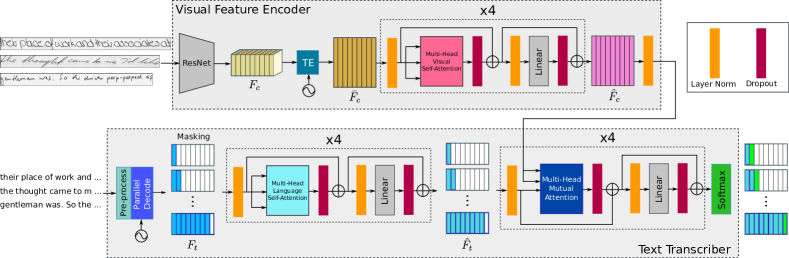
- モデルは、従来の畳み込み型または再帰型エンコーダーに代わって、視覚トランスフォーマー・エンコーダーを用いて手書きテキストライン画像から視覚的特徴を抽出する。
- マルチヘッド自己注意機構が視覚的トークンを処理し、画像全体の空間的および順序的依存関係を学習する。
- デコーダーは、別のマルチヘッド自己注意モジュールを用いて、視覚的特徴と以前に生成されたトークンに注目しながら、逐次的に文字を生成する。
- 全アーキテクチャは、文字レベルの予測における交差エントロピー損失を用いてエンド・トゥ・エンドで学習され、視覚的および言語的モデリングを統合的に実現する。
- 少データ一般化を向上させるために、合成データでの事前学習ステップを採用する。特に、実際のアノテーション付きデータが限られる状況で有効である。
- モデルは文字レベルで動作するため、固定語彙を必要とせず、未学習のOOV語の認識が可能になる。
実験結果
リサーチクエスチョン
- RQ1再帰的でないトランスフォーマーに基づくアーキテクチャは、再帰モデルと比較して競争力のある性能を達成できるか?
- RQ2外部言語モデルに依存せずに、提案手法が言語的依存関係を効果的にモデル化できるか?
- RQ3特に実際のアノテーション付きデータが限られる状況において、少データ学習のシナリオで十分に一般化できるか?
- RQ4合成データでの事前学習が、実世界の手書きテキスト認識タスクの性能にどの程度向上効果をもたらすか?
- RQ5事前定義された語彙を必要とせず、語彙外語(OOV語)を認識できるか?
主な発見
- 提案手法は、IAMデータセットにおいて、文字誤り率(CER)4.67%、語誤り率(WER)15.45%を達成し、オープン語彙HTR分野で新たな最先端性能を樹立した。
- 実際の学習データの20%のみで、合成データで事前学習した場合、sequence-to-sequenceベースラインを上回る性能を示し、強力な少データ一般化能力を示した。
- 外部言語モデルを後処理として追加しても性能向上が得られず(CER:4.66% vs. 4.67%)、モデルが内部的に十分な言語的文脈を捉えていることを示している。
- 特にオープン語彙設定において、閉じた語彙に依存する従来のSOTA手法を大きく上回り、すべての先行手法を凌駕した。
- アブレーションスタディにより、視覚的および言語的自己注意機構の両方が最適性能を達成するために不可欠であることが確認され、視覚エンコーダーが特徴表現において重要な役割を果たしていることが示された。
- 合成データを用いた事前学習により、実データが限られる状況でも高い性能を達成でき、低リソース環境におけるスケーラビリティが顕著に示された。
この論文を読む
Nubintのビューアで原文を開き、読みながら気になる箇所をすぐに質問できます。
Nubintでこの論文を読むこのレビューはAIが論文の原文をもとに作成しました。引用する前に原文をご確認ください。