
[論文レビュー] PCR: Proxy-based Contrastive Replay for Online Class-Incremental Continual Learning
本稿では、災害的忘却を軽減するため、プロキシベースとコントラスト学習ベースのリプレイを統合した、新しいオンラインクラスインクリメンタル継続的学習手法であるプロキシベースコントラストリプレイ(PCR)を提案する。コントラスト損失におけるアンカー・サンプルペアをクラス固有のプロキシに置き換えることで、安定的かつ高速な収束が達成されるとともに、クラス不均衡からのバイアスが軽減される。CIFAR100、MiniImageNet、TinyImageNetの各データセットにおいて、最先端手法を上回る性能を発揮する。
Online class-incremental continual learning is a specific task of continual learning. It aims to continuously learn new classes from data stream and the samples of data stream are seen only once, which suffers from the catastrophic forgetting issue, i.e., forgetting historical knowledge of old classes. Existing replay-based methods effectively alleviate this issue by saving and replaying part of old data in a proxy-based or contrastive-based replay manner. Although these two replay manners are effective, the former would incline to new classes due to class imbalance issues, and the latter is unstable and hard to converge because of the limited number of samples. In this paper, we conduct a comprehensive analysis of these two replay manners and find that they can be complementary. Inspired by this finding, we propose a novel replay-based method called proxy-based contrastive replay (PCR). The key operation is to replace the contrastive samples of anchors with corresponding proxies in the contrastive-based way. It alleviates the phenomenon of catastrophic forgetting by effectively addressing the imbalance issue, as well as keeps a faster convergence of the model. We conduct extensive experiments on three real-world benchmark datasets, and empirical results consistently demonstrate the superiority of PCR over various state-of-the-art methods.
研究の動機と目的
- データストリームからの単一パスアクセスにおいて、古い知識が上書きされるリスクがあるオンラインクラスインクリメンタル継続的学習における災害的忘却を解消すること。
- 既存のリプレイベース手法の限界を克服すること:プロキシベース手法はクラス不均衡バイアスに苦しむが、コントラストベース手法は少数のサンプルにより不安定になる。
- プロキシベースリプレイの安定性とコントラストベースリプレイの選択的ペアサンプリングの利点を統合した包括的フレームワークを構築し、相補的な利点を実現すること。
- 特にバッファメモリが限られている状況やクラス増加が続く状況においても、強固な性能を発揮すること。
提案手法
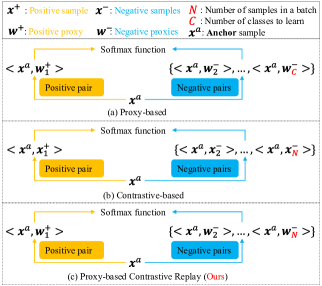
- コントラスト損失内のアンカー・サンプルペアを、クラスの代表を表すプロキシに置き換えるハイブリッドリプレイ機構を導入する。
- 現在の訓練バッチに含まれるクラスに基づいてアンカー・プロキシペアを選択する——コントラストベースのサンプリング戦略を模倣することで、選択の関連性を向上させる。
- 安定的かつ高速な収束を実現するためのプロキシベース損失を用いる一方で、バッチ依存の選択により頻度の高いクラスへのバイアスを低減する。
- メモリバッファに原始的なサンプルではなくプロキシを格納することで、ストレージを削減し、一般化性能を向上させる。
- 推論時に近いクラス平均(NCM)分類器とコントラスト損失を統合し、古いクラスの性能を向上させる。
- 重複するアンカー・プロキシペアを削除する選択コンponentと、複数のネガティブペアを保持する複製コンponentを統合し、両者ともモデルの耐性向上に寄与する。
実験結果
リサーチクエスチョン
- RQ1プロキシベースとコントラストベースのリプレイ機構を統合することで、単独で用いる場合よりも優れた性能が得られるか?
- RQ2バッチ内クラスの存在に基づいてアンカー・プロキシペアを選択することで、全プロキシベースサンプリングに比べ、一般化性能が向上しバイアスが低減されるか?
- RQ3限られたバッファサイズ下で、順次タスクを経る中で、PCRは災害的忘却の緩和と新規クラス学習の両面でどの程度の性能を示すか?
- RQ4提案されたPCRフレームワークにおける選択コンponentと複製コンponentが、全体のモデル性能に果たす貢献度は何か?
主な発見
- PCRは、Split CIFAR100、Split MiniImageNet、TinyImageNetの各データセットにおいて、最先端手法を一貫して上回り、タスク全体の平均精度で顕著な向上を示す。
- Split CIFAR100では、最終的な平均精度が78.4%に達し、次善の手法(ER-ACE:76.8%)を上回り、タスク数の増加に伴う強い忘却耐性を示す。
- Split MiniImageNetでは、SCRおよびER-ACEを著しく上回り、古い知識の保持能力と新規クラスの学習能力の両面で優れた性能を発揮する。
- アブレーションスタディにより、選択コンponent(重複ペアの削除)と複製コンponent(複数のネガティブペアの保持)が性能に不可欠であることが確認され、PCRは両方のコンponentを含むER+A+Bバージョンを上回る。
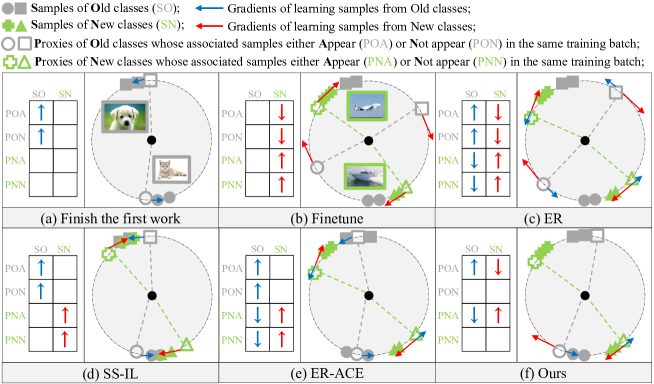
- 図5に示すように、PCRはすべてのプロキシに均一な勾配更新を生じさせ、プロキシベース手法に一般的なクラス不均衡バイアスを軽減する。
- バッチサイズが増加するに従ってもPCRの性能優位性を維持するため、トレーニングダイナミクスに強く、大バッチ設定でのスケーラビリティに優れている。
この論文を読む
Nubintのビューアで原文を開き、読みながら気になる箇所をすぐに質問できます。
Nubintでこの論文を読むこのレビューはAIが論文の原文をもとに作成しました。引用する前に原文をご確認ください。