
[論文レビュー] Phase-space analysis of a novel cosmological model in $f(Q)$ theory
本稿は、空間的に平坦なFLRW時空における非自明な接続を用いた新しい$f(Q)$重力モデルを提案し、$f(T)$理論との退化を解消する。動的系の位相空間解析を通じて、遅い時間における安定なde Sitter吸引子と、物質/放射時代における不安定な固定点を同定し、スカラーフィールドを用いずに完全な宇宙進化の順序を示した。
The vanishing affine connections have been used solely while adopting the modified $f(Q)$ gravity theory to the cosmology. Consequently, researchers could not get beyond what is already known in $f(T)$ theory earlier. To alleviate this problem, in the present manuscript we investigate a recently proposed construction of $f(Q)$ theory using non-vanishing affine connection in the spatially flat FLRW spacetime. We then investigate the cosmological solutions of $f(Q)$ theory for a perfect fluid through the phase space analysis. We introduce few variables and dimensionless parameters to construct the corresponding equations suitable for the dynamical system approach. The conservation of the energy-momentum tensor leads to a constraint equation that relates the dynamical variables. Briefly, both unstable and stable de Sitter solutions appear which correspond to early and late times accelerated expansions. Also, unstable points corresponding to the matter dominated and radiation dominated eras have been found which do exist for every $f(Q)$ function. As a result, the present discussion shows that $f(Q)$ gravity endowed by non-vanishing affine connections is capable of explaining a true sequence of cosmic eras.
研究の動機と目的
- 従来の$f(Q)$宇宙論研究が、$f(T)$理論の結果を再現する唯一の零接続に依存するという制限を克服すること。
- 時間に依存するパラメータ$\gamma(t)$を用いてパrameter化された非零でねじれのない接続を用いた、$f(Q)$重力の新しい定式化を開発すること。これにより、$f(T)$理論とは異なる力学的性質を保証すること。
- 動的系理論を用いて、新規$f(Q)$モデルの宇宙論的解を解析し、固定点と安定性に焦点を当てる。
- モデルが初期de Sitter(インフレーション)、物質支配、および遅い時間におけるde Sitter(ダークエネルギー)の各時代を含む完全な宇宙時代の順序を記述できることを示すこと。
- スカラーフィールドを導入せず、重力の幾何的修正にのみ依存して、上記の進化を達成できることを示すこと。
提案手法
- 曲率とねじれが零である非零な接続$\Gamma^\lambda_{\mu\nu}$を用いて$f(Q)$重力を定式化し、空間的に平坦なFLRW計量に時間に依存するパラメータ$\gamma(t)$を導入する。
- 作用$\mathcal{L} = \sqrt{-g} f(Q)$から、場の運動方程式、エネルギー密度、および圧力を導出する。ここで$Q$は非計量性スカラー量である。
- エネルギー運動量テンソルの保存を課し、動的変数を関連付ける制約方程式を導出し、動的系の閉じた形式を得る。
- 次元なし変数$x_1, x_2, x_3$を導入し、系を位相空間解析に適した自己同型形式に変換する。
- 得られた動的系に対して、臨界点を特定し、線形化と固有値解析を用いて安定性を評価する。
- 特定のモデルを検討する:$f(Q) = \alpha Q^\beta$、$f(Q) = \eta Q + \zeta Q^\sigma$、および$f(Q) = \xi e^{\chi Q}$。これらは時間変化する$\gamma(t)$および定数$\gamma(t)$の両方の状況を含む。
実験結果
リサーチクエスチョン
- RQ1非零な接続が$f(Q)$重力において、$f(T)$理論とは異なる宇宙論的力学を生じるか?
- RQ2$\gamma(t)$に依存する接続を持つ提案された$f(Q)$モデルが、初期および遅い時間における安定なde Sitter解を支持するか?
- RQ3モデルが外部のスカラーフィールドを用いずに、放射時代、物質支配時代、および遅い時間の加速時代を自然に記述できるか?
- RQ4パラメータ$\gamma(t)$は、位相空間構造および固定点の安定性にどのような役割を果たすか?
- RQ5$f(Q)$の異なる関数的形態が、特に加速膨張に対応する固定点の存在と性質にどのように影響を与えるか?
主な発見
- 非零な接続を用いたモデルは、$f(T)$理論とは異なるFriedmann型方程式を生成し、従来の退化を解消した。
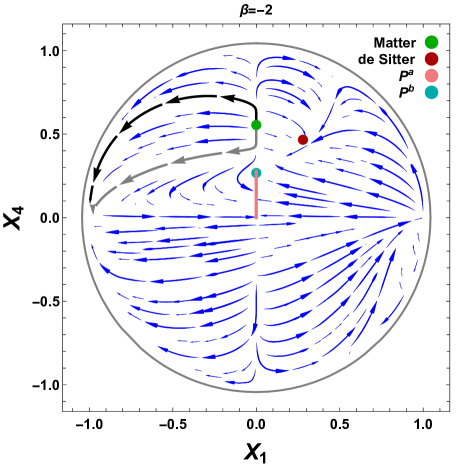
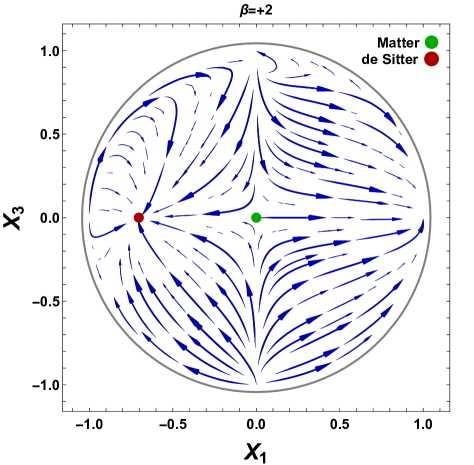
- モデル$f(Q) = \alpha Q^\beta$では、遅い時間に安定なde Sitter固定点が存在し、初期時間に不安定な物質支配固定点が存在する。軌道は後者から前者へ進化する。
- モデル$f(Q) = \xi e^{\chi Q}$では、2つのde Sitter固定点が存在する:初期時間の不安定な(インフレーション)と、遅い時間の安定な(加速)もの。これにより、初期から遅いde Sitter時代への遷移が可能である。
- モデル$f(Q) = \xi e^{\chi Q}$における位相空間軌道は、$R^{ds}_e$(初期de Sitter)から$R^{ds}_l$(遅いde Sitter)への進化を示し、初期値が小さい場合、遅い時間における$x_1$の値がゼロに近づく。
- モデル$f(Q) = \eta Q + \zeta Q^\sigma$では物質支配固定点を支持せず、標準的宇宙進化と不適合であることが示された。
- 一部のモデルでは、$w^{\text{eff}} < -1/3$である孤立した安定固定点が存在し、これは物質支配点とは接続されていない加速膨張を示しており、代替的な遅い時間の力学を示唆している。
この論文を読む
Nubintのビューアで原文を開き、読みながら気になる箇所をすぐに質問できます。
Nubintでこの論文を読むこのレビューはAIが論文の原文をもとに作成しました。引用する前に原文をご確認ください。