
[論文レビュー] Pisces VII/Triangulum III -- M33's second dwarf satellite galaxy
この論文は、深さのあるGemini GMOS-N画像を用いて、Pisces VII/Triangulum III (Pisc VII) がM33の第二の衛星であることを確認した。距離は916⁺⁶⁵₋₅₃ kpcと測定され、半光半径(186⁺⁵⁸₋₃₂ pc)、絶対等級(MV = −6.0 ± 0.3)、および全光度(2.2⁺⁰.⁷₋₀.⁵ × 10⁴ L☉)が確認された。この銀河のM33のハロー内での位置は、M33がアンドロメダ系に最初の接近を迎えているという仮説を支持するが、その潜在的な若い星形成群(約1.5 Gyr)は、超微弱矮星系における再イオン化駆動型停止モデルを挑戦するものである。
Pisces VII/Triangulum III (Pisc~VII) was discovered in the DESI Legacy Imaging Survey and was shown to be a Local Group dwarf galaxy with follow-up imaging from the 4-m Telescopio Nazionale Galileo. However, this imaging was unable to reach the horizontal branch of Pisc VII, preventing a precision distance measurement. The distance bound from the red giant branch population placed Pisc VII as either an isolated ultra-faint dwarf galaxy or the second known satellite galaxy of Triangulum (M33). Using deep imaging from Gemini GMOS-N, we have resolved the horizontal branch of Pisc VII, and measure a distance of $D=916^{+65}_{-53}$~kpc, making Pisc VII a likely satellite of M33. We also remeasure its size and luminosity from this deeper data, finding $r_{ m half}=186^{+58}_{-32}$ pc, $M_V=-6.0\pm0.3$ and $L=2.2^{+0.7}_{-0.5} imes10^4\,{ m L}_\odot$. Given its position in the M33 halo, we argue that Pisc VII could support the theory that M33 is on its first infall to the Andromeda system. We also discuss the presence of blue plume and helium burning stars in the colour-magnitude diagram of Pisc VII that are consistent with ages of $\sim1.5$~Gyr. If these are truly members of the galaxy, it would transform our understanding of how reionisation affects the faintest galaxies. Future deep imaging and dynamics could allow significant insight into both the stellar populations of Pisc VII and the evolution of M33
研究の動機と目的
- DESIs Legacy Imaging Surveyで発見された微弱な矮星系候補Pisces VII/Triangulum III (Pisc VII) の真の距離および構造的パラメータを特定すること。
- Pisc VII がM33の衛星であるのか、それともローカルグループ内に孤立した超微弱矮星系(UFD)であるのかを評価すること。
- CMDにおける青いプラウムおよびヘリウム燃焼星の存在を調査し、特にそのような若年星形成群(約1.5 Gyr)が、微弱銀河における再イオン化駆動型停止モデルの理解にどのような影響を及えるかを検討すること。
- Pisc VII がM33から約97 kpcの投影距離にあることから、M33の軌道的歴史が最初の接近シナリオであるかどうかを評価すること。
提案手法
- 水平枝の解像を可能にするために、Gemini GMOS-N機器を用いてPisc VIIの深さのある画像を取得し、正確な距離測定を実施した。
- 写真測定の還元および解析には、Gemini DRAGONSパイプラインを用い、高精度な写真測定カタログを生成した。
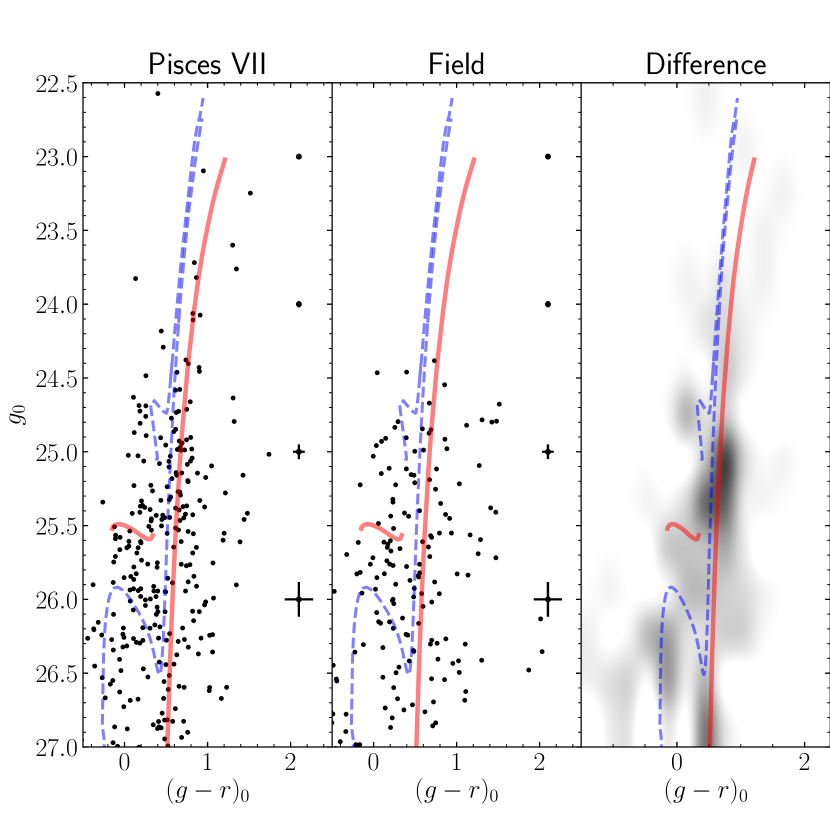
- 深さのある写真測定から色-等級図(CMD)を構築し、赤巨星系列、水平枝、青いプラウムなどの星形成群を特定した。
- 観測された水平枝を理論的等時曲線にフィットさせることで距離を導出し、不確実性はブートストラップ再サンプリングを用いて伝搬させた。
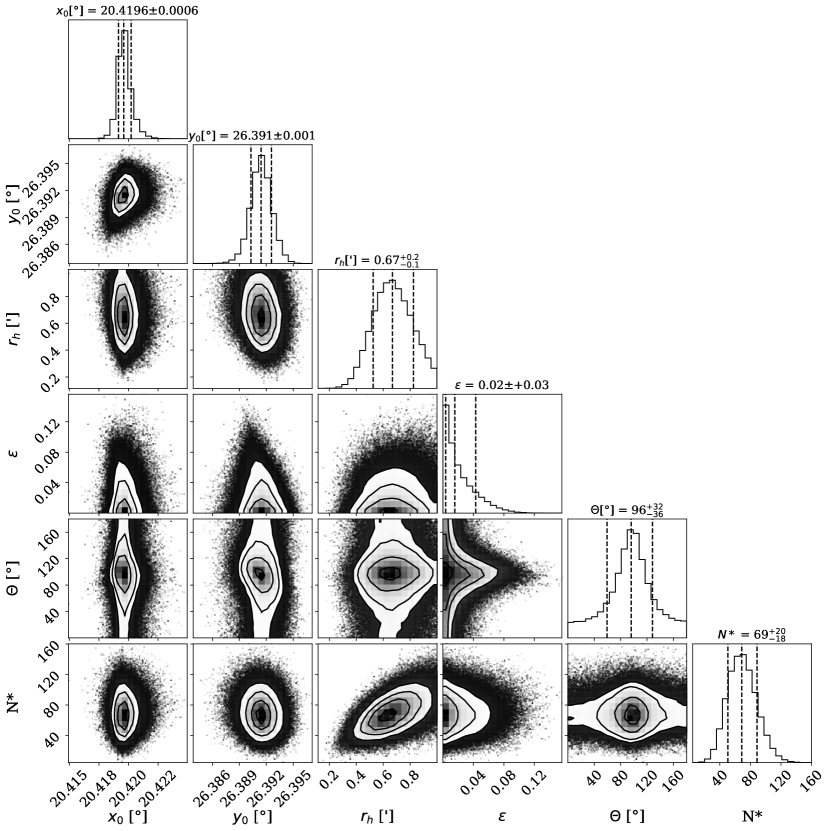
- より深いデータから、星の密度および表面輝度プロファイルのフィッティングを用いて、半光半径や全光度などの構造的パラメータを再測定した。
- 測定された視線距離と投影角距離を用いて、M33への3次元距離を計算し、M33ハローへの束縛状態を評価した。
実験結果
リサーチクエスチョン
- RQ1Pisces VII/Triangulum III はM33の衛星であるのか、それともローカルグループ内に孤立した超微弱矮星系であるのか?
- RQ2Pisces VII への正確な距離は何か? そして、それはM33のハローの半徴半径内にあるのか?
- RQ3CMDにおける青いプラウムおよびヘリウム燃焼星の存在は、年齢が約1.5 Gyrの若い星形成群を示唆するのか? その場合、再イオン化駆動型停止モデルにどのような含意があるか?
- RQ4Pisc VII がM33から約97 kpcの投影距離にあることから、M33がアンドロメダ系に最初の接近を迎えているというシナリオが支持されるのか、それともM31との以前の接近を経験したのか?
- RQ5深さのある画像に基づいて、Pisc VII の真の全光度、サイズ、構造的形状は何か?
主な発見
- Pisces VII への距離は916⁺⁶⁵₋₅₃ kpcと測定され、M33からの3次元距離は97 ± 6 kpcに位置し、M33のハロー内にあることが確認された。
- Pisc VII の半光半径は186⁺⁵⁸₋₃₂ pcであり、矮星系縞状銀河(dSph)と整合的である。
- Vバンドの絶対等級はMV = −6.0 ± 0.3であり、全光度は2.2⁺⁰.⁷₋₀.⁵ × 10⁴ L☉である。これにより、超微弱矮星系としての分類が確認された。
- CMDにおける青いプラウムおよびヘリウム燃焼星の存在は、年齢が約1.5 Gyrの星形成群を示しており、最近の星形成を示唆している。
- Pisc VII がM33から大きな投影距離にあることから、M33がアンドロメダ系に最初の接近を迎えているという仮説が支持される。M31との以前の接近は想定されない。
- M33の第二の遠方衛星の検出は、M33が広範囲にわたる拡張した衛星系を有している可能性を示唆し、その「欠落衛星問題」の解決に寄与する可能性がある。
この論文を読む
Nubintのビューアで原文を開き、読みながら気になる箇所をすぐに質問できます。
Nubintでこの論文を読むこのレビューはAIが論文の原文をもとに作成しました。引用する前に原文をご確認ください。