
[論文レビュー] Pixel-Aware Stable Diffusion for Realistic Image Super-resolution and Personalized Stylization
PASD は、ピクセル認識型のクロスアテンション機構と劣化除去および高レベルのセマンティック信号を統合して、追加の画像空間トレーニングなしに、事前学習済みの拡散事前知識を用いて Real-ISR および個別スタイル適用を実現します。
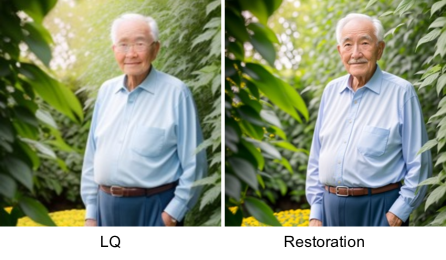
Diffusion models have demonstrated impressive performance in various image generation, editing, enhancement and translation tasks. In particular, the pre-trained text-to-image stable diffusion models provide a potential solution to the challenging realistic image super-resolution (Real-ISR) and image stylization problems with their strong generative priors. However, the existing methods along this line often fail to keep faithful pixel-wise image structures. If extra skip connections between the encoder and the decoder of a VAE are used to reproduce details, additional training in image space will be required, limiting the application to tasks in latent space such as image stylization. In this work, we propose a pixel-aware stable diffusion (PASD) network to achieve robust Real-ISR and personalized image stylization. Specifically, a pixel-aware cross attention module is introduced to enable diffusion models perceiving image local structures in pixel-wise level, while a degradation removal module is used to extract degradation insensitive features to guide the diffusion process together with image high level information. An adjustable noise schedule is introduced to further improve the image restoration results. By simply replacing the base diffusion model with a stylized one, PASD can generate diverse stylized images without collecting pairwise training data, and by shifting the base model with an aesthetic one, PASD can bring old photos back to life. Extensive experiments in a variety of image enhancement and stylization tasks demonstrate the effectiveness of our proposed PASD approach. Our source codes are available at \url{https://github.com/yangxy/PASD/}.
研究の動機と目的
- GAN ベースの手法によるアーティファクトを排除し、知覚的に現実的な質感を回復する Real-ISR を動機づける。
- 堅牢な画像復元とスタイリゼーションのために、事前学習済みの拡散事前知識(例: Stable Diffusion)を活用する。
- 構造を保持するためのピクセルレベルのガイダンスを、ピクセル認識型クロスアテンションモジュールを介して導入する。
- 未知の現実世界の劣化を、劣化除去モジュールで緩和する。
- ベース拡散モデルを交換することで、PASD が個別スタイライズをサポートすることを実証する。
提案手法
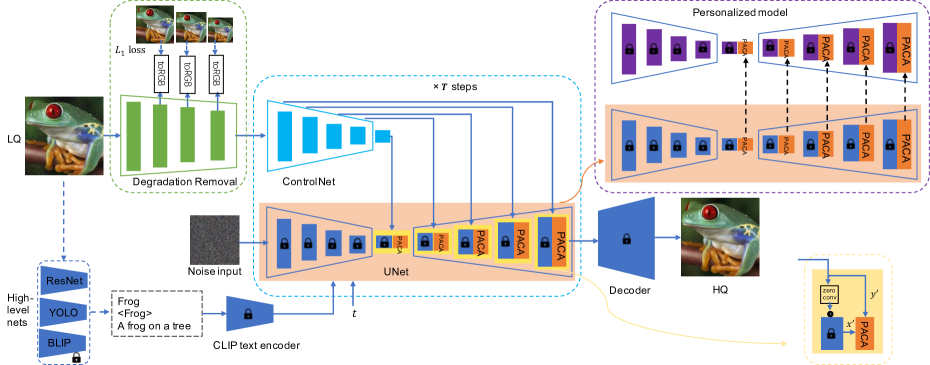
- Pixel-Aware Cross Attention (PACA) を導入し、条件付き入力から拡散 UNet へピクセルレベルの情報を、スキップ接続なしで伝達する。
- toRGB 監視と複数スケールの L1 損失(L_DR)を用いたピラミッド特徴抽出器を用いた劣化除去モジュールを追加。
- 分類/検出/キャプションなどの高レベル情報抽出と、CLIP ベースのテキストガイダンスを、条件付けのための classifier-free ガイダンスと組み合わせて組み込む。
- 拡散損失 L_DF を auxiliary L_DR 損失とともに最適化して訓練する;事前学習済み SD を凍結し、追加モジュール(PACA、劣化除去、ControlNet)と高レベル情報経路を訓練する。
- スタイル転送の一形態として、ベースの拡散モデルを個別化されたモデルに置換するだけで、追加のトレーニングなしに個別スタイライズを可能にする。
- 推論時のモードカバレージを改善するために、任意でネガティブプロンプトを利用する。
実験結果
リサーチクエスチョン
- RQ1PACAによるピクセルレベルの条件付けは、画像空間のトレーニングアーチファクトを追加することなく、Real-ISR 出力の忠実度を向上させることができるか?
- RQ2劣化耐性を有する特徴抽出は、現実世界の劣化下での拡散ベース復元を改善するか?
- RQ3高レベルのセマンティック信号(キャプション/検出/分類)が Real-ISR の性能をさらに向上させるか?
- RQ4ベース拡散モデルを単に変更するだけで、PASD は効果的な個別スタイライズを実現できるか?
- RQ5知覚指標において、PASD は GAN ベースおよび他の拡散ベース Real-ISR 手法と比べてどうであるか?
主な発見
- PASD は RealSR および DRealSR で MUSIQ および他の知覚指標全般において、GAN ベースの Real-ISR 手法よりも強い知覚品質を達成する。
- PASD は競合する拡散ベースの Real-ISR 手法を大半の知覚指標で上回り、テストデータセットで最高の MUSIQ スコアを得る。
- アブレーションにより、PACA がピクセル精度の構造と質感を維持する上で重大であることが示される。除去すると色・構造の忠実度が低下する。
- 劣化除去と高レベル情報は結果を向上させる。これらを除くと出力がノイズっぽくなり、指標も悪化する。
- PASD は個別の拡散モデルへ置換することで個別スタイライズを可能にし、ピクセルレベルの詳細を他のいくつかのベースラインよりも良好に保存する。
- ユーザ調査は、Real-ISR およびスタイライズタスクにおいて PASD が好まれることを裏付ける。
この論文を読む
Nubintのビューアで原文を開き、読みながら気になる箇所をすぐに質問できます。
Nubintでこの論文を読むこのレビューはAIが論文の原文をもとに作成しました。引用する前に原文をご確認ください。