
[論文レビュー] Pragmatic Instruction Following and Goal Assistance via Cooperative Language-Guided Inverse Planning
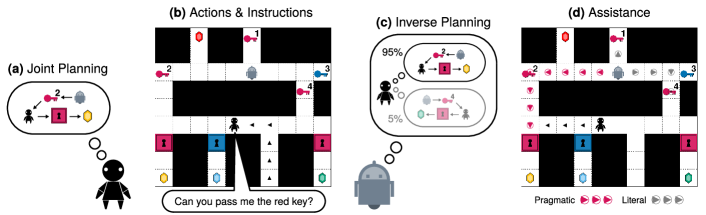
本稿では、言語を通じて共同計画をコミュニケーションする協力的プランナとしての人間をモデル化することで、文化的な指示理解と目的支援を可能にするベイジアンエージェントアーキテクチャであるCooperative Language-Guided Inverse Plan Search(CLIPS)を提案する。CLIPSは、大規模言語モデル(LLM)を用いて指示の尤度と逆プランニングをスコアリングすることで、人間の目的に関するマルチモーダルベイジアン推論を実行し、期待される目的達成コストを最小化する行動をとる。このアプローチは、2つのドメインにおいて、GPT-4V、直訳的指示理解、および単モーダル逆プランニングを著しく上回る精度と有用性を達成した。
People often give instructions whose meaning is ambiguous without further context, expecting that their actions or goals will disambiguate their intentions. How can we build assistive agents that follow such instructions in a flexible, context-sensitive manner? This paper introduces cooperative language-guided inverse plan search (CLIPS), a Bayesian agent architecture for pragmatic instruction following and goal assistance. Our agent assists a human by modeling them as a cooperative planner who communicates joint plans to the assistant, then performs multimodal Bayesian inference over the human's goal from actions and language, using large language models (LLMs) to evaluate the likelihood of an instruction given a hypothesized plan. Given this posterior, our assistant acts to minimize expected goal achievement cost, enabling it to pragmatically follow ambiguous instructions and provide effective assistance even when uncertain about the goal. We evaluate these capabilities in two cooperative planning domains (Doors, Keys & Gems and VirtualHome), finding that CLIPS significantly outperforms GPT-4V, LLM-based literal instruction following and unimodal inverse planning in both accuracy and helpfulness, while closely matching the inferences and assistive judgments provided by human raters.
研究の動機と目的
- 文脈的ヒントに依存する曖昧な人間の指示を解消する課題に対処すること。
- 協力的状況における堅牢な目的推論を実現するため、言語的および行動的ヒントを統合する支援エージェントを開発すること。
- 目的達成の期待コストを最小化することで、不確実性下での目的支援を可能にすること。
- 合理的な言語行動理論と逆プランニング理論に裏付けられた理論的マインドフレームワークを通じて、アシスタントの行動を人間の意図に一致させること。
提案手法
- CLIPSは、言語を通じて共同計画をコミュニケーションする協力的プランナとしての人間をモデル化し、共有された目的推論を可能にする。
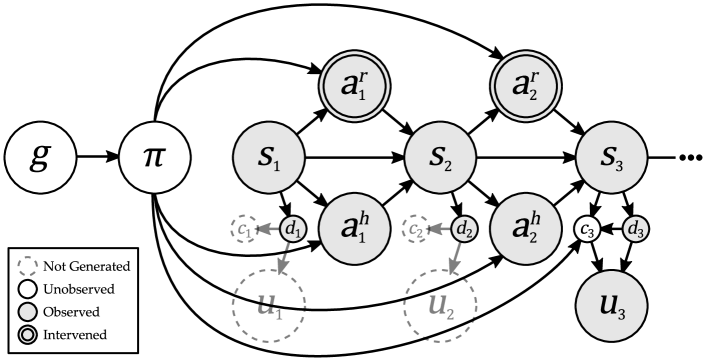
- 観察された行動と言語的発話に基づいて、人間の目的に関するマルチモーダルベイジアン推論を実行する。
- 大規模言語モデル(LLM)が仮定された計画のもとでの指示の尤度を評価することで、曖昧な言語の文化的な解釈を可能にする。
- 逐次的逆プランニングを用いて、マルチモーダル観測に基づき目的の事後分布を計算する。
- 事後分布における期待される目的達成コストを最小化することで、文脈に応じた協力的行動をとる支援ポリシーを導出する。
- このアーキテクチャは、オンライン(動的)およびオフライン(静的)の両方の計画モードをサポートしており、オンライン適応により不確実性下でのパフォーマンスが向上する。
実験結果
リサーチクエスチョン
- RQ1曖昧な指示と観察された行動から、文脈に応じた形で人間の目的をどのように推論できるか?
- RQ2言語と行動を組み合わせたマルチモーダル推論は、単モーダルまたは直訳的解釈に比べて、目的の正確性と支援品質をどの程度向上させられるか?
- RQ3ベイジアン理論的マインドフレームワークに言語理解を根拠づけることで、協力的計画タスクにおける文化的な指示理解はどのように向上するか?
- RQ4目的事後分布における期待コスト最小化が、アシスタント行動の安全性と有用性に与える影響は何か?
- RQ5実世界の協力的計画環境において、CLIPSはLLMベースのベースラインおよび単モーダル逆プランニングと比べてどのように差をつけるか?
主な発見
- オンライン $Q_{\text{MDP}}$ アシスタンスを用いたドア・キーワイズ・ジェム環境では、CLIPSは100%の目的正確性を達成し、GPT-4V(97%)、言語のみの逆プランニング(90%)、行動のみの逆プランニング(43%)を著しく上回った。
- バーチャルホームドメインでは、オンライン $Q_{\text{MDP}}$ アシスタンスを用いたCLIPSは90%の正確性を達成し、言語のみ(59%)および行動のみ(61%)の逆プランニングを上回った。
- CLIPSは、目的推論および支援品質の両面で人間のレーティングと強く一致しており、人間の協力的推論と強い整合性を示した。
- オンライン $Q_{\text{MDP}}$ アシスタンスの使用は、オフライン手法よりもパフォーマンスを向上させたが、特に初期段階の曖昧性解消において顕著だった。
- オンライン $Q_{\text{MDP}}$ アシスタンスを用いたCLIPSは、オフラインよりもわずかに有用性が高かったが、十分な行動観測が得られれば、オフラインアシスタンスも依然として非常に有効であった。
- $\bar{\pi}_{\text{MDP}}$ ポリシーは、判断がより段階的であったが、$Q_{\text{MDP}}$ よりも安全でなく、正確性も低かった。これは、不確実性下でのコスト最小化の重要性を示している。
この論文を読む
Nubintのビューアで原文を開き、読みながら気になる箇所をすぐに質問できます。
Nubintでこの論文を読むこのレビューはAIが論文の原文をもとに作成しました。引用する前に原文をご確認ください。