
[論文レビュー] Privacy-Preserving Language Model Inference with Instance Obfuscation
本稿では、ブラックボックス型言語モデルアーサービス(LMaaS)における意思決定の機密性を保護するための新規手法であるインスタンス断片化推論(IoI)を提案する。入力インスタンスを推論前に断片化することで、モデルの出力が機密性を保たれたままタスクパフォーマンスが維持される。IoIにより、ユーザーは機密情報を暴露せずに真の意思決定を回復可能であり、これはブラックボックス制約下におけるPLM推論における意思決定プライバシーを保護する初のアプローチである。
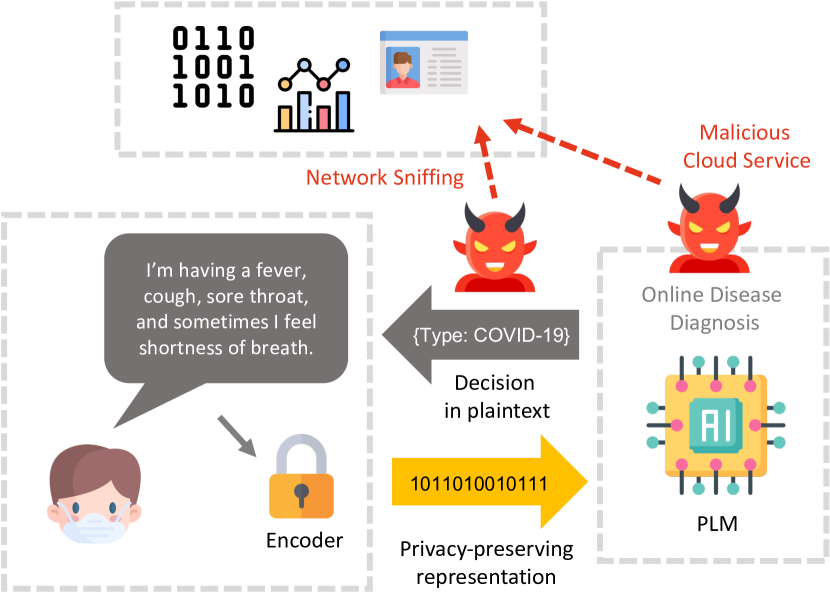
Language Models as a Service (LMaaS) offers convenient access for developers and researchers to perform inference using pre-trained language models. Nonetheless, the input data and the inference results containing private information are exposed as plaintext during the service call, leading to privacy issues. Recent studies have started tackling the privacy issue by transforming input data into privacy-preserving representation from the user-end with the techniques such as noise addition and content perturbation, while the exploration of inference result protection, namely decision privacy, is still a blank page. In order to maintain the black-box manner of LMaaS, conducting data privacy protection, especially for the decision, is a challenging task because the process has to be seamless to the models and accompanied by limited communication and computation overhead. We thus propose Instance-Obfuscated Inference (IOI) method, which focuses on addressing the decision privacy issue of natural language understanding tasks in their complete life-cycle. Besides, we conduct comprehensive experiments to evaluate the performance as well as the privacy-protection strength of the proposed method on various benchmarking tasks.
研究の動機と目的
- 言語モデルアーサービス(LMaaS)システムにおける意思決定プライバシー、すなわちモデル推論出力の機密性を保護するという重要なギャップを埋める。
- モデルの変更や内部パラメータへのアクセスを必要とせず、サービスプロバイダーの知的財産を保護するブラックボックス互換のソリューションを設計する。
- ユーザーが元の入力インスタンスを隠蔽しつつも、正確な予測を再構築できるように、インスタンスを断片化する手法を提供する。
- 意思決定プライバシーの強度とタスクパフォーマンスを厳密に評価するための新しいメトリクスを定義・評価する。
- 実世界のLMaaS制約下におけるテキスト分類タスクにおいて、インスタンス断片化の実用性と有効性を示す。
提案手法
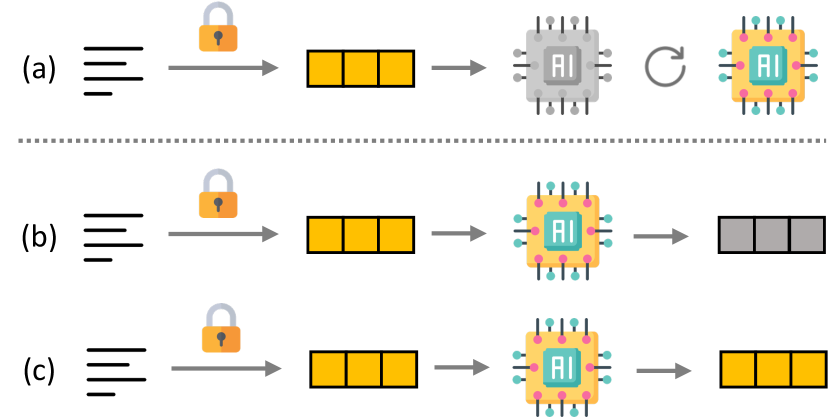
- IoIは、クラウドベースの言語モデルに送信する前に、入力インスタンスを意図的に断片化する技術を導入する。バランス化やランダム化などの戦略を用いて、真のインスタンスを隠蔽する。
- 本手法は、代表表現のミックスアップに類似したインスタンスレベルの断片化に依存し、ターゲットインスタンスを断片化器と組み合わせることで、その意思決定分布をマスキングする。
- 断片化は推論時に行われ、モデルが元の入力や出力をプレーンテキストで一度も見ることはないため、入力および意思決定プライバシーの両方が保護される。
- ユーザーが複数回の断片化された推論結果から真の意思決定を再構築できる回復メカニズムを提供し、断片化にもかかわらずモデルの正確性を維持する。
- 既存の入力プライバシー技術と互換性があり、モデルやインfraの変更なしにレイヤード保護を実現できる。
- ブラックボックス設定下で評価され、モデル互換性が維持され、通信および計算オーバーヘッドが最小限に抑えられる。
実験結果
リサーチクエスチョン
- RQ1モデルの変更や内部パラメータの公開なしに、ブラックボックス型LMaaS環境下で意思決定プライバシーを効果的に保護できるか?
- RQ2強力な断片化を施してもタスクパフォーマンスを維持しつつ、機密な意思決定分布を隠蔽できるようにインスタンス断片化をどのように設計できるか?
- RQ3NLP推論における意思決定プライバシー強度を測定するのに適したメトリクスは何か?
- RQ4既存の入力のみのプライバシー技術と比較して、IoIはプライバシー保護の強度とタスク精度の両面で優れているか?
- RQ5提案された断片化フレームワークにおいて、プライバシー強度と推論コストのトレードオフはどのようになるか?
主な発見
- IoIはブラックボックス型LMaaS環境下におけるテキスト分類タスクにおいて、意思決定プライバシーを効果的に保護した。これは、この分野における同種のアプローチとしては初である。
- 強力な断片化に対しても、ベースラインモデルと比較して精度の低下が最小限に抑えられ、高いタスクパフォーマンスを維持した。
- 意思決定プライバシー用の評価メトリクスにより、IoIがモデル出力内の機密情報を効果的に隠蔽し、推論漏洩のリスクを低減していることが示された。
- 複数回の断片化リクエストによる追加コストは限定的であり、モデルの微調整や完全なモデル共有を要する代替手法と比較して顕著に低い。
- IoIは既存の入力プライバシー技術と互換性があり、システムの使いやすさやモデルの整合性を損なわず、レイヤードプライバシー保護を実現できる。
- 出力長が可変である生成タスクには直接適用できないことが判明した。これは、トークンレベルのミックスアップ処理の難しさに起因し、今後の適応が求められる。
この論文を読む
Nubintのビューアで原文を開き、読みながら気になる箇所をすぐに質問できます。
Nubintでこの論文を読むこのレビューはAIが論文の原文をもとに作成しました。引用する前に原文をご確認ください。