
[論文レビュー] Probabilistic Domain Adaptation for Biomedical Image Segmentation
本稿では、確率的U-Netからの不確実性推定を用いて偽ラベルのフィルタリングを改善する確率的ドメイン適応手法を提案する。複数のセグメンテーションサンプルを活用して偽ラベルを精錬し、ジョイント訓練とセパレート訓練の戦略を評価することで、細胞、ミトコンドリア、肺のセグメンテーションという3つの挑戦的なバイオメディカルセグメンテーションタスクにおいて、強いベースラインを著しく上回る最先端の性能を達成した。
Segmentation is a crucial analysis task in biomedical imaging. Given the diverse experimental settings in this field, the lack of generalization limits the use of deep learning in practice. Domain adaptation is a promising remedy: it involves training a model for a given task on a source dataset with labels and adapts it to a target dataset without additional labels. We introduce a probabilistic domain adaptation method, building on self-training approaches and the Probabilistic UNet. We use the latter to sample multiple segmentation hypotheses to implement better pseudo-label filtering. We further study joint and separate source-target training strategies and evaluate our method on three challenging domain adaptation tasks for biomedical segmentation. Our code is publicly available at https://github.com/computational-cell-analytics/Probabilistic-Domain-Adaptation.
研究の動機と目的
- 多様な実験設定や画像モalityにわたるバイオメディカル画像セグメンテーションにおけるディープラーニングモデルの一般化能力の制限を解決すること。
- ドメイン適応における偽ラベルフィルタリングのための予測信頼度を推定する決定的モデルの不良キャリブレーションを克服すること。
- 不確実性に配慮したフィルタリングを用いて偽ラベルの品質を向上させる、確率的セグメンテーションと自己学習を統合することでドメイン適応の性能を向上させること。
- ジョイント訓練とセパレート訓練戦略(ソースおよびターゲット)が適応性能に与える影響を調査すること。
- 限られたラベル付きデータを有するターゲットドメインにおいて、提案手法の有効性を多様で現実的なバイオメディカル画像認識タスクで示すこと。
提案手法
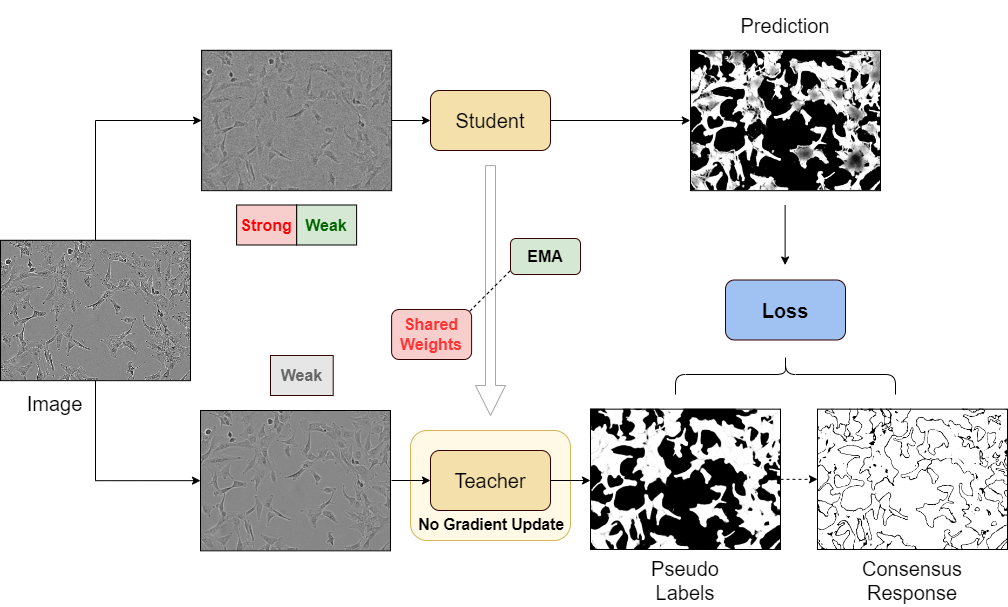
- 学生モデルをラベル付きソースデータと偽ラベル付きターゲットデータで訓練する自己学習フレームワークを採用し、教師モデルが予測を提供する。
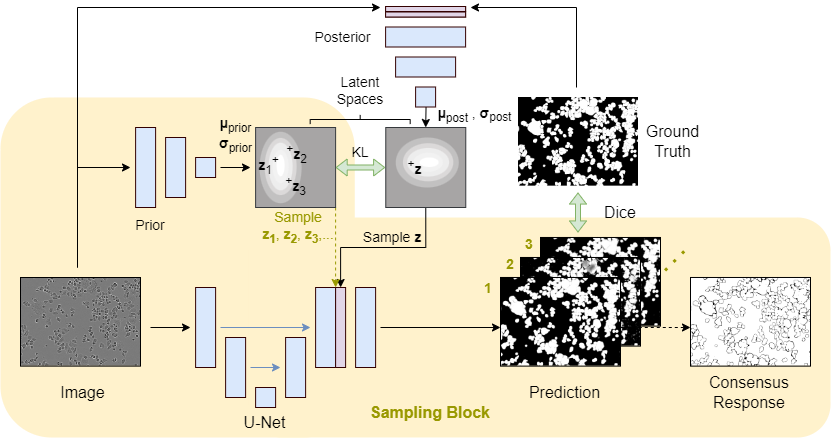
- 確率的U-Net(PUNet)を用いて、事後分布からの確率的サンプリングにより複数のセグメンテーション仮説を生成し、不確実性に配慮した信頼度推定を可能にする。
- コンSENSUSマスキングを用いた偽ラベルフィルタリングを実装——複数のサンプルが一致する場合にのみ予測を保持する——これにより、決定的モデルが提供する信頼度スコアの信頼性の低さを克服する。
- 2つの訓練戦略を検討:(1) ソースの別個訓練の後、ターゲットへの適応(2段階)、(2) ソースおよびターゲットデータを同時に訓練する(1段階)。
- FixMatchスタイルの強化と弱化のデータオーグメンテーションを適用し、訓練の安定性を確保し、予測の崩壊を防ぐ。
- PUNetフレームワークにおいて、事前分布と事後分布の整合性を保つために、Dice損失とKLダイバージェンスの組み合わせでモデルを最適化する。
実験結果
リサーチクエスチョン
- RQ1確率的セグメンテーションは、決定的信頼度推定と比較して、バイオメディカル画像セグメンテーションのドメイン適応における偽ラベルフィルタリングを改善できるか?
- RQ2ジョイント訓練とセパレート訓練(ソース・ターゲット)という異なる訓練戦略は、セグメンテーションにおける適応性能にどのように影響するか?
- RQ3複数の確率的サンプルを用いたコンセンサスベースのフィルタリングは、リソースが限られたターゲットドメインにおいて、より頑健で正確な偽ラベルをもたらすか?
- RQ4顕微鏡観察(ライブセル顕微鏡)、電子顕微鏡、X線画像など、顕著なドメインシフトを示す多様なバイオメディカル画像認識タスクにおいて、提案手法はどのように性能を発揮するか?
- RQ5PUNetからの不確実性推定の統合により、ターゲットドメインに追加のラベル付きデータが不要な状況でも、ドメイン適応における一般化性能が向上するか?
主な発見
- 特にジョイント訓練とコンセンサスマスキングを組み合わせた $FM_{j}^{m}$ 変種が、3つのベンチマークタスク全体で最良の性能を達成した。
- ライブセルデータセットでは、$FM_{j}^{m}$ がHuh7でDiceスコア0.88、SkBr3で0.87を達成し、ベースラインの $UNet$(0.54–0.79)および $PUNet$(0.76–0.83)を著しく上回った。
- LucchiおよびVNCデータセットにおけるミトコンドリアセグメンテーションでは、$MT_{s}^{w}$ がそれぞれ0.90および0.74のDiceスコアを達成し、$UNet$(0.86および0.59)および $PUNet$(0.80および0.46)を上回った。
- X線肺セグメンテーションでは、$FM_{j}^{m}$ がNIHで0.85、Montgomeryで0.80のDiceスコアを達成し、$UNet$(0.77–0.78)および $PUNet$(0.76–0.75)を上回った。特に難易度の高いJSRT2セットで顕著な優位性を示した。
- アブレーションスタディの結果、コンセンサスマスキングは、フィルタリングなしや重み付けの手法よりも一貫して性能向上をもたらした。特に困難なタスクでは、マスキングが重み付けよりも優れた結果をもたらした。
- ジョイント訓練($FM_{j}$)は、常にセパレート訓練($FM_{s}$)を上回った。後者は不安定な訓練と劣った結果を示しており、ジョイント最適化がドメイン適応においてより効果的であることが示された。
この論文を読む
Nubintのビューアで原文を開き、読みながら気になる箇所をすぐに質問できます。
Nubintでこの論文を読むこのレビューはAIが論文の原文をもとに作成しました。引用する前に原文をご確認ください。