
[論文レビュー] ProRes: Exploring Degradation-aware Visual Prompt for Universal Image Restoration
ProRes は、ViT を backbone とする制御可能で普遍的な画質復元フレームワークを可能にする degraded-aware visual prompts を導入し、新しいタスク/データセットへ適応するためのプロンプト調整を行う。
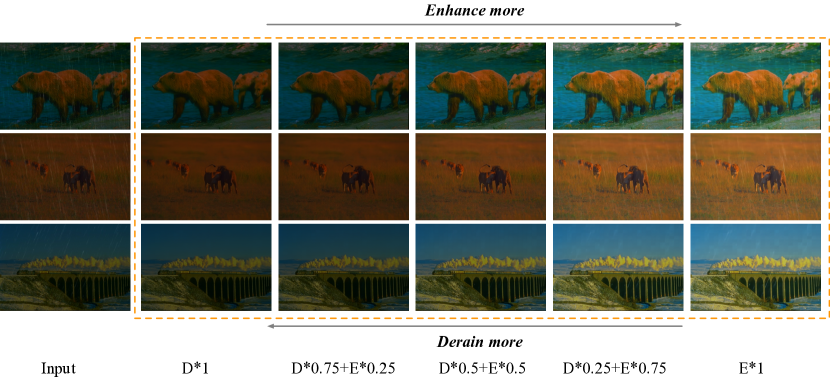
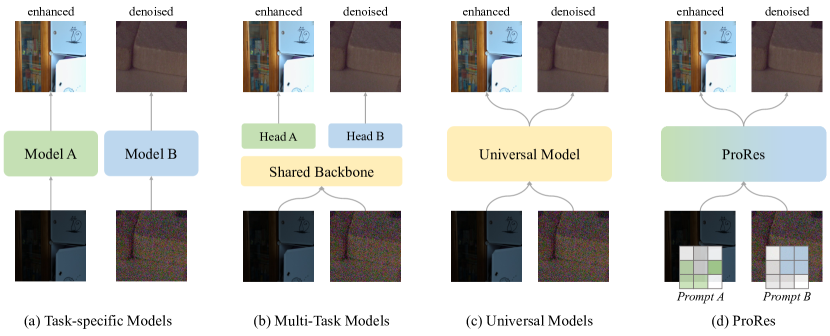
Image restoration aims to reconstruct degraded images, e.g., denoising or deblurring. Existing works focus on designing task-specific methods and there are inadequate attempts at universal methods. However, simply unifying multiple tasks into one universal architecture suffers from uncontrollable and undesired predictions. To address those issues, we explore prompt learning in universal architectures for image restoration tasks. In this paper, we present Degradation-aware Visual Prompts, which encode various types of image degradation, e.g., noise and blur, into unified visual prompts. These degradation-aware prompts provide control over image processing and allow weighted combinations for customized image restoration. We then leverage degradation-aware visual prompts to establish a controllable and universal model for image restoration, called ProRes, which is applicable to an extensive range of image restoration tasks. ProRes leverages the vanilla Vision Transformer (ViT) without any task-specific designs. Furthermore, the pre-trained ProRes can easily adapt to new tasks through efficient prompt tuning with only a few images. Without bells and whistles, ProRes achieves competitive performance compared to task-specific methods and experiments can demonstrate its ability for controllable restoration and adaptation for new tasks. The code and models will be released in \url{https://github.com/leonmakise/ProRes}.
研究の動機と目的
- 多様な劣化に対応し、タスク特化のアーキテクチャを用いずに普遍的な画像復元を推進する。
- 異なる劣化を画像に類似したプロンプトとして符号化する劣化対応視覚的プロンプトを提案する。
- プロンプレスを、プロンプトベースの制御を活用した簡易な ViT ベースの普遍的復元フレームワークとして構築する。
- 新しいタスク/データセットへ ProRes を適応させる効率的な方法としてプロンプト調整を示す。
提案手法
- 特定の劣化を符号化するため、入力画像と同じ高さ/幅を持つ劣化対応視覚的プロンプトを定義する。
- 劣化プロンプトを1つだけ劣化画像に追加し、素の ViT エンコーダと単純なピクセルデコーダで処理する。
- 最適化を安定化させるため、事前学習済み復元モデルの他の部分を固定しつつプロンプトを学習する。
- 完全なモデル微調整を行わずに ProRes を新しいタスク/データセットへ適応させる、軽量なプロンプト調整プロトコルを用いる。
- 異なるプロンプト初期化戦略と訓練損失を検討し、安定性と性能のために事前学習済みプロンプトと Smooth-L1 損失を選択する。
実験結果
リサーチクエスチョン
- RQ1劣化を考慮した視覚的プロンプトは、複数のタスクに跨る制御可能で普遍的な復元能力を提供できるか?
- RQ2ノイズ除去、雨除去、強化、ブラー除去において、ProRes はタスク特化モデルおよび素の普遍モデルとどう比較されるか?
- RQ3プロンプト調整は、モデル全体を再学習せずに ProRes を新しい劣化タスクやデータセットへ効率的に適応させることができるか?
- RQ4プロンプトの初期化の影響と、ネットワークのどこにプロンプトを統合すべきか?
主な発見
- ProRes は、単純な ViT ベースのアーキテクチャを用い、いくつかのベンチマークでタスク特化法と競合する性能を達成する。
- 劣化対応プロンプトは、複雑な劣化に対してプロンプトを重み付け・組み合わせることで制御可能な復元を提供する。
- プロンプト調整は、新しいタスク/データセット(例: 低照度には FiveK、除霧には RESIDE-6K のような)への効果的な転移を、完全なモデル微調整なしに可能にする。
- 事前学習済みプロンプトを分離最適化で用いると、トレーニングが安定し、タスクを跨いで良好な結果が得られる。
- このアプローチは視覚化ベースの制御と転送性を実証し、プロンプトを用いたより大規模な普遍的復元の可能性を示唆する。
この論文を読む
Nubintのビューアで原文を開き、読みながら気になる箇所をすぐに質問できます。
Nubintでこの論文を読むこのレビューはAIが論文の原文をもとに作成しました。引用する前に原文をご確認ください。