
[論文レビュー] Prototype Global Analysis of LISA Data with Multiple Source Types
本論文では、LISAデータの最初のグローバル解析パイプラインであるGLASSを提示する。GLASSは、ブロック化メトロポリス・ハスティングス法を用いて、超密な連星(UCBs)、検証用連星(VGBs)、質量ブラックホール合体(MBHBs)、および機器ノイズを同時にフィットする。この手法は、LISA Data Challenge 2a-v2のシミュレートされたLISAデータにおいて、ソース集団とノイズモデルを成功裏に再構築し、将来のLISA運用に向けたモジュラーでスケーラブルなグローバルフィッティングフレームワークの実現可能性を示している。
The novel data analysis challenges posed by the Laser Interferometer Space Antenna (LISA) arise from the overwhelmingly large number of astrophysical sources in the measurement band and the density with which they are found in the data. Robust detection and characterization of the numerous gravitational wave sources in LISA data can not be done sequentially, but rather through a simultaneous global fit of a data model containing the full suite of astrophysical and instrumental features present in the data. While previous analyses have focused on individual source types in isolation, here we present the first demonstration of a LISA global fit analysis containing combined astrophysical populations. The prototype pipeline uses a blocked Metropolis Hastings algorithm to alternatingly fit to a population of ultra compact galactic binaries, known ``verification binaries'' already identified by electromagnetic observations, a population of massive black hole mergers, and an instrument noise model. The Global LISA Analysis Software Suite (GLASS) is assembled from independently developed samplers for the different model components. The modular design enables flexibility to future development by defining standard interfaces for adding new, or updating additional, components to the global fit without being overly prescriptive for how those modules must be internally designed. The GLASS pipeline is demonstrated on data simulated for the LISA Data Challenge 2b. Results of the analysis and a road-map for continued development are described in detail.
研究の動機と目的
- LISAデータに多数の重複する重力波源と複雑なノイズが存在する中での解析の課題に対処すること。
- 複数のソースタイプと機器効果を同時にフィットできるスケーラブルでモジュラーなフレームワークを開発すること。
- LISA Data Challenge 2a-v2の現実的なシミュレートLISAデータを用いて、グローバルフィットアプローチの実現可能性を示すこと。
- 将来のLISAデータ解析における高度なノイズモデル、グルーチャル現象、自己キャリブレーション技術の統合の基盤を築くこと。
提案手法
- GLASSは、4つのモデルコンポonent(UCBs、VGBs、MBHBs、および現象論的ノイズモデル)のパラメータを同時にサンプリングするため、ブロック化メトロポリス・ハスティングス法を用いる。
- 各ソースタイプは解析的波形でモデル化される:UCBsとVGBsは時域テンプレートで、MBHBsはポストニュートニアン波形で。
- ノイズモデルは、機器ノイズと解釈不能な銀河連星の前景を含み、確率的信号として扱う。
- パイプラインはモジュラー設計であり、各コンポonentに独立したサンプラーを設け、標準化されたインターフェースを介して通信することで拡張性を実現する。
- データは時間ストライド単位で逐次処理され、リアルタイムミッション運用を模擬することで、計算スケーラビリティを向上させる。
- ウェーブレットドメインでの解析が採用され、フーリエベースの手法に比べてデータギャップの処理とスペクトル漏れの低減が自然に行われる。
実験結果
リサーチクエスチョン
- RQ1グローバルフィッティングフレームワークは、LISAデータにおいて複数の重力波ソースタイプを同時にかつ頑健にモデル化できるか?
- RQ2モジュラーでブロック化されたメトロポリス・ハスティングス法は、信号の混乱状態下でもソースパラメータとノイズレベルをどれほど正確に回復できるか?
- RQ3GLASSパイプラインは、LISA Data Challenge 2a-v2のシミュレートデータからUCB、VGB、MBHB集団をどれほど正確に再構築できるか?
- RQ4ウェーブレットドメイン手法は、フーリエベースの手法に比べて、データギャップと非定常ノイズをどのように処理するか?
- RQ5グローバルフィットを全LISAミッションデータにスケーリングするにあたり、主な課題と今後の拡張は何か?
主な発見
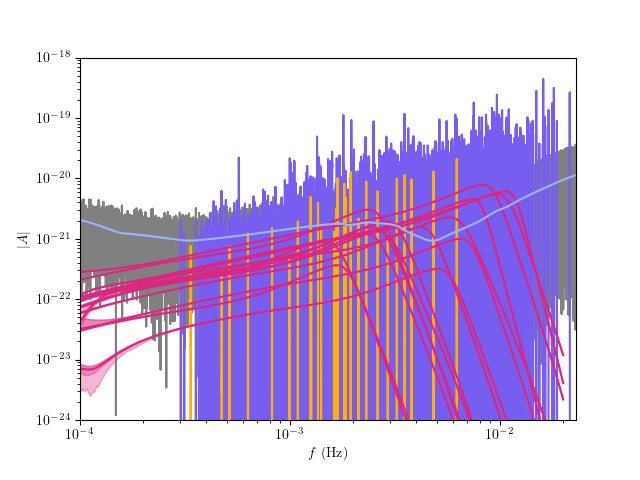
- GLASSパイプラインは、AチャネルTDIデータの振幅スペクトル密度を成功裏に再構築し、UCB波形の事後分布が注入された信号と密接に一致した。
- 35個の検証用連星(VGBs)のパラメータは高い忠実度で回復され、グローバルフィッティングアプローチの頑健性が確認された。
- 解釈不能な銀河連星の前景は確率的成分として効果的にモデル化されたが、今後の研究ではソース分布に関する物理的事前分布を用いて改善される予定である。
- モジュラー設計により、グルーチャルモデルや自己キャリブレーションモジュールなどの新しいコンポーネントを、コアフレームワークの再設計なしにスムーズに統合できる。
- ウェーブレットドメイン手法は、従来のフーリエ手法に比べてデータギャップの処理が優れており、追加のデータ調整なしにスペクトル漏れを低減した。
- パイプラインはすでにTDI Tチャネルと時間変動するノイズモデルの統合に向けて拡張されており、今後は物理的機器モデルと位相安定化効果の統合を計画している。
この論文を読む
Nubintのビューアで原文を開き、読みながら気になる箇所をすぐに質問できます。
Nubintでこの論文を読むこのレビューはAIが論文の原文をもとに作成しました。引用する前に原文をご確認ください。