
[論文レビュー] Proximal Policy Gradient Arborescence for Quality Diversity Reinforcement Learning
この論文は、初めてオンポリシーPPOと微分可能質的多様性(DQD)を統合した、質的多様性強化学習(RL)アルゴリズムであるProximal Policy Gradient Arborescence(PPGA)を紹介する。これにより、困難な歩行タスクにおいて多様で高パフォーマンスなポリシーの効率的発見が可能になった。PPGAはHumanoid環境においてベースライン比4倍の最高報酬を達成しながら、標準PPOの性能を維持し、強い行動的多様性を保っている。
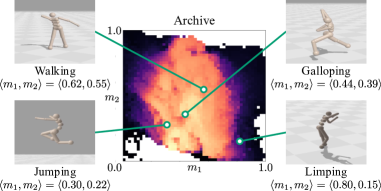
Training generally capable agents that thoroughly explore their environment and learn new and diverse skills is a long-term goal of robot learning. Quality Diversity Reinforcement Learning (QD-RL) is an emerging research area that blends the best aspects of both fields -- Quality Diversity (QD) provides a principled form of exploration and produces collections of behaviorally diverse agents, while Reinforcement Learning (RL) provides a powerful performance improvement operator enabling generalization across tasks and dynamic environments. Existing QD-RL approaches have been constrained to sample efficient, deterministic off-policy RL algorithms and/or evolution strategies, and struggle with highly stochastic environments. In this work, we, for the first time, adapt on-policy RL, specifically Proximal Policy Optimization (PPO), to the Differentiable Quality Diversity (DQD) framework and propose additional improvements over prior work that enable efficient optimization and discovery of novel skills on challenging locomotion tasks. Our new algorithm, Proximal Policy Gradient Arborescence (PPGA), achieves state-of-the-art results, including a 4x improvement in best reward over baselines on the challenging humanoid domain.
研究の動機と目的
- 高次元で動的な制御タスクにおける標準強化学習と質的多様性RLの間のパフォーマンス格差を埋める。
- 従来はオフポリシーまたは進化的メソッドを好んでいたDQDフレームワーク内で、PPOのようなオンポリシーRLアルゴリズムを効果的に活用することを可能にする。
- RLに適合する方法で非マルコフ的行動的多様性指標を最適化する課題に対処する。
- xNESのような現代的な自然推進戦略(NES)を統合することで、DQDにおける訓練の安定性と探索効率を向上させる。
- 複数のタスクにわたるパフォーマンスと多様性勾配を同時に最適化するスケーラブルでベクトル化されたPPO実装を開発する。
提案手法
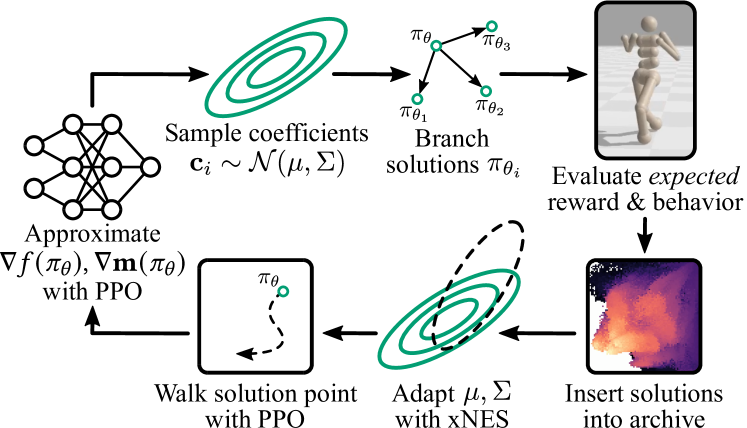
- 1回の順方向伝搬で目的関数と指標の両方の勾配を計算するベクトル化PPO(VPPO)実装を提案し、計算オーバーヘッドを低減する。
- CMAに基づくDQDアルゴリズムを自然推進戦略(NES)の一種として再定式化し、xNESのような高度なNES手法を用いて安定性と収束性を向上させる。
- 非マルコフ的行動的多様性指標を微分可能でRLに適合する形に変換するためのマルコフ的指標プロキシ(MMPs)を導入する。
- オンラインPPO勾配を用いて現在の探索ポリシーを行動空間内で「歩行」するイテレーティブな戦略を採用し、未探索領域への標的的探索を可能にする。
- PPOポリシー更新とxNESに基づく共変行列適応を組み合わせたハイブリッド最適化ループを採用し、高品質で多様な行動への探索を導く。
- オンラインデータと勾配情報を活用する新しい探索ポリシー更新メカニズムを導入し、パフォーマンスと多様性を統合的最適化プロセスでバランスさせる。
実験結果
リサーチクエスチョン
- RQ1オンポリシー強化学習、特にPPOは、微分可能質的多様性(DQD)フレームワークに効果的に統合可能か? これによりポリシーのパフォーマンスと多様性が向上するか?
- RQ2QD-RLで一般的な非マルコフ的行動的多様性指標は、勾配ベースのRL最適化に適合させられるか?
- RQ3PPOとDQDの相乗効果は、オフポリシーQD-RLベースラインと比較して、より優れたサンプル効率、パフォーマンス、頑健性をもたらすか?
- RQ4xNESのような現代的なNES手法は、従来のCMA-MAEGAに比べ、DQDベースのQD-RLにおける訓練の安定性と収束性を向上させるか?
- RQ5PPGAは、困難な歩行タスクにおいて標準PPOのパフォーマンスを維持または上回りながら、多様性をどの程度保持できるか?
主な発見
- PPGAは、挑戦的なHumanoid歩行タスクにおいて、ベースライン比4倍の最高報酬を達成し、新たなSOTAを樹立した。
- PPGAはHumanoidでQDスコア1.02×10⁵と52%のカバレッジを維持し、両方の多様性とパフォーマンスにおいてすべてのベースラインを上回った。
- 確率的環境での事後再評価において、PPGAは最高の補正済みQDスコアと報酬を維持し、環境ノイズに対する頑健性を示した。
- 補正済みCCDFプロットから、PPGAはベースラインと比較してより望ましいポリシー分布を生成しており、Antを除くすべてのタスクで優れたパフォーマンスを示した。
- PPGAにおけるxNESの使用により、特に高次元空間において、従来のCMA-MAEGAベース手法と比較してより安定した訓練と良好な収束が達成された。
- サンプル複雑性がやや高いものの、PPGAはすべてのドメインで標準PPOのパフォーマンスを達成しながら行動的多様性を保持しており、オンポリシーRLとDQDの有効な統合を示した。
この論文を読む
Nubintのビューアで原文を開き、読みながら気になる箇所をすぐに質問できます。
Nubintでこの論文を読むこのレビューはAIが論文の原文をもとに作成しました。引用する前に原文をご確認ください。