
[論文レビュー] PySAGES: flexible, advanced sampling methods accelerated with GPUs
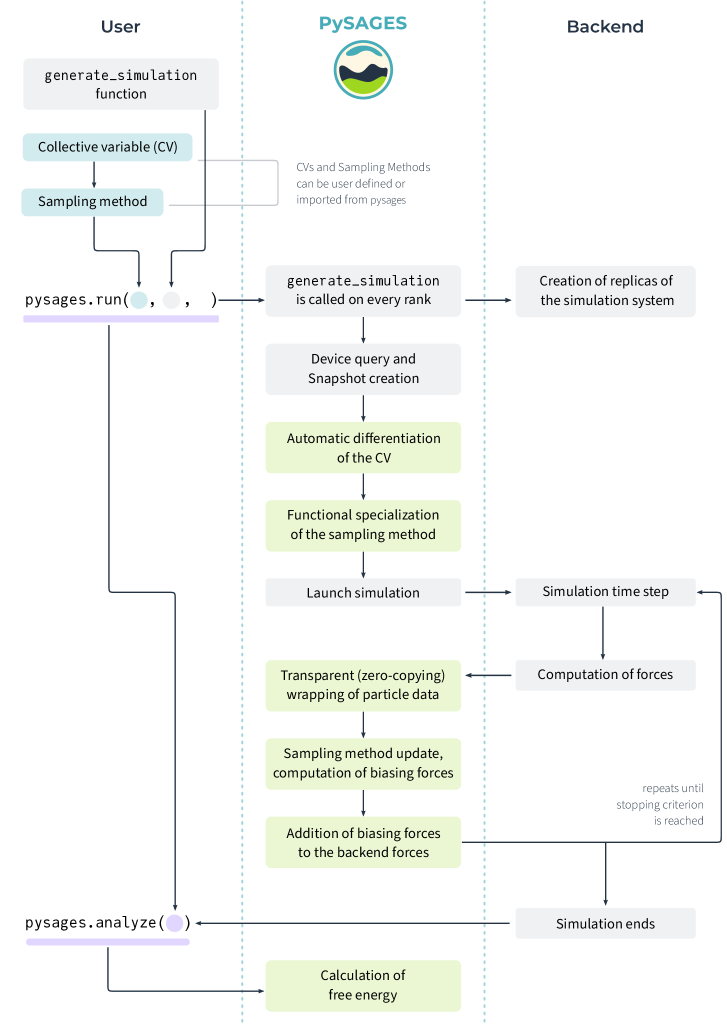
PySAGES は、GPUアクセラレーションを備えた Python ベースのソフトウェアライブラリであり、分子動力学シミュレーションにおける高度なサンプリング手法——例えば、適応的バイアス力、メタダイナミクス、フォワードフラックスサンプリング——を可能にします。集団変数と自由エネルギー計算の定義に柔軟で使いやすいインターフェースを提供し、OpenMM や hoomd-blue などの MD バックエンドとのシームレスな統合により、ネイティブな GPU アクセラレーションによって高いパフォーマンスを実現します。
Molecular simulations are an important tool for research in physics, chemistry, and biology. The capabilities of simulations can be greatly expanded by providing access to advanced sampling methods and techniques that permit calculation of the relevant underlying free energy landscapes. In this sense, software that can be seamlessly adapted to a broad range of complex systems is essential. Building on past efforts to provide open-source community supported software for advanced sampling, we introduce PySAGES, a Python implementation of the Software Suite for Advanced General Ensemble Simulations (SSAGES) that provides full GPU support for massively parallel applications of enhanced sampling methods such as adaptive biasing forces, harmonic bias, or forward flux sampling in the context of molecular dynamics simulations. By providing an intuitive interface that facilitates the management of a system's configuration, the inclusion of new collective variables, and the implementation of sophisticated free energy-based sampling methods, the PySAGES library serves as a general platform for the development and implementation of emerging simulation techniques. The capabilities, core features, and computational performance of this new tool are demonstrated with clear and concise examples pertaining to different classes of molecular systems. We anticipate that PySAGES will provide the scientific community with a robust and easily accessible platform to accelerate simulations, improve sampling, and enable facile estimation of free energies for a wide range of materials and processes.
研究の動機と目的
- 分子シミュレーションにおける高度なサンプリングのための柔軟でオープンソースのソフトウェアフレームワークの開発。
- 強化サンプリング手法の GPU アクセラレーテッド実装を用いた自由エネルギー計算の高速化。
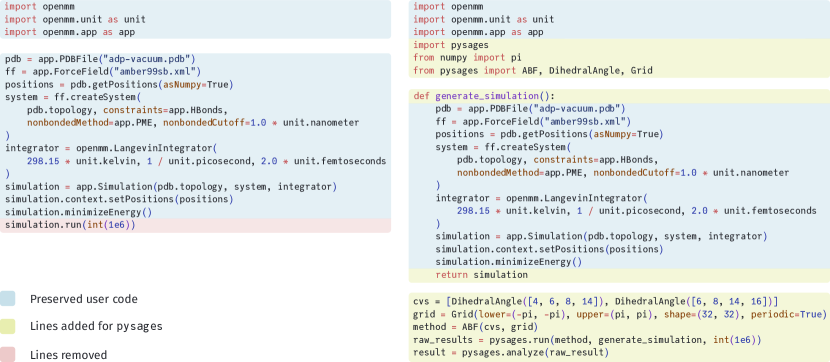
- 集団変数の定義と既存の MD バックエンドへの統合を容易にする直感的な Python インターフェースの提供。
- バイオ分子やソフトマテリアルを含む多様な複雑系への対応。
- さまざまな分子系において、自由エネルギー・ランドスケープの正確で効率的な推定を可能にすること。
提案手法
- CUDA および cuDNN を介した完全な GPU サポートを備えた、SSAGES フレームワークに基づくモジュラー Python ライブラリの実装。
- 適応的バイアス力(ABF)、ウェル・テンパードメタダイナミクス(WTMD)、フォワードフラックスサンプリング(FFS)を含む高度なサンプリング手法の統合。
- 距離-界面の集団変数(CV)をガウス重み付き投影を用いて実装する柔軟なインターフェースを通じたユーザー定義 CV の有効化。
- OpenMM や hoomd-blue などの高性能 MD バックエンドを活用し、GPU アクセラレーテッドの動的シミュレーションを実現。
- ニューラルネットワークベースのバイアス(ANN、FUNN)およびスペクトル ABF を用いて、収束性とサンプリング効率の向上。
- シミュレーションワークフローの簡単なセットアップと再現可能性を実現する JSON ベースの設定システムの提供。
実験結果
リサーチクエスチョン
- RQ1高水準言語である Python で高度なサンプリング手法を効率的かつ柔軟に実装しつつ、GPU パフォーマンスを維持できるか。
- RQ2GPU アクセラレーションが、複雑系における自由エネルギー計算の収束性と計算効率にどの程度寄与するか。
- RQ3統一されたソフトウェアフレームワークが、異なる MD バックエンドとシステムタイプにわたり多様なサンプリング技術を効果的にサポートできるか。
- RQ4PySAGES で実装された手法が、基準シミュレーションと比較して、既知の自由エネルギー・ランドスケープをどの程度正確に再現できるか。
- RQ5異なる集団変数の定義とバイアス戦略が、サンプリング効率と収束性に及ぼす影響は何か。
主な発見
- PySAGES は、GPU アクセラレーションを活用することで、ABF や WTMD、FFS などの高度なサンプリング手法の効率的実行を実現し、高いパフォーマンスを達成しています。
- アラニンジペプチドとブタンのベンチマーク自由エネルギー・ランドスケープが、長時間の ABF シミュレーションを基準として高精度に再現されています。
- 特に複雑なエネルギー障壁を持つ系では、CPU に基づく手法と比較して、はるかに短いシミュレーション時間で自由エネルギーの収束が達成されています。
- ガウス重み付き投影を用いた界面系向けの距離-界面の集団変数の実装により、ロバストで微分可能な CV が実現されています。
- ニューラルネットワークベースのバイアス(ANN、FUNN)およびスペクトル ABF は、テスト系において従来手法と比較して収束性が向上し、サンプリング時間が短縮されています。
- 主な MD エンジン(OpenMM、hoomd-blue)と相互運用可能であり、バイオ分子系やソフトマテリアル系への広範な応用が可能になっています。
この論文を読む
Nubintのビューアで原文を開き、読みながら気になる箇所をすぐに質問できます。
Nubintでこの論文を読むこのレビューはAIが論文の原文をもとに作成しました。引用する前に原文をご確認ください。