
[論文レビュー] Quantum-Noise-Driven Generative Diffusion Models
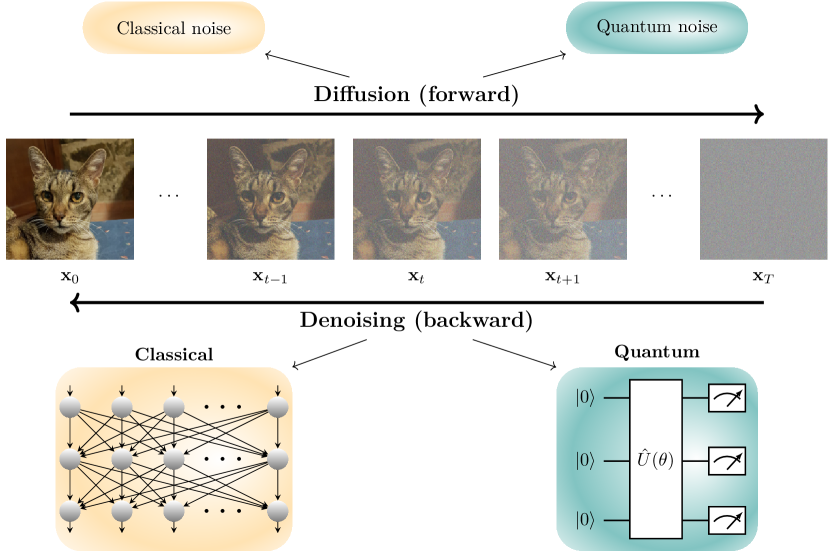
本稿では、量子ノイズ、コherence、もつれを誤差ではなく計算的利点として活用する3つの量子ノイズ駆動型生成拡散モデル(CQGDM、QCGDM、QQGDM)を提案する。古典的拡散またはノイズ除去を量子確率的ダイナミクスに置き換えることで、複雑な確率分布のより効率的なサンプリングが可能となり、数値シミュレーションではパラメータ化された量子回路を用いた1次元データセットにおけるハイブリッド古典量子モデルの成功した学習が示された。
Generative models realized with machine learning techniques are powerful tools to infer complex and unknown data distributions from a finite number of training samples in order to produce new synthetic data. Diffusion models are an emerging framework that have recently overcome the performance of the generative adversarial networks in creating synthetic text and high-quality images. Here, we propose and discuss the quantum generalization of diffusion models, i.e., three quantum-noise-driven generative diffusion models that could be experimentally tested on real quantum systems. The idea is to harness unique quantum features, in particular the non-trivial interplay among coherence, entanglement and noise that the currently available noisy quantum processors do unavoidably suffer from, in order to overcome the main computational burdens of classical diffusion models during inference. Hence, we suggest to exploit quantum noise not as an issue to be detected and solved but instead as a very remarkably beneficial key ingredient to generate much more complex probability distributions that would be difficult or even impossible to express classically, and from which a quantum processor might sample more efficiently than a classical one. An example of numerical simulations for an hybrid classical-quantum generative diffusion model is also included. Therefore, our results are expected to pave the way for new quantum-inspired or quantum-based generative diffusion algorithms addressing more powerfully classical tasks as data generation/prediction with widespread real-world applications ranging from climate forecasting to neuroscience, from traffic flow analysis to financial forecasting.
研究の動機と目的
- 生成的モデリングにおける量子ノイズを障害要因ではなく計算リソースとして活用することを検討すること。
- もつれやコherenceといった量子特徴を活用する古典拡散モデルの量子一般化を開発すること。
- 古典的ダイナミクスを量子確率的過程に置き換えることで、複雑な確率分布のより効率的なサンプリングを可能にすること。
- 数値シミュレーションを通じてハイブリッド古典量子拡散モデルの実現可能性を示すこと。
- 気象予測、神経科学、金融モデリングなどの分野における量子強化型生成的モデリングの新たな道筋を開くこと。
提案手法
- 3つの変種を提案:古典的拡散に量子ノイズ除去を適用する(CQGDM)、量子的拡散に古典的ノイズ除去を適用する(QCGDM)、完全に量子的拡散とノイズ除去を組み合わせる(QQGDM)。
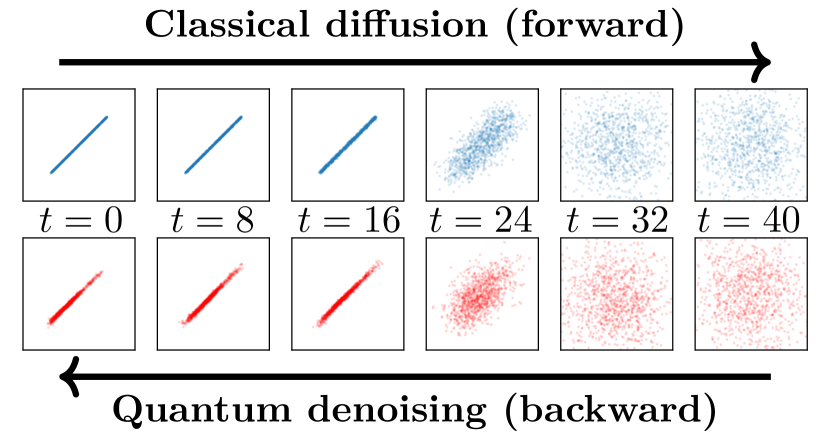
- データを時間T=40で等方的ガウス分布にマッピングするため、ガウス移動核を用いた古典的マルコフ連鎖を前向き拡散プロセスとして実装する。
- 平均と対角行列の共分散を推定するために、角度埋め込みとエンタングルメントCNOTゲートを備えたパラメータ化された量子回路(PQC)をノイズ除去プロセスのモデルとして採用する。
- 2段階の量子回路構造を設計:『ヘッド』は特徴エンコーディングに、『テイル』は時間依存パrameter化に使用し、それぞれ共有パラメータと固有パラメータを採用する。
- 40,000エポックにわたり、バッチサイズ1,000で、Adam最適化法を用いた確率的勾配降下法によりPQCを学習し、Kullback-Leibler損失を最小化する。
- シミュレーションにはPennylaneとPyTorchを用い、期待値σzを測定することで平均と分散の予測値を抽出する。
実験結果
リサーチクエスチョン
- RQ1量子ノイズは、誤差の原因ではなく、生成的モデリングにおける有益なリソースとして活用可能か?
- RQ2量子確率的ダイナミクスは、古典的拡散モデルと比較して、複雑な確率分布のサンプリング効率をどのように向上させるか?
- RQ3ハイブリッド古典量子拡散モデルの合成データ生成における性能特性は何か?
- RQ4パラメータ化された量子回路は、拡散フレームワークにおける逆ノイズ除去プロセスを効果的に近似可能か?
- RQ5もつれやコherenceといった量子特徴は、生成的モデルの表現力向上にどのような役割を果たすか?
主な発見
- ハイブリッド古典量子生成拡散モデル(CQGDM)は、1次元線分分布からのデータノイズ除去を、目的のガウス分布に成功して行うことができた。
- 学習率10−4でAdam最適化法を用い、40,000エポックにわたり、予測分布と目的分布間のKullback-Leibler損失を最小化して学習が行われた。
- 4キュービットの回路と256層のパラメトリック回転とCNOTゲートを備えたPQCアーキテクチャにより、平均と分散パラメータの効果的な推定が可能になった。
- 回路のヘッドは時間ステップ間でパラメータを共有し、テイルは時間別パラメータを用いることで、ノイズ除去シーケンス全体での一般化性能が向上した。
- モデル出力を平均予測値に3倍のスケーリング、分散に1の加算を施すことで、正の値を保証するとともに生成サンプルの範囲を拡大した。
- 数値結果により、複雑な分布に対して古典モデルよりも効率的にデノイジングステップを実装するための量子プロセッサの利用可能性が示された。
より良い研究を、今すぐ始めましょう
論文の読解から最終レビューまで、研究時間を劇的に削減しましょう。
クレジットカード登録不要
このレビューはAIが作成し、人間の編集者が確認しました。