
[論文レビュー] Random unitaries in extremely low depth
この論文は、特定の近似的ユニタリ $k$-デザインおよび擬似ランダムユニタリ(PRUs)が、極めて浅い回路深さで構築可能であることを示している:設計では $\log n$、PRUs では $\text{poly}\log n$ または $\text{poly}\log\log n$ であり、幾何構造にかかわらず、1次元を含むすべての構造で成立する。構成法は $\log n$ または $\text{poly}\log n$ サイズの局所的ランダムユニタリを用い、最適な $n$ スケーリングを達成し、指数的深さのハールランダム回路の効率的で低深さの代替手段を可能にする。
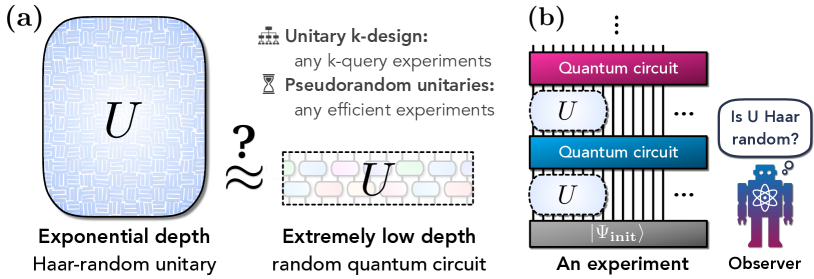
We prove that random quantum circuits on any geometry, including a 1D line, can form approximate unitary designs over $n$ qubits in $\log n$ depth. In a similar manner, we construct pseudorandom unitaries (PRUs) in 1D circuits in $ ext{poly}(\log n)$ depth, and in all-to-all-connected circuits in $ ext{poly}(\log \log n)$ depth. In all three cases, the $n$ dependence is optimal and improves exponentially over known results. These shallow quantum circuits have low complexity and create only short-range entanglement, yet are indistinguishable from unitaries with exponential complexity. Our construction glues local random unitaries on $\log n$-sized or $ ext{poly}(\log n)$-sized patches of qubits to form a global random unitary on all $n$ qubits. In the case of designs, the local unitaries are drawn from existing constructions of approximate unitary $k$-designs, and hence also inherit an optimal scaling in $k$. In the case of PRUs, the local unitaries are drawn from existing PRU constructions. Applications of our results include proving that classical shadows with 1D log-depth Clifford circuits are as powerful as those with deep circuits, demonstrating superpolynomial quantum advantage in learning low-complexity physical systems, and establishing quantum hardness for recognizing phases of matter with topological order.
研究の動機と目的
- 従来の構成法よりも指数的に低い深さで、近似的ユニタリ $k$-デザインおよび擬似ランダムユニタリ(PRUs)を構築すること。
- 1次元やすべてのノードが接続されたネットワークを含む、あらゆる幾何構造において、ランダムユニタリ生成の最適な $n$ スケーリングを達成すること。
- 短距離もつれを有する浅い回路が、指数的に複雑なハールランダムユニタリの統計的性質を模倣できることを示すこと。
- 古典的シャドウ、量子優位性プロトコル、トポロジカル位相の認識のリソース要件を低減することで、量子情報分野における実用的応用を可能にすること。
提案手法
- 小規模な $\log n$ または $\text{poly}\log n$ 量子ビットのパッチに局所的ランダムユニタリをタイル状に配置することで、グローバルなランダムユニタリを構築する。
- 既存の近似的ユニタリ $k$-デザインを $\log n$ サイズのパッチに適用し、$\tilde{\mathcal{O}}(k)\cdot\log(n/\varepsilon)$ の深さでグローバルな $\varepsilon$-近似的 $k$-デザインを構築する。
- $\text{poly}\log n$ サイズのパッチに、仮定された擬似ランダムユニタリアンサンブル(例:$PFC$)を用い、任意の幾何構造で $\text{poly}\log n$ 深さのPRUsを構築する。
- 同じパッチベースの接合アプローチを用いて、すべてのノードが接続されたネットワークでは $\text{poly}\log\log n$ 深さのPRUsを実現する。
- 近似忠実度が同じであるような、より浅い構成が不可能であることを示すことにより、深さにおける最適な $n$ 依存性を証明する。
- 集中不等式およびモーメント計算(例:チェビシェフの不等式)を用い、出力分布が一様分布およびハール測度からどれほど逸脱するかを評価する。
実験結果
リサーチクエスチョン
- RQ11次元を含む任意の量子回路幾何構造において、近似的ユニタリ $k$-デザインを $\log n$ 深さで構築できるか?
- RQ2任意の幾何構造において、擬似ランダムユニタリ(PRUs)を $\text{poly}\log n$ 深さで実装できるか? また、すべてのノードが接続されたネットワークでは $\text{poly}\log\log n$ 深さで可能か?
- RQ3これらの構成における深さの $n$ 依存性は最適であり、$\log n$ よりも改善可能か?
- RQ4短距離もつれのみを有する浅い回路が、指数的に複雑なハールランダムユニタリの統計的性質を模倣できるか?
- RQ5このような浅い構成が、物理的系の学習における量子優位性およびトポロジカル位相の認識に及ぼす影響は何か?
主な発見
- 近似的ユニタリ $k$-デザインは、任意の幾何構造で $\tilde{\mathcal{O}}(k)\cdot\log(n/\varepsilon)$ 深さで構築可能であり、最適な $n$ スケーリングを達成する。
- 擬似ランダムユニタリ(PRUs)は、任意の接続された有界次数の幾何構造で $\text{poly}\log n$ 深さで構築可能であり、すべてのノードが接続された回路では $\text{poly}\log\log n$ 深さで実現可能である。
- 設計およびPRUsの両方において、深さにおける $n$ 依存性が最適であり、従来の多項式深さを要する構成法よりも指数的に改善されている。
- 構築されたアンサンブルの出力分布は、高確率で一様分布から大きく離れていることが確認され、それらが自明な分布に崩壊しないことを裏付けた。
- この手法により、対数深さのクリフォード回路を用いた古典的シャドウが、線形深さの回路と同等の忠実度保証を達成可能となり、実験的負荷を大幅に低減できる。
- この構成により、生成されたユニタリの擬似ランダム性に起因し、量子状態におけるトポロジカル位相の認識が、任意の量子実験において超多項式的に困難であることが示された。

この論文を読む
Nubintのビューアで原文を開き、読みながら気になる箇所をすぐに質問できます。
Nubintでこの論文を読むこのレビューはAIが論文の原文をもとに作成しました。引用する前に原文をご確認ください。