
[論文レビュー] Re-ReST: Reflection-Reinforced Self-Training for Language Agents
本稿では、外部フィードバック(例:単体テストの結果など)を用いて低品質な出力を補正するためのリフレクションモデルを活用することで、言語エージェントの自己学習を強化する、Reflection-Reinforced Self-Training(Re-ReST)を提案する。修正されたサンプルが再び自己学習に用いられることで、推論のオーバーヘッドが一切ないまま、複数のタスクで一貫した性能向上が達成される。
Finetuning language agents with reasoning-action trajectories is effective, but obtaining these trajectories from human annotations or stronger models is costly and sometimes impractical. In this paper, we investigate the use of self-training in language agents, which can generate supervision from the agent itself, offering a promising alternative without relying on human or stronger model demonstrations. Self-training, however, requires high-quality model-generated samples, which are hard to obtain for challenging language agent tasks. To address this, we present Reflection-Reinforced Self-Training (Re-ReST), which uses a extit{reflector} to refine low-quality generated samples during self-training. The reflector takes the agent's output and feedback from an external environment (e.g., unit test results in code generation) to produce improved samples. This technique enhances the quality of inferior samples and efficiently enriches the self-training dataset with higher-quality samples. We conduct extensive experiments on open-source language agents across tasks, including multi-hop question answering, sequential decision-making, code generation, visual question answering, and text-to-image generation. The results demonstrate the effectiveness of self-training and Re-ReST in language agent tasks, with self-training improving baselines by 7.6\% on HotpotQA and 28.4\% on AlfWorld, and Re-ReST further boosting performance by 2.0\% and 14.1\%, respectively. Our studies also confirm the efficiency of using a reflector to generate high-quality samples for self-training. Moreover, we demonstrate a method to employ reflection during inference without ground-truth feedback, addressing the limitation of previous reflection work. Our code is released at https://github.com/PlusLabNLP/Re-ReST.
研究の動機と目的
- 複雑なタスクにおいて高品質なサンプルを取得するための自己学習の非効率性を解消すること。
- 低品質なサンプルを破棄するという制限を克服し、リフレクションによる修正を可能にすること。
- 推論時に信頼性の低い自己判断に依存するのを避けるために、訓練時に外部フィードバック(例:テスト結果)を活用し、正確な補正を誘導すること。
- リフレクションに基づくデータ拡張後に、エージェントが直接正しい出力を生成できるように訓練することで、推論時のコストをゼロに保つこと。
- 既存の自己一貫性デコード法との互換性を示し、多様な言語エージェントタスクにスケーラブルであることを実証すること。
提案手法
- モデルが出力した結果と外部フィードバック(例:実行結果、テスト結果)を入力として受けるリフレクションモデルを導入する。
- リフレクションモデルを用いて、誤りまたは低品質な出力の修正版、つまり高品質なバージョンを生成する。
- これらの精錬済みサンプルを自己学習データセットに追加し、ファインチューニング段階でのエージェント性能を向上させる。
- 元のサンプルとリフレクションによるサンプルの両方を含むデータセットを用いて、標準的な自己学習の目的関数に従ってエージェントを訓練する。
- リフレクションを推論から分離する:テスト時にはエージェントモデルのみが使用され、実行時のオーバーヘッドが発生しない。
- 自己一貫性デコードとの互換性を確保するため、リフレクタが複数の生成結果を処理し、改善されたバージョンを出力できるようにする。

実験結果
リサーチクエスチョン
- RQ1低品質なモデル出力に対するリフレクションベースの補正は、自己学習の効率性と性能を顕著に向上させることができるか?
- RQ2訓練時に外部フィードバック(例:単体テスト)を用いることで、自己判断のみに依存する方法よりも信頼性が高く、品質の高いサンプル精錬が可能になるか?
- RQ3リフレクション拡張自己学習は、コード生成やマルチホップQAを含む多様な言語エージェントタスクにどの程度一般化可能か?
- RQ4Re-ReSTは、アンサンブル自己学習や他の自己改善手法と比較して、サンプル品質と下流タスク性能の両面で優れているか?
- RQ5リフレクション機構は、自己一貫性などの既存の推論時デコード戦略と互換性があるか?
主な発見
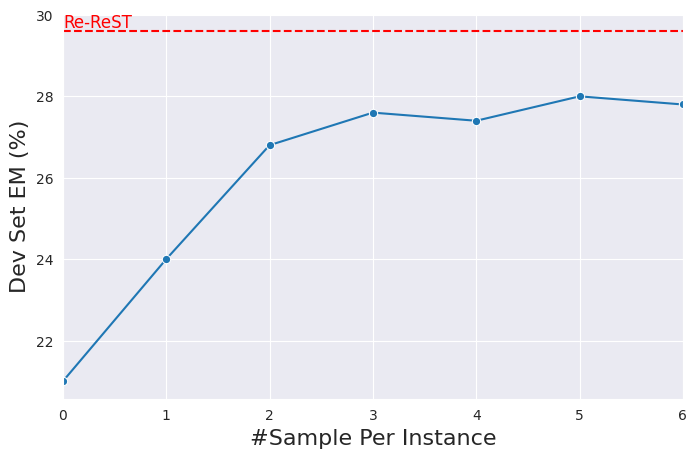
- Re-ReSTは、マルチホップQA、逐次的意思決定、コード生成、視覚的質問応答、テキストから画像生成に至る5つの多様なタスクにおいて、アンサンブル自己学習よりも一貫した性能向上を達成した。
- アブレーションスタディの結果、リフレクションモデルが自己学習サンプルの品質と有用性を顕著に向上させていることが確認され、単にモデルのサンプリングに依存する手法を上回った。
- 自己一貫性デコードとの互換性が確認されたため、変更を加えずに既存の強力な推論パイプラインに統合可能であることが示された。
- 訓練時に外部フィードバック(例:テスト結果)を活用することで、リフレクタは正確な補正を生成でき、自己判断のみに依存する手法で見られる性能低下を回避した。
- 最終的なエージェントモデルは、推論時にリフレクションを一切行わず、テスト時の計算オーバーヘッドがゼロであることを達成した。
- 本手法は強く一般化能力を示し、低ショットや複雑な推論シナリオにおいても改善が観察された。
この論文を読む
Nubintのビューアで原文を開き、読みながら気になる箇所をすぐに質問できます。
Nubintでこの論文を読むこのレビューはAIが論文の原文をもとに作成しました。引用する前に原文をご確認ください。