
[論文レビュー] Rethinking Attention-Based Multiple Instance Learning for Whole-Slide Pathological Image Classification: An Instance Attribute Viewpoint
本稿では、全スライド画像(WSI)分類のための新しい複数インスタンス学習フレームワーク、Attribute-Driven MIL(AttriMIL)を提案する。この手法は、信頼性の低い注意スコアの代わりに学習可能な属性スコアメカニズムを導入し、インスタンスの寄与度をより正確に定量化する。空間的および順序制約を導入することで、インスタンス間の内・外スライド相関をモデル化し、組織の識別性と腫瘍の局在化性能を向上させる。3つの公的ベンチマークで最先端の手法を上回り、解釈可能性とOOD検出能力が向上している。
Multiple instance learning (MIL) is a robust paradigm for whole-slide pathological image (WSI) analysis, processing gigapixel-resolution images with slide-level labels. As pioneering efforts, attention-based MIL (ABMIL) and its variants are increasingly becoming popular due to the characteristics of simultaneously handling clinical diagnosis and tumor localization. However, the attention mechanism exhibits limitations in discriminating between instances, which often misclassifies tissues and potentially impairs MIL performance. This paper proposes an Attribute-Driven MIL (AttriMIL) framework to address these issues. Concretely, we dissect the calculation process of ABMIL and present an attribute scoring mechanism that measures the contribution of each instance to bag prediction effectively, quantifying instance attributes. Based on attribute quantification, we develop a spatial attribute constraint and an attribute ranking constraint to model instance correlations within and across slides, respectively. These constraints encourage the network to capture the spatial correlation and semantic similarity of instances, improving the ability of AttriMIL to distinguish tissue types and identify challenging instances. Additionally, AttriMIL employs a histopathology adaptive backbone that maximizes the pre-trained model's feature extraction capability for collecting pathological features. Extensive experiments on three public benchmarks demonstrate that our AttriMIL outperforms existing state-of-the-art frameworks across multiple evaluation metrics. The implementation code is available at https://github.com/MedCAI/AttriMIL.
研究の動機と目的
- 注目ベースのMILにおける組織タイプの区別に用いられる注意スコアの信頼性の低さを是正すること。
- 新しい属性スコアメカニズムを用いて、各パッチがバッグレベルの予測に与える寄与度を定量化することで、インスタンスの識別性能を向上させること。
- 空間的属性と順序制約を用いて、パッチ間の空間的および意味的相関をモデル化し、一般化性能を向上させること。
- 属性スコアの解釈可能性を活用して、分布外(OOD)検出を可能にすること。
- ヒストパスロジーに適応したバックボーンを構築し、WSIからの特徴抽出を強化すること。
提案手法
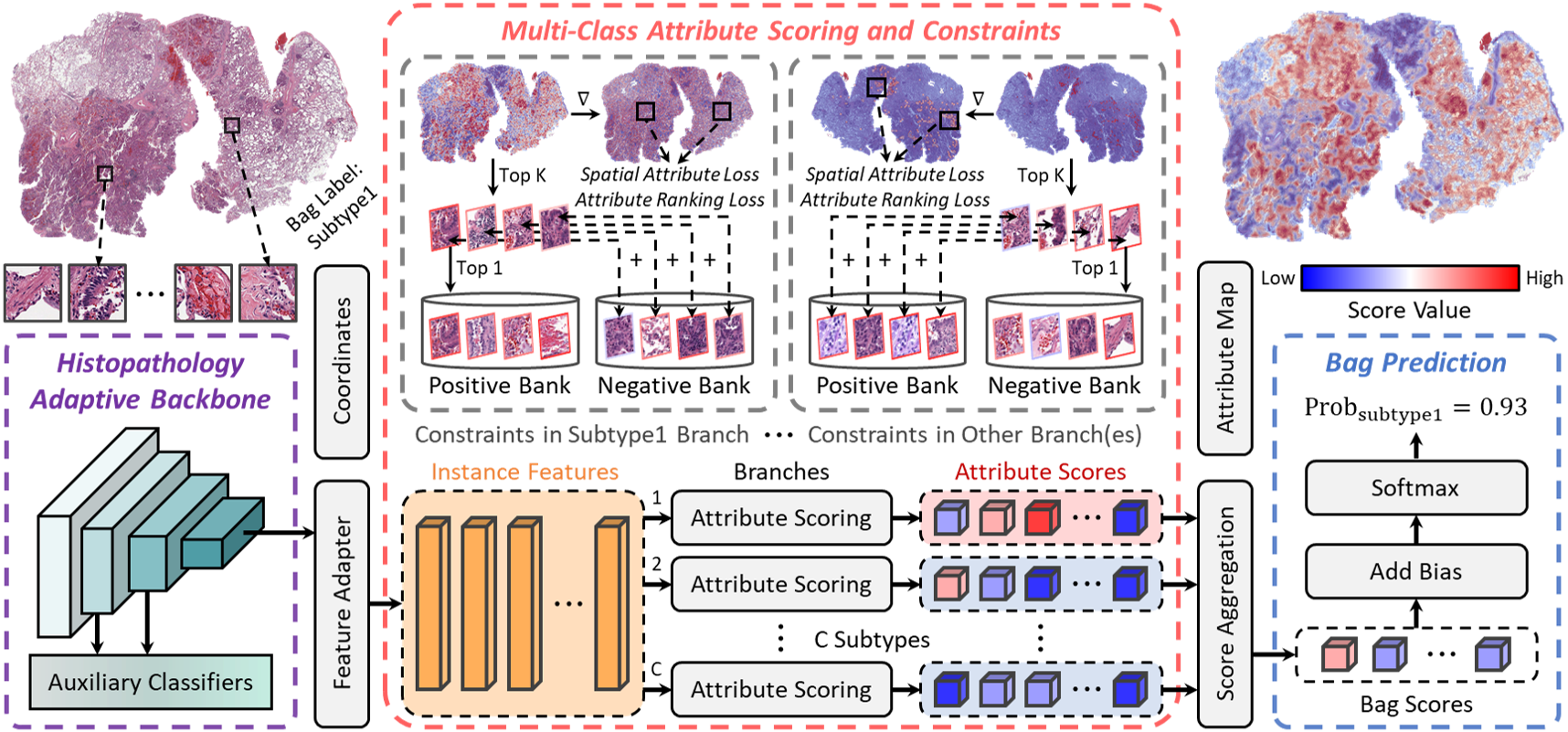
- 各インスタンスがバッグ予測に与える寄与度を定量化する属性スコアメカニズムを提案し、注目スコアの代わりにインスタンスの関連性の主な指標とする。
- 隣接するパッチが類似した属性を持つ場合に同じスコアを持つよう促すことで、1枚のWSI内での局所的空間的相関をモデル化する空間的属性制約を導入する。
- 異なるWSI間で正例インスタンスを負例インスタンスより高い順位にすることで、意味的類似性を強制する属性順序損失を開発する。
- 病理的データで事前学習されたヒストパスロジー適応型バックボーンを採用し、パッチレベルの埋め込みの特徴表現品質を向上させる。
- 属性スコアをインスタンス間で合計する学習可能な集約関数を用い、スコアの合計が0を超えるかどうかでバッグレベルの予測を決定する。
- 各診断クラスに対応する複数の分岐を持つ分類ヘッドを採用し、最終的な予測は集約された属性スコアが0を超えるかどうかに基づく。
![Figure 1: Illustration of ABMIL and our AttriMIL. For features, red cuboids denote positive attributes and blue cuboids are negative; for scores, redder colors represent higher scores and bluer colors indicate lower ones. Notably, for a positive bag, existing methods [ 6 , 7 , 8 , 4 , 5 ] generally](https://ar5iv.labs.arxiv.org/html/2404.00351/assets/AttributeScoring.png)
実験結果
リサーチクエスチョン
- RQ1属性スコアは、WSI分類において注目スコアよりもインスタンス寄与度の測定に信頼性が高いか?
- RQ2パッチ間の空間的およびスライド間相関を効果的にモデル化することで、インスタンス識別性能を向上させられるか?
- RQ3属性スコアメカニズムにより、病理的画像解析における分布外(OOD)サンプル検出が可能になるか?
- RQ4ヒストパスロジー適応型バックボーンの統合により、特徴表現と分類性能が向上するか?
- RQ5既存のABMILベース手法と比較して、AttriMILは腫瘍の局在化精度をどの程度向上させるか?
主な発見
- AttriMILは、Camelyon16、PatchCamelyon、UniToPathoの3つの公的WSIベンチマークで、AUCやF1スコアといった複数の評価指標において、最先端の手法を上回った。
- 属性スコアメカニズムにより、特に小さなまたは微細な腫瘍領域の正例インスタンスの局在化が顕著に向上したことが、定性的な比較で示された。
- 肺アキニやLUSCにおける結合組織など、腫瘍領域に埋め込まれた負例インスタンスを効果的に区別でき、優れた識別能力を示した。
- 属性順序損失により、スライド間で意味的に意味のあるインスタンス順序付けが学習可能となり、一般化性能とロバストネスが向上した。
- すべての分岐スコアが0未満であるサンプルを特定することで、OOD検出が有効に実現され、診断システムにおける臨床的セーフティの可能性を示した。
- アブレーションスタディにより、空間的属性制約と属性順序損失の両方が、特に複雑な組織領域において性能向上に顕著な寄与をしていることが確認された。
より良い研究を、今すぐ始めましょう
論文の読解から最終レビューまで、研究時間を劇的に削減しましょう。
クレジットカード登録不要
このレビューはAIが作成し、人間の編集者が確認しました。