
[論文レビュー] Rethinking Depth Estimation for Multi-View Stereo: A Unified Representation
本論文では、回帰のサブピクセル精度と分類のロバストなコストボリューム監視の両方の利点を統合する、新しい統一的深度表現であるUniMVSNetを提案する。サンプルの不均衡を解消するために、新規の統一的フォーカル損失(UFL)を用いる。本手法は、DTUおよびTanks and Templesベンチマークの両方で最先端の性能を達成し、優れた汎化性とロバスト性を示した。
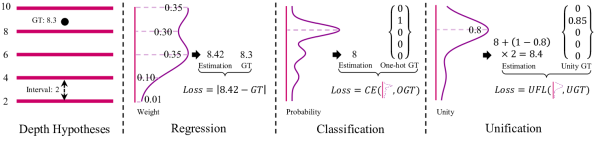
Depth estimation is solved as a regression or classification problem in existing learning-based multi-view stereo methods. Although these two representations have recently demonstrated their excellent performance, they still have apparent shortcomings, e.g., regression methods tend to overfit due to the indirect learning cost volume, and classification methods cannot directly infer the exact depth due to its discrete prediction. In this paper, we propose a novel representation, termed Unification, to unify the advantages of regression and classification. It can directly constrain the cost volume like classification methods, but also realize the sub-pixel depth prediction like regression methods. To excavate the potential of unification, we design a new loss function named Unified Focal Loss, which is more uniform and reasonable to combat the challenge of sample imbalance. Combining these two unburdened modules, we present a coarse-to-fine framework, that we call UniMVSNet. The results of ranking first on both DTU and Tanks and Temples benchmarks verify that our model not only performs the best but also has the best generalization ability.
研究の動機と目的
- 学習ベースのマルチビューステレオ(MVS)における回帰と分類の限界を克服し、両者の利点を統合すること。
- 回帰における間接的監視と、分類における離散的性質が深度推定に与える影響を軽減すること。
- 直接的なコストボリューム監視とサブピクセル深度予測を可能にする統一的表現の設計。
- 連続的なラベルにおけるサンプルの不均衡をより効果的に扱う、より効果的な損失関数、統一的フォーカル損失(UFL)の開発。
- プラグアンドプレイフレームワークであるUniMVSNetを通じて、提案モジュールの有効性と汎化性を実証すること。
提案手法
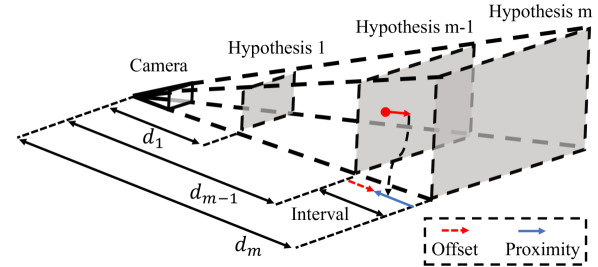
- 最適な深度仮説とその真値からのオフセットを両方とも表現できる連続的で近接性に基づくラベル(ユニティ)を用いる、統一的深度表現と呼ばれる新規な表現を提案。
- ユニティラベルを、連続区間内に1つの非ゼロ値を持つように定義し、近接度(1 - オフセット)が真値深度の信頼性と位置を符号化する。
- 真値の大きさを組み込むことで、ハードサンプルとイージーサンプルをより明確に区別できるように一般化されたフォーカル損失とGFLの一般化である、統一的フォーカル損失(UFL)を導入。
- UFLを統一的表現に直接適用することで、より良好なサンプルバランスを実現するロバストなエンドツーエンド学習を可能にする。
- 追加の計算コストやメモリコストが発生しない標準的なMVSパイプラインに、UnificationとUFLを統合した粗〜細かいフレームワーク、UniMVSNetを設計。
- 公平な比較のための適応的集約とより精細な真値監視を採用。アブレーションスタディにより、本手法の独立した優位性が確認された。
実験結果
リサーチクエスチョン
- RQ1統一的深度表現は、回帰のサブピクセル精度と分類ベースの監視のロバスト性を効果的に統合できるか?
- RQ2特に真値の大きさが変動する場合に、連続的深度ラベルにおけるクラスの不均衡をより効果的に処理できる損失関数はどのように設計できるか?
- RQ3仮説範囲が真値をカバーしない場合でも、統一的表現はロバスト性を維持できるか?
- RQ4統一的フォーカル損失(UFL)は、従来のフォーカル損失の変種と比較して、精度と完全性の両面でどの程度向上するか?
- RQ5提案されたモジュールは、計算コストを増加させることなく、既存のMVSフレームワークに効果的に統合できるか?
主な発見
- UniMVSNetはDTUベンチマークで最先端の性能を達成し、全体誤差0.324 mm(ベースラインの0.333 mmと比較)で1位を獲得した。
- Tanks and Templesベンチマークでは、中程度のセットで前回の最良モデル比2.68ポイント、高度なセットで3.24ポイントの向上を達成した。
- 仮説範囲が真値をカバーしなくても、ユニティラベルがすべてゼロになるため、正しく監視が維持され、モデルの劣化を回避できる。
- 統一的フォーカル損失(UFL)は、GFLおよび標準フォーカル損失と比較して、特にハードサンプルの処理において、精度と完全性の両方を顕著に向上させた。
- アブレーション実験では、学習データの50%のみを用いても、ベースラインの全データを用いた場合を上回る性能を示し、強力な汎化性を示した。
- 提案されたモジュールはプラグアンドプレイであり、計算コストやメモリコストを追加せず、既存のMVSフレームワークにスムーズに統合可能である。
この論文を読む
Nubintのビューアで原文を開き、読みながら気になる箇所をすぐに質問できます。
Nubintでこの論文を読むこのレビューはAIが論文の原文をもとに作成しました。引用する前に原文をご確認ください。