
[論文レビュー] RoboDepth: Robust Out-of-Distribution Depth Estimation under Corruptions
本論文は RoboDepth を提案。3 カテゴリの 18 種類の劣化を含むロバストネスベンチマークで、室内外データ上の 42 個のモノラル深度推定モデルを評価し、OoD 深度推定のロバストネスに影響を与える要因を分析する。さらに、より頑健な MDE システムの構築に向けた洞察と推奨を提供する。
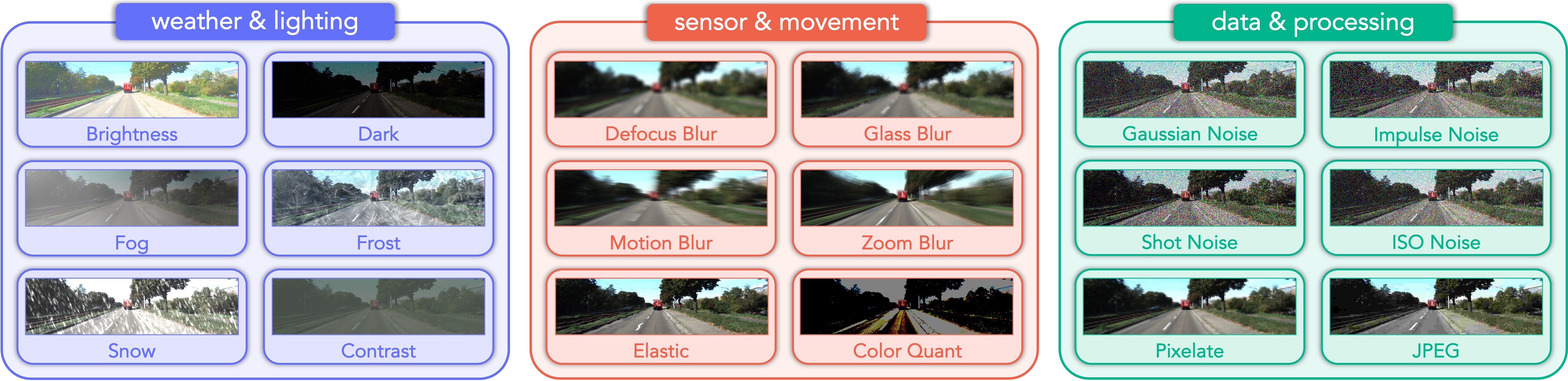
Depth estimation from monocular images is pivotal for real-world visual perception systems. While current learning-based depth estimation models train and test on meticulously curated data, they often overlook out-of-distribution (OoD) situations. Yet, in practical settings -- especially safety-critical ones like autonomous driving -- common corruptions can arise. Addressing this oversight, we introduce a comprehensive robustness test suite, RoboDepth, encompassing 18 corruptions spanning three categories: i) weather and lighting conditions; ii) sensor failures and movement; and iii) data processing anomalies. We subsequently benchmark 42 depth estimation models across indoor and outdoor scenes to assess their resilience to these corruptions. Our findings underscore that, in the absence of a dedicated robustness evaluation framework, many leading depth estimation models may be susceptible to typical corruptions. We delve into design considerations for crafting more robust depth estimation models, touching upon pre-training, augmentation, modality, model capacity, and learning paradigms. We anticipate our benchmark will establish a foundational platform for advancing robust OoD depth estimation.
研究の動機と目的
- 実世界の劣化下でのモノラル深度推定(MDE)における頑健性評価の必要性を動機づける。
- 室内および屋外データセットを含む MDE の包括的な OoD ロバストネス ベンチマークを定義・公開する。
- 多様な劣化条件下で最先端 MDE モデルの広範なベンチマークを体系的に評価する。
- 入力、学習パラダイム、モデル設計の選択が頑健性に与える影響を分析する。
- MDE システムの頑健性と信頼性を向上させる設計上の考慮事項とガイドラインを提供する。
提案手法
- MDE の OoD ロバストネス評価スイートとして RoboDepth を導入。 weather/lighting、sensor/movement、データ処理の 3 カテゴリにまたがる 18 の劣化を含む。
- 3 つのベンチマークを作成:KITTI-C(屋外)、NYUDepth2-C(室内)、KITTI-S(スタイル/シフト)。
- ロバストネス指標を定義:Corruption Error(mCE)と Resilience Rate(mRR)、さらに深度推定誤差(DEE)指標。
- KITTI または NYU-Depth2 上で訓練された 42 の深度推定モデル(屋外および室内)を、統一評価プロトコルでベンチマークする。
- 複製と拡張を可能にする劣化シミュレーションツールキットをオープンソース化。
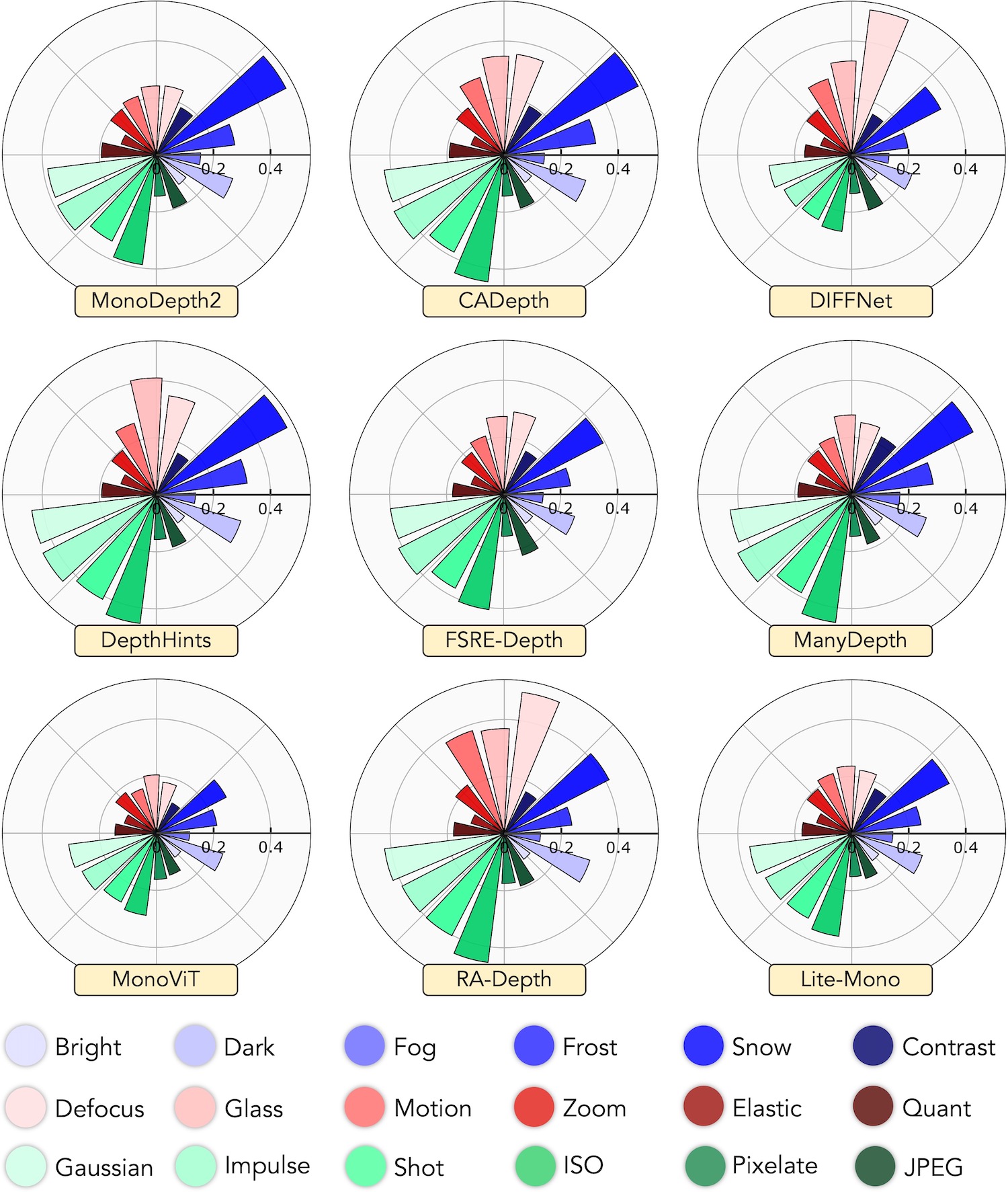
実験結果
リサーチクエスチョン
- RQ1現行の MDE モデルは現実世界の劣化に対して頑健か?
- RQ2どの入力モダリティ(モノラル、ステレオ、またはその両方)がより頑健さをもたらすか?
- RQ3学習パラダイム(監視付き vs自己教師付き)は劣化に対する頑健性に影響を与えるか?
- RQ4前学習、入力解像度、容量などのモデル設計の選択は OoD 深度推定の頑健性に影響するか?
- RQ5シミュレートされた劣化は実世界のシナリオを十分に reflect しているか?
主な発見
- 最先端の MDE モデルは劣化に対して脆弱であり、ロバストネスはアーキテクチャと劣化タイプによって変動する。
- モノラルのみの MDE モデルは、劣化下でステレオベースのものより頑健である傾向がある。
- 自己教師付き MDE は照明変化や動作ブレに対して監視付きモデルより鈍感であることがあるが、ノイズには両方が影響を受ける。
- 高解像度の入力はノイズに対する頑健性を向上させる可能性があるが、より大きなモデルが必ずしも頑健性を向上させるとは限らず、時には悪化させる。
- トランスフォーマーベースのモデル(例:MonoViT、Lite-Mono)は、質感シフトやエッジの歪みに対する頑健性が強いことが多い。
この論文を読む
Nubintのビューアで原文を開き、読みながら気になる箇所をすぐに質問できます。
Nubintでこの論文を読むこのレビューはAIが論文の原文をもとに作成しました。引用する前に原文をご確認ください。