
[論文レビュー] Robust Privatization with Multiple Tasks and the Optimal Privacy-Utility Tradeoff
本稿では、非特定のタスクに対してデータ公開を行う際の耐障害的プライバシーフレームワークを提案し、複数の可能なタスクにおいて、プライバシー漏洩を最小限に抑えつつ、ユーティリティ制約を満たすことを目的としている。問題を重み付き成分を有する並列プライバシーファンネル問題に分解することで、決定論的プライベート特徴量の閉形式解を導出し、線形計画法を用いて最適な重み付けを特定可能であることが示され、最小のプライバシー漏洩を達成するのに十分な公開レートを実現する。
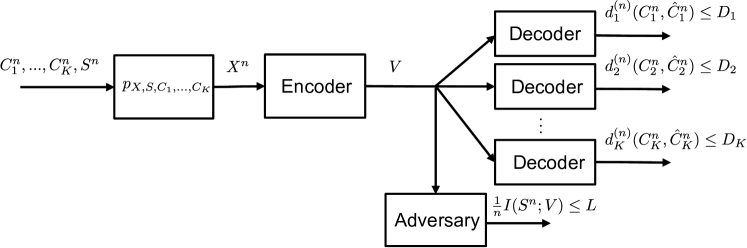
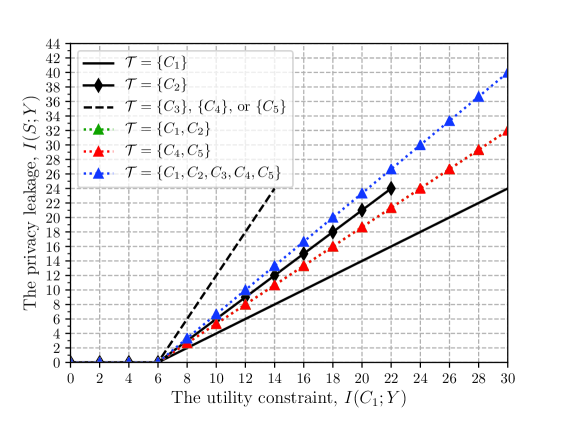
In this work, fundamental limits and optimal mechanisms of privacy-preserving data release that aims to minimize the privacy leakage under utility constraints of a set of multiple tasks are investigated. While the private feature to be protected is typically determined and known by the sanitizer, the target task is usually unknown. To address the lack of information on the specific task, utility constraints laid on a set of multiple possible tasks are considered. The mechanism protects the specific privacy feature of the to-be-released data while satisfying utility constraints of all possible tasks in the set. First, the single-letter characterization of the rate-leakage-distortion region is derived, where the utility of each task is measured by a distortion function. It turns out that the minimum privacy leakage problem with log-loss distortion constraints and the unconstrained released rate is a non-convex optimization problem. Second, focusing on the case where the raw data consists of multiple independent components, we show that the above non-convex optimization problem can be decomposed into multiple parallel privacy funnel (PF) problems with different weightings. We explicitly derive the optimal solution to each PF problem when the private feature is a component-wise deterministic function of a data vector. The solution is characterized by a leakage-free threshold: when the utility constraint is below the threshold, the minimum leakage is zero; once the required utility level is above the threshold, the privacy leakage increases linearly. Finally, we show that the optimal weighting of each privacy funnel problem can be found by solving a linear program (LP). A sufficient released rate to achieve the minimum leakage is also derived. Numerical results are shown to illustrate the robustness of our approach against the task non-specificity.
研究の動機と目的
- 公開されたデータを用いた下流タスクが不明な状況において、プライバシーを保護する課題に対処すること。
- 複数の可能なタスクに対してユーティリティ制約のもとでプライバシー漏洩を最小化し、タスクの非特定性に対して耐障害性を確保すること。
- 対数損失歪みを用いた情報理論的枠組みにおいて、プライバシー-ユーティリティトレードオフの根本的限界を導出すること。
- 最小プライバシー漏洩を達成する最適解が、重み付き成分を有する並列プライバシーファンネル問題に分解可能であることを示すこと。
- 最小プライバシー漏洩を達成するにあたり必要な十分な公開レートを特定し、最適重み付けのための線形計画法定式化を提示すること。
提案手法
- 論文では、ユーティリティ指標として対数損失歪み、プライバシー指標として相互情報量を用いてプライバシー-ユーティリティトレードオフを定式化する。
- 複数のユーティリティ制約のもとで、レート-漏洩-歪み領域の単一記述子を導出する。
- 独立なデータ成分と決定論的プライベート特徴量の仮定の下、問題は異なる重み付けを有する並列プライバシーファンネル問題に分解される。
- 各プライバシーファンネル問題は閉形式で解かれ、プライバシー漏洩がゼロの閾値以下では漏洩が発生せず、閾値を超えると必要なユーティリティ水準に応じて線形に増加することが明らかになる。
- 各成分の最適重み付けは線形計画法(LP)を解くことで特定可能であり、最小漏洩の効率的計算が可能となる。
- 最小漏洩を達成するにあたり必要な十分な公開レートが導出され、並列化されたプライバシーフレームワークを用いる場合、その妥当性が保証される。
実験結果
リサーチクエスチョン
- RQ1下流タスクが不明で複数のタスクが想定される状況において、プライバシー-ユーティリティトレードオフの根本的限界は何か?
- RQ2複数の可能なタスクに対してユーティリティ制約のもとで、どのようにすればプライバシー漏洩を最小化できるか?
- RQ3最小プライバシー漏洩を求める非凸最適化問題は、より単純な部分問題に分解可能か?
- RQ4複数のユーティリティ制約のもとで、プライバシーフレームワークにおけるデータ成分の最適重み付けは何か?
- RQ5耐障害的設定において、最適プライバシー-ユーティリティトレードオフを達成するために必要な十分な公開レートは何か?
主な発見
- 複数のユーティリティ制約を満たす最小プライバシー漏洩問題は非凸であるが、独立性と決定論的プライベート特徴量の仮定のもとで、並列プライバシーファンネル問題に分解可能である。
- 各成分について、プライバシー漏洩は漏洩フリー閾値以下ではゼロであり、閾値を超えると必要なユーティリティ水準に比例して線形に増加する。
- 各プライバシーファンネル成分の最適重み付けは線形計画法により計算可能であり、効率的な最適化が可能となる。
- 最小漏洩を達成するにあたり必要な十分な公開レートが導出され、並列化されたプライバシーフレームワークを用いる場合、そのタイトネスが示された。
- 数値結果により、タスクの非特定性に対して本アプローチの耐障害性が確認され、タスク集合の選定がプライバシー-ユーティリティトレードオフに与える影響が明確に示された。
- フレームワークは微分プライバシーへ拡張可能であり、この場合も最小漏洩問題は並列的な単一制約問題に分解可能であるが、閉形式解は未解決のままである。
より良い研究を、今すぐ始めましょう
論文の読解から最終レビューまで、研究時間を劇的に削減しましょう。
クレジットカード登録不要
このレビューはAIが作成し、人間の編集者が確認しました。