
[論文レビュー] S4Fusion: Saliency-aware Selective State Space Model for Infrared Visible Image Fusion
S4Fusionは、線形計算量でグローバルな空間的相互作用とクロスモーダル相互作用を同時に捉えることができる、サリエンシーに配慮した選択的状態空間モデルを提案する。事前学習されたResNet50の意思決定層における不確実性を最小化することで、顕著なターゲットを適応的に強化し、融合品質および下流の検出タスクで最先端の手法を上回る性能を達成する。
As one of the tasks in Image Fusion, Infrared and Visible Image Fusion aims to integrate complementary information captured by sensors of different modalities into a single image. The Selective State Space Model (SSSM), known for its ability to capture long-range dependencies, has demonstrated its potential in the field of computer vision. However, in image fusion, current methods underestimate the potential of SSSM in capturing the global spatial information of both modalities. This limitation prevents the simultaneous consideration of the global spatial information from both modalities during interaction, leading to a lack of comprehensive perception of salient targets. Consequently, the fusion results tend to bias towards one modality instead of adaptively preserving salient targets. To address this issue, we propose the Saliency-aware Selective State Space Fusion Model (S4Fusion). In our S4Fusion, the designed Cross-Modal Spatial Awareness Module (CMSA) can simultaneously focus on global spatial information from both modalities while facilitating their interaction, thereby comprehensively capturing complementary information. Additionally, S4Fusion leverages a pre-trained network to perceive uncertainty in the fused images. By minimizing this uncertainty, S4Fusion adaptively highlights salient targets from both images. Extensive experiments demonstrate that our approach produces high-quality images and enhances performance in downstream tasks.
研究の動機と目的
- 既存の融合モデルが、クロスモーダル相互作用中にグローバルな空間的およびクロスモーダル情報を同時に捉えることができないという限界に対処すること。
- 人間の視覚認識に従い、顕著なターゲットの認識を向上させるために、選択的で適応的な融合を可能にすること。
- 事前学習済みネットワークの意思決定層における不確実性の最小化を活用することで、融合結果におけるモダリティバイアスを低減すること。
- グローバルな空間的およびモード間情報の統合を線形計算量で効率的に行えるワンステージの融合モジュールを設計すること。
- 包括的な消去実験、定性的・定量的評価および下流タスク評価を通じて、本手法の優位性を検証すること。
提案手法
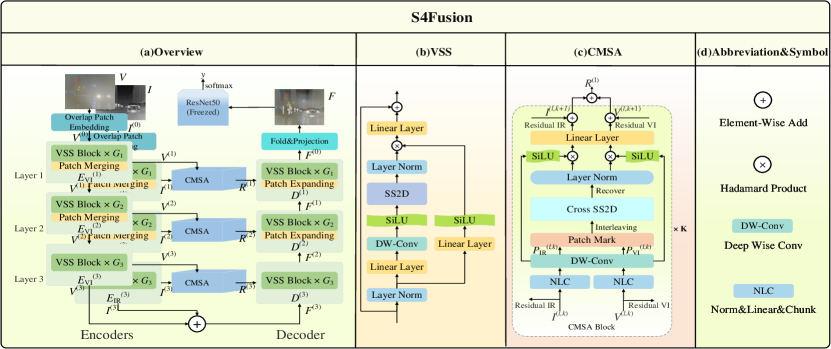
- クロスモーダル空間的アウェアネス(CMSA)モジュールを提案し、選択的状態空間機構を用いて、モダリティ内空間特徴とモード間相互作用を同時にモデル化する。
- 事前学習済みResNet50の意思決定層における不確実性を最小化する、知覚強化型損失関数を導入し、顕著な構造を強調する方向にモデルを誘導する。
- エンコーダーとデコーダーの両方にS4ブロックを用いたマルチスケールネットワークアーキテクチャを採用し、特徴の精錬にG=[1,2,1]の構成を適用する。
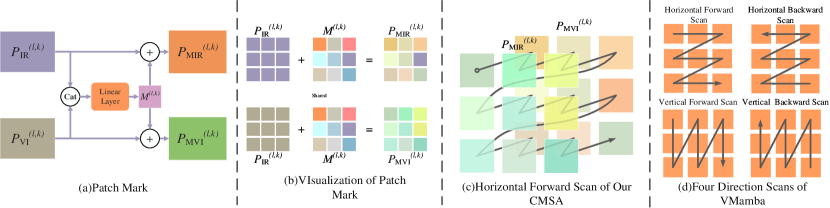
- クロスSS2Dアテンション機構内での空間的およびクロスモーダル相互作用の区別に、Patch Markを活用し、特徴の分離性を向上させる。
- CMSAモジュールをワンステージの融合フレームワークに統合し、グローバルな文脈認識を備えたエンドツーエンド学習を可能にする。
- ResNet50の事前学習済み特徴を、人間の認識に類似した顕著なコンテンツの理解を促す監視信号として活用する。
実験結果
リサーチクエスチョン
- RQ1クロスモーダル相互作用の過程で、赤外線および可視光モダリティ両方のグローバルな空間的文脈を融合モデルが効果的に捉えることができるか?
- RQ2事前学習済みネットワークの意思決定層における不確実性を、融合画像における顕著性強化に適応的に活用できるか?
- RQ3提案されたCMSAモジュールは、テクスチャおよび顕著なターゲット情報を両方効果的に保持する点で、既存のアテンションまたは融合モジュールを上回るか?
- RQ4手作業で設計された損失関数と比較して、知覚強化型損失は融合品質および下流タスクのパフォーマンスをどの程度向上させるか?
- RQ5Patch Markや主要な構成要素が欠落した場合、モデルの忠実度および補完的情報の保持能力にどのような影響が生じるか?
主な発見
- S4Fusionは、3つのベンチマークデータセット(FLIR、TILRD、M3FD)で最先端の性能を達成し、比較手法すべてを上回る高いSSIM、AG、SF、Qabfスコアを記録した。
- M3FDデータセットにおけるマルチモダリティ物体検出のmAP@50は82.1に達し、U2Fusion、DeFusion、EMMAを上回った。
- 消去実験の結果、知覚強化型損失を除去すると性能が著しく低下することが確認され、そのサリエンシー強化における役割が裏付けられた。
- CMSAをADD、クロスアテンション、CNN、FSSMに置き換えると性能が劣化し、特にクロスアテンションとFSSMはグローバル文脈モデリングにおいて顕著な失敗を示した。
- 可視化結果から、CMSAは融合後の可視光および赤外線特徴の両方を改善しており、顕著な物体の表現が明確で、背景の一貫性も保たれていることが確認された。
- CMSAにおけるPatch Markの削除は、情報保持および融合忠実度の著しい低下を引き起こし、空間的およびクロスモーダル相互作用の分離にその重要性が確認された。
この論文を読む
Nubintのビューアで原文を開き、読みながら気になる箇所をすぐに質問できます。
Nubintでこの論文を読むこのレビューはAIが論文の原文をもとに作成しました。引用する前に原文をご確認ください。