
[論文レビュー] Searching for Time-Dependent Axion Dark Matter Signals in Pulsars
本研究では、パulsar PSR J2144−3933の MeerKAT データを用いて、初めて時間領域でのaxion暗黒物質信号の検索を実施し、一致フィルタリングを適用した。時間領域解析は、時間平均された放射度手法と比較して、axionから光子への結合に対する感度を向上させることを示した。著者らは、パルサーの回転およびプラズマ効果による周期的信号変調を活用し、axion質量範囲 3.9{-}4.7\,\mu\text{eV} の間で $ g_{a\gamma\gamma} < 5.5 \times 10^{-11}(D/0.165\,\text{pc})\,\text{GeV}^{-1} $ の新たな上限を設定した。
Axion dark matter can be converted into photons in the magnetospheres of neutron stars leading to a spectral line centred on the Compton wavelength of the axion. Due to the rotation of the star and the plasma effects in the magnetosphere the signal is predicted to be periodic with significant time variation - a unique smoking gun for axion dark matter. As a proof of principle and to develop the methodology, we carry out the first time domain search of the signal using data from PSR J2144$-$3933 taken as part of the MeerTIME project on MeerKAT telescope. We search for specific signal templates using a matched filter technique and discuss when a time-domain analysis (as is typically the case in pulsar observations) gives greater sensitivity to the axion-coupling to photons in comparison to a simple time-averaged total flux study. We do not find any candidate signals and, hence, impose an upper limit on the axion-to-photon coupling of $g_{aγγ}<4 imes 10^{-11}\,{ m GeV}^{-1}$ over the mass range $m_{ m a}=3.9-4.7\,μ{ m eV}$ using this data. This limit relies on PSR J2144$-$3933 not being an extremely aligned rotator, as strongly supported by simple arguments based on the observed pulse profile width. We discuss the possibilities of improving this limit using future observations with MeerKAT and also SKA1-mid and the possibility of using other objects. Finally, to evade modelling uncertainties in axion radio signals, we also carry out a generic ``any periodic-signal search" in the data, finding no evidence for an axion signal.
研究の動機と目的
- パルサーの電波放射からのaxion暗黒物質信号を検出するための時間領域解析手法を開発・適用すること。
- 時間平均された放射度測定と比較して、パルサー信号の時間変動性を用いることで得られる感度向上を定量化すること。
- PSR J2144−3933からの実観測データを用いて、axionから光子への結合定数 $ g_{a\gamma\gamma} $ の新たな上限を設定すること。
- axionに特有のテンプレートに依存しない一般的な周期的信号検索を実施し、信号モデルの頑健性を検証すること。
提案手法
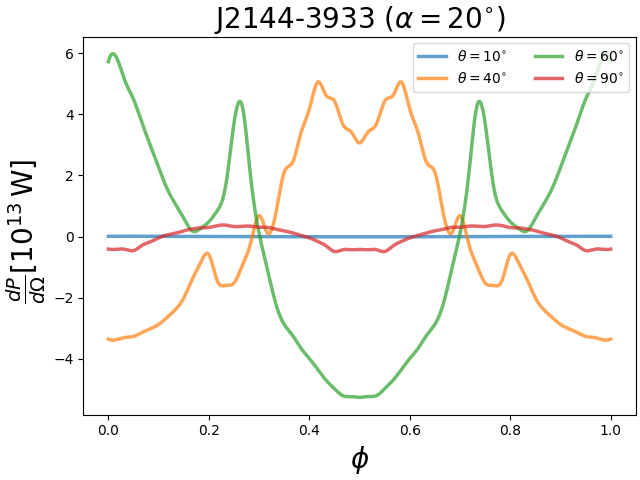
- 理論的信号テンプレートを用いた一致フィルタリング手法を採用。これらのテンプレートは、中性子星磁気圏内でのaxionから光子への変換を示す光線追跡シミュレーションから導出された。
- SciPyを用いた補間を用いて、視線角 $ \theta $ と $ \alpha $ の変化に伴う時間依存放射度プロファイルをモデル化し、計算コストを低減した。
- MeerKATの MeerTIME プロジェクトデータを用いて時間領域検索を実施。パルサーの回転およびプラズマ効果に起因する信号の周期的変調に注目した。
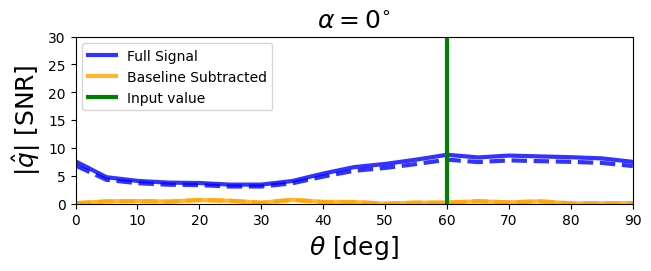
- 時間領域解析の感度を標準的な時間平均放射度手法と比較し、わずかだが有意義なSNR向上が確認された。
- axionに特化したモデルに依存しない一般的な周期的信号検索を実施し、狭帯域で変調された信号を検出可能であるかを検証した。
実験結果
リサーチクエスチョン
- RQ1時間領域でのパルサー信号解析は、時間平均された放射度測定と比較して、axion暗黒物質の検出感度を顕著に向上させることができるか?
- RQ2実データから得たPSR J2144−3933における時間領域検索に基づき、axionから光子への結合定数 $ g_{a\gamma\gamma} $ の上限は何か?
- RQ3プラズマ効果および回転に起因する変調を組み込むことで、パルサーにおけるaxion信号の検出可能性はどのように変化するか?
- RQ4axionに類似した信号を特定するための特定理論的テンプレートに依存しない一般的な周期的信号検索は、axion的信号を検出可能か?
主な発見
- 時間領域解析は、時間平均放射度手法と比較してわずかだが測定可能なSNRの向上をもたらし、検出可能性を高めた。
- データ中にaxion信号の候補は検出されず、axion質量が 3.9 から 4.7 $\mu\text{eV}$ の範囲で $ g_{a\gamma\gamma} < 5.5 \times 10^{-11}(D/0.165\,\text{pc})\,\text{GeV}^{-1} $ の上限が設定された。
- PSR J2144−3933が極めて整列した回転子でないという仮定のもとで、導出された上限は頑健であることが、パルスプロファイル幅の解析によって裏付けられた。
- 光線追跡結果の補間は、任意の角度に対して十分な精度を達成しており、全シミュレーションに代えて使用可能であることが検証された。
- 一般的な周期的信号検索では、変調信号の証拠は得られず、null結果の信頼性が高まり、モデル依存性が低減した。
- 今後のMeerKATおよびSKA1-mid観測では、最適化された時間領域戦略を用いることで感度が向上すると予想される。
この論文を読む
Nubintのビューアで原文を開き、読みながら気になる箇所をすぐに質問できます。
Nubintでこの論文を読むこのレビューはAIが論文の原文をもとに作成しました。引用する前に原文をご確認ください。