
[論文レビュー] Self-Supervised Guided Segmentation Framework for Unsupervised Anomaly Detection
本論文は、局所化を向上させるために自己教師付きガイド機能を活用する、自己教師付きガイド付きセグメンテーションフレームワーク(SGSF)を提案する。この手法は、局所化のための自己教師付きガイド機能を活用し、局所化を向上させる。Saliency Augmentation Module(SAM)を用いて、局所化に焦点を当てたリアルな偽の異常サンプルを生成する。この方法により、ベンチマークデータセットで最先端の性能を達成し、局所化の精度を向上させる。
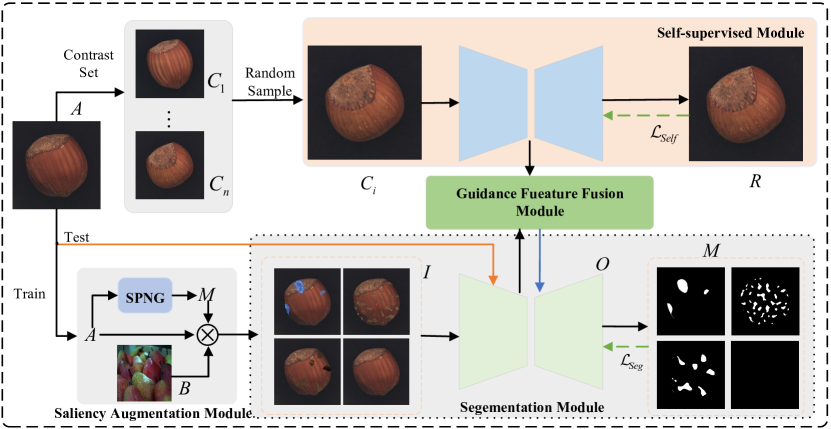
Unsupervised anomaly detection is a challenging task in industrial applications since it is impracticable to collect sufficient anomalous samples. In this paper, a novel Self-Supervised Guided Segmentation Framework (SGSF) is proposed by jointly exploring effective generation method of forged anomalous samples and the normal sample features as the guidance information of segmentation for anomaly detection. Specifically, to ensure that the generated forged anomaly samples are conducive to model training, the Saliency Augmentation Module (SAM) is proposed. SAM introduces a saliency map to generate saliency Perlin noise map, and develops an adaptive segmentation strategy to generate irregular masks in the saliency region. Then, the masks are utilized to generate forged anomalous samples as negative samples for training. Unfortunately, the distribution gap between forged and real anomaly samples makes it difficult for models trained based on forged samples to effectively locate real anomalies. Towards this end, the Self-supervised Guidance Network (SGN) is proposed. It leverages the self-supervised module to extract features that are noise-free and contain normal semantic information as the prior knowledge of the segmentation module. The segmentation module with the knowledge of normal patterns segments out the abnormal regions that are different from the guidance features. To evaluate the effectiveness of SGSF for anomaly detection, extensive experiments are conducted on three anomaly detection datasets. The experimental results show that SGSF achieves state-of-the-art anomaly detection results.
研究の動機と目的
- 実際の異常サンプルが限られている、あるいは存在しない状況における自己教師付き異常検出の課題に対処すること。
- よりリアルで局所化に基づいた異常領域を生成することで、偽の異常と実際の異常との分布ギャップを低減すること。
- セグメンテーションのための事前知識として、ノイズのない自己教師付き特徴を活用することで、異常局所化を向上させること。
- 微小で不規則な異常に対しても一般化しやすい堅牢なフレームワークの開発。
提案手法
- Saliency Augmentation Module(SAM)は、局所化マップを用いて、局所化領域に焦点を当てたペリンノイズマップを生成し、不規則でリアルな見た目の異常マスクを生成する。
- 適応的セグメンテーション戦略により、これらのマスクを正常画像に適用し、実際の異常とより類似した偽の異常サンプルを生成する。
- Self-Supervised Guidance Network(SGN)は、変換された視覚的ビューの対から、クリアで意味論的な豊かな特徴を抽出し、セグメンテーションのための事前知識として機能する。
- ガイド機能統合モジュールは、セグメンテーションデコーダー内で、自己教師付き特徴と偽の異常画像からの特徴を統合する。
- モデルは、自己教師付き再構成損失とセグメンテーション損失の組み合わせを用いて訓練され、特徴の質と異常局所化の両方を最適化する。
- 推論時、SAMは無効化され、入力画像が直接セグメンテーションネットワークに与えられる。
![Figure 1: Comparison of different unsupervised anomaly detection methods. (1) Denoising-based method [ 11 , 13 ] . (2) DRAEM method [ 5 ] . (3) The proposed framework (SGSF). The denoising network in methods (1) and (2) cannot accurately remove anomalies, resulting in inaccurate anomaly localization](https://ar5iv.labs.arxiv.org/html/2209.12440/assets/x1.png)
実験結果
リサーチクエスチョン
- RQ1局所化に焦点を当てた偽の異常は、自己教師付き異常検出における訓練データの現実性と有効性を向上させるか?
- RQ2自己教師付き特徴学習は、異常セグメンテーションのロバスト性と精度をどのように向上させるか?
- RQ3対照セットに元の画像を含めることで、ガイド特徴の質とモデル性能にどのような影響を与えるか?
- RQ4マスク生成における適応的しきい値処理は、微小または不規則な異常の局所化精度にどのように影響するか?
- RQ5モデルの収束と性能の最適なバランスを実現するための自己教師付き損失とセグメンテーション損失の最適な重みバランスは何か?
主な発見
- SGSFは、異常分類および局所化の両面で、3つのベンチマークデータセットで最先端の性能を達成した。
- アブレーションスタディの結果、対照セットから元の画像を除外することで性能が向上し、低レベル特徴への過学習を防げる。
- 元の画像を含めないn=4の対照セットサイズが、特徴の多様性とガイド品質の両立を図り、最良の局所化結果をもたらした。
- 適応的しきい値セグメンテーション戦略(a=0.4, b=0.2)は、固定しきい値を上回り、特に微小で散在する異常の検出において優れた性能を示した。
- 損失関数における最適なハイパーパrameter λ=1 は、自己教師付きとセグメンテーションの目的をバランスよく保証し、低い値および高い値で性能が低下することを確認した。
より良い研究を、今すぐ始めましょう
論文の読解から最終レビューまで、研究時間を劇的に削減しましょう。
クレジットカード登録不要
このレビューはAIが作成し、人間の編集者が確認しました。