
[論文レビュー] Semi-decentralized Inference in Heterogeneous Graph Neural Networks for Traffic Demand Forecasting: An Edge-Computing Approach
本論文は、大規模な都市交通ネットワークにおけるリアルタイムのタクシー需要・供給予測のため、クラウドレットを用いた準分散型推論フレームワークを提案する。この手法により、通信基地局に統合された複数のクラウドレットを介して、交通ネットワークの部分グラフにわたり計算を分散させることで、相互のクラウドレット間通信を低減し、中央集権的または完全分散型GNN方式と比較して推論時間を最大10倍短縮する。また、個々のタクシーをノードとして動的モデル化することで、空間的・時間的依存性を高精度に捉えることが可能となり、予測精度が向上する。
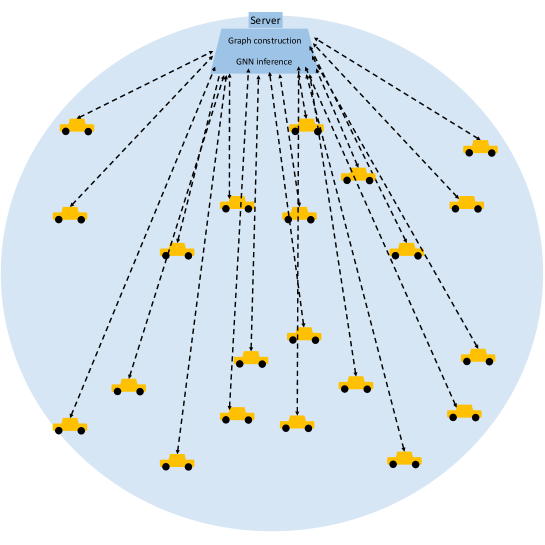
Prediction of taxi service demand and supply is essential for improving customer's experience and provider's profit. Recently, graph neural networks (GNNs) have been shown promising for this application. This approach models city regions as nodes in a transportation graph and their relations as edges. GNNs utilize local node features and the graph structure in the prediction. However, more efficient forecasting can still be achieved by following two main routes; enlarging the scale of the transportation graph, and simultaneously exploiting different types of nodes and edges in the graphs. However, both approaches are challenged by the scalability of GNNs. An immediate remedy to the scalability challenge is to decentralize the GNN operation. However, this creates excessive node-to-node communication. In this paper, we first characterize the excessive communication needs for the decentralized GNN approach. Then, we propose a semi-decentralized approach utilizing multiple cloudlets, moderately sized storage and computation devices, that can be integrated with the cellular base stations. This approach minimizes inter-cloudlet communication thereby alleviating the communication overhead of the decentralized approach while promoting scalability due to cloudlet-level decentralization. Also, we propose a heterogeneous GNN-LSTM algorithm for improved taxi-level demand and supply forecasting for handling dynamic taxi graphs where nodes are taxis. Extensive experiments over real data show the advantage of the semi-decentralized approach as tested over our heterogeneous GNN-LSTM algorithm. Also, the proposed semi-decentralized GNN approach is shown to reduce the overall inference time by about an order of magnitude compared to centralized and decentralized inference schemes.
研究の動機と目的
- 大規模なグラフニューラルネットワーク(GNN)推論におけるスケーラビリティと通信オーバーヘッドの課題に対処すること。
- 異種GNN-LSTMアーキテクチャを用いて、動的タクシー水準の需要・供給予測に効率的かつリアルタイムな推論を可能にすること。
- 完全分散型GNNに内在する2次関数的メッセージ伝達遅延を、準分散型エッジコンピューティングアーキテクチャによって低減すること。
- 個々のタクシーをノードとして扱う動的グラフモデリングを可能とすることで、進化を続ける都市交通システムにおけるより高精度で迅速な予測を実現すること。
提案手法
- 通信基地局に統合された中程度の能力を持つデバイス(クラウドレット)を複数用いて、交通ネットワークの部分グラフにわたりGNN計算を分散させる準分散型推論フレームワークを提案する。
- タクシーを動的ノードとして扱い、交通需要と供給の複雑な空間的・時間的依存性を捉える異種GNN-LSTMモデルを導入する。
- 伝送時間($t_s, t_r$)、処理時間($t_p$)、ノード次数($d_i$)のパラメータを用いて、Lホップグラフにおける推論遅延が解析的に上限付きで抑えられるメッセージ伝達メカニズムを採用する。
- 理論的遅延上限を導出し、推論遅延がホップ数の2乗に比例して増大することを示し、クラウドレットを用いた分散化によって通信ホップ数を低減する必要性を裏付ける。
- 1ホップおよび2ホップの近接ノード相互作用を考慮した計算グラフモデルを用いて、並列処理と逐次処理の両状況を想定し、総推論遅延の上限および下限を導出する。
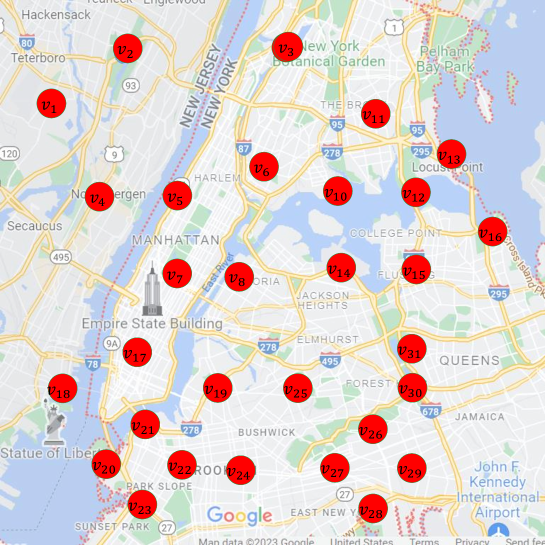
- 実世界のタクシーデータを用いてフレームワークを適用し、中央集権的および完全分散型GNN手法と比較して、推論速度と予測精度の両面で性能向上を実証する。
実験結果
リサーチクエスチョン
- RQ1大規模な都市交通グラフにおける完全分散型GNN推論の通信オーバーヘッドは、ホップ数の増加に伴いどのように変化するか?
- RQ2クラウドレットを用いた準分散型アーキテクチャは、大規模交通予測において推論遅延を顕著に低減しつつ、スケーラビリティを維持できるか?
- RQ3異種GNNにおいてタクシーを動的ノードとしてモデル化することで、固定領域ノードモデルと比較して予測精度はどの程度向上するか?
- RQ4多ホップGNNメッセージ伝達における推論遅延の理論的上限は何か? そして、アーキテクチャ設計によってどのように最小化できるか?
- RQ5提案された準分散型GNN-LSTMフレームワークは、中央集権的および完全分散型GNN推論方式と比較して、性能と遅延の点でどの程度優れているか?
主な発見
- 提案された準分散型GNN推論フレームワークは、中央集権的および完全分散型GNN方式と比較して、全体の推論時間を約1桁短縮(約10倍の高速化)する。
- 理論的分析により、完全分散型GNN推論は、通信ホップ数の増加に伴い2次関数的遅延増加を示し、大規模都市グラフでは実用的でないことが判明した。
- クラウドレットがカバーする部分グラフ内で計算を局所化することで、準分散型アプローチは相互クラウドレット間通信を最小限に抑え、メッセージ伝達のオーバーヘッドを顕著に低減した。
- 異種GNN-LSTMモデルは、個々のタクシーを動的ノードとしてモデル化することで、静的領域ベースのモデルと比較して、リアルタイムでの供給・需要の変化をより効果的に捉えることができ、予測精度が向上した。
- Lホップグラフに対する遅延上限を導出すると、総推論遅延はノード次数、伝送遅延、処理時間の式で表され、上限値はホップ数の2乗に比例して増大することが判明した。
- 実世界のタクシーデータを用いた実験的評価により、準分散型フレームワークは高い予測精度を維持しながら、推論速度を著しく向上させ、リアルタイムの都市移動管理を可能にした。
この論文を読む
Nubintのビューアで原文を開き、読みながら気になる箇所をすぐに質問できます。
Nubintでこの論文を読むこのレビューはAIが論文の原文をもとに作成しました。引用する前に原文をご確認ください。