
[論文レビュー] Smaller Language Models are Better Black-box Machine-Generated Text Detectors
この論文は、曲率に基づく局所最適性を用いて、人間が書いた文章とモデルが生成した文章を区別する、より小さな言語モデルを普遍的検出器として用いて、機械生成テキストのゼロショット検出を調査している。小さな部分訓練済みモデルが、大規模モデルよりもクロス検出で優れた性能を示し、OPT-125MはChatGPTの出力に対してAUC 0.81を達成しており、GPTJ-6B(AUC 0.45)のような大規模モデルよりも顕著に優れている。
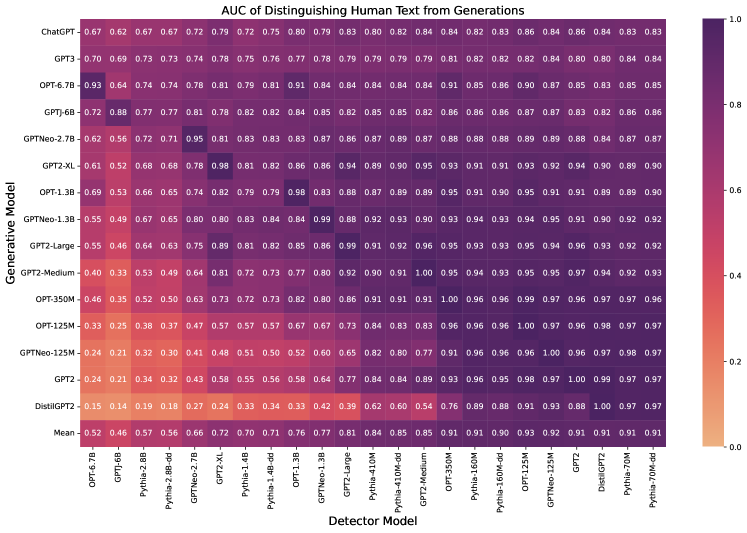
With the advent of fluent generative language models that can produce convincing utterances very similar to those written by humans, distinguishing whether a piece of text is machine-generated or human-written becomes more challenging and more important, as such models could be used to spread misinformation, fake news, fake reviews and to mimic certain authors and figures. To this end, there have been a slew of methods proposed to detect machine-generated text. Most of these methods need access to the logits of the target model or need the ability to sample from the target. One such black-box detection method relies on the observation that generated text is locally optimal under the likelihood function of the generator, while human-written text is not. We find that overall, smaller and partially-trained models are better universal text detectors: they can more precisely detect text generated from both small and larger models. Interestingly, we find that whether the detector and generator were trained on the same data is not critically important to the detection success. For instance the OPT-125M model has an AUC of 0.81 in detecting ChatGPT generations, whereas a larger model from the GPT family, GPTJ-6B, has AUC of 0.45.
研究の動機と目的
- 異なるアーキテクチャやトレーニングデータを持つ言語モデルが、別の言語モデルが生成したテキストを検出できるかどうかを調査すること。
- 機械生成テキストの普遍的検出器として最も効果的な言語モデルを特定すること。
- モデルサイズ、トレーニング段階、事前学習データが検出性能に与える影響を評価すること。
- 検出器の性能が、生成モデルとアーキテクチャ的またはデータ分布的に類似しているかどうかに依存するかどうかを調査すること。
提案手法
- 本研究では、検出器モデル下でのターゲットシーケンスとその近傍の摂動の尤度を比較することで、局所最適性を測定する曲率に基づく検出手法を用いる。
- 多様なモデルやシーケンス長をカバーする、50%が人間が書いたもので、残り50%が機械生成されたテキストから成るターゲットプールを構築する。
- 生成元の尤度関数にアクセスできない状況でも、検出器モデルが曲率指標を用いて人間生成と機械生成のテキストを区別できるかを評価する。
- パラメータ数が125Mから6.7Bにわたるモデル、アーキテクチャがGPT、OPT、Pythia、事前学習データがWebTextやThe Pileであるモデルを含め、部分トレーニング段階を含む多様な設定で実験を実施する。
- AUCスコアをROC曲線に基づいて測定し、人間生成と機械生成のシーケンスの区別可能性を評価する。
- 生成元が不明またはアクセス不能であっても、尤度関数が利用可能な代替検出器モデルを用いることで、ブラックボックス検出が可能になる。

実験結果
リサーチクエスチョン
- RQ1より小さな言語モデルは、異なるアーキテクチャを持つ、より大きなモデルが生成した機械生成テキストを効果的に検出できるか?
- RQ2検出器モデルの性能は、生成モデルと同じデータで学習されたか、同程度のパラメータ数であるかどうかに依存するか?
- RQ3なぜ小さなモデルや部分訓練済みモデルが、大規模で完全に訓練されたモデルよりもクロス検出で優れているのか?
- RQ4アーキテクチャやトレーニングデータに関係なく、多様な生成モデルに対して優れた性能を示す普遍的検出器が存在するか?
主な発見
- OPT-125Mのような小さな言語モデルは、大規模モデルよりも顕著に高い検出性能を示し、ChatGPTの出力を検出する際のAUCが0.81に達している。
- GPTJ-6Bのような大規模モデルは、同様のタスクでAUCが0.45にとどまり、検出器としての性能が著しく低い。
- 部分訓練済みモデルは完全に訓練されたモデルを上回り、特に大規模アーキテクチャでは顕著である。これは過剰学習が検出能力を低下させることを示唆している。
- 小さなモデルは、同程度またはより大きなサイズのモデルの生成物に対して高い曲率を割り当てており、機械生成のパターンに対してより感度が高い。
- 生成モデルと検出器モデルの間で、アーキテクチャの類似性や共有事前学習データの有無が、検出器性能に重大な影響を与えるわけではない。
- OPT-125Mは平均的に自己検出性能から0.07AUC以内にとどまり、強力な普遍的検出能力を示している。
より良い研究を、今すぐ始めましょう
論文の読解から最終レビューまで、研究時間を劇的に削減しましょう。
クレジットカード登録不要
このレビューはAIが作成し、人間の編集者が確認しました。