
[論文レビュー] SN2023ixf in Messier 101: A Variable Red Supergiant as the Progenitor Candidate to a Type II Supernova
本研究では、M101におけるタイプII超新星SN 2023ixfの前身星として、質量が大きく、ほこりを含む円周状物質殻を持つ変動赤超巨星(RSG)を同定した。予爆の前に行われたハッブル宇宙望遠鏡、スピッツァー宇宙望遠鏡、地上望遠鏡の画像を用いて、この源の全放射光度は log(L/L☉) = 4.74 ± 0.07、効果的温度は3920 Kであり、8600 R☉の半径、約5×10⁻⁵ M☉のほこり殻を持つことが判明した。これは約11 M☉のRSG前身星と整合的である。この源は9年間にわたり70%の変動を示しており、κ機構による脈動の影響であるとされる。
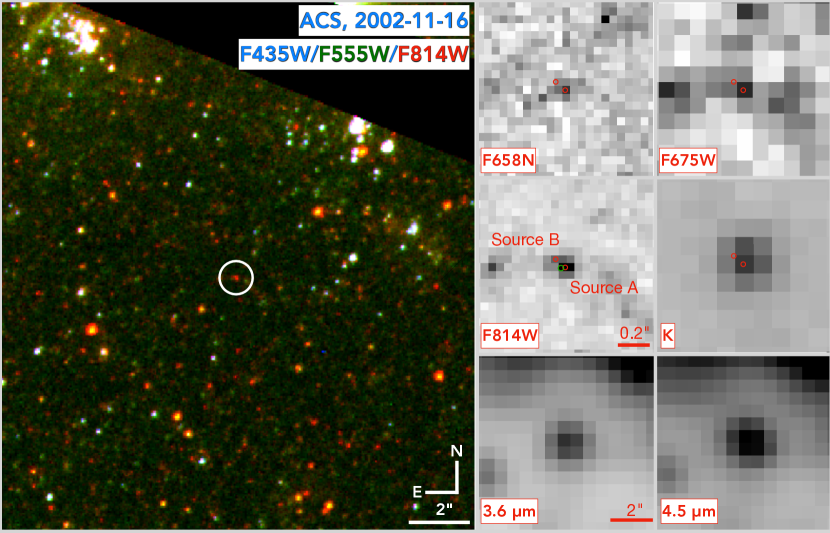
We present pre-explosion optical and infrared (IR) imaging at the site of the type II supernova (SN II) 2023ixf in Messier 101 at 6.9 Mpc. We astrometrically registered a ground-based image of SN 2023ixf to archival Hubble Space Telescope (HST), Spitzer Space Telescope (Spitzer), and ground-based near-IR images. A single point source is detected at a position consistent with the SN at wavelengths ranging from HST $R$-band to Spitzer 4.5 $μ$m. Fitting to blackbody and red supergiant (RSG) spectral-energy distributions (SEDs), we find that the source is anomalously cool with a significant mid-IR excess. We interpret this SED as reprocessed emission in a 8600 $R_{\odot}$ circumstellar shell of dusty material with a mass $\sim$5$ imes10^{-5} M_{\odot}$ surrounding a $\log(L/L_{\odot})=4.74\pm0.07$ and $T_{ m eff}=3920\substack{+200\\-160}$ K RSG. This luminosity is consistent with RSG models of initial mass 11 $M_{\odot}$, depending on assumptions of rotation and overshooting. In addition, the counterpart was significantly variable in pre-explosion Spitzer 3.6 $μ$m and 4.5 $μ$m imaging, exhibiting $\sim$70% variability in both bands correlated across 9 yr and 29 epochs of imaging. The variations appear to have a timescale of 2.8 yr, which is consistent with $κ$-mechanism pulsations observed in RSGs, albeit with a much larger amplitude than RSGs such as $α$ Orionis (Betelgeuse).
研究の動機と目的
- 予爆画像データを用いて、みずへん座銀河M101におけるタイプII超新星SN 2023ixfの前身星を同定すること。
- 高質量RSG(>20 M☉)がタイプII超新星の前身として著しく不足しているという「赤超巨星問題」を解明するために、その原因を調査すること。
- 全放射光度、温度、円周環境といった前身星の物理的性質を同定すること。
- 前身星の変動の性質を調査し、脈動不安定性および質量放出に与える影響を解明すること。
- 前身星の性質が、RSGの進化および核崩壊超新星の理論的モデルと整合するかを検証すること。
提案手法
- 超新星位置を正確に特定するため、予爆前の地上望遠鏡、ハッブル宇宙望遠鏡(HST)、スピッツァー宇宙望遠鏡の画像をアストロメトリックに登録する。
- 黒体放射およびRSGモデルを用いたスペクトルエネルギー分布(SED)フィッティングにより、前身星の効果的温度と全放射光度を導出する。
- 3次元放射遷移法を用いて、中赤外域の過剰放射を円周状ほこり殻による再放射光としてモデル化する。
- 9年間にわたる長期間のスピッツァー宇宙望遠鏡の3.6 μmおよび4.5 μm光度曲線(29エポック)を分析し、変動の振幅と時標を測定する。
- 理論的RSG進化モデルと比較することで、前身星の全放射光度と温度から初期質量を推定する。
- ベイズ推論(emcee)を用いて、SEDフィッティングおよび変動パラメータの不確実性を制約する。
実験結果
リサーチクエスチョン
- RQ1SN 2023ixfの前身星の性質は何か?また、これは赤超巨星として期待される性質と一致するか?
- RQ2前身星のSEDに顕著な中赤外域過剰放射が見られるのはなぜか?これは円周環境に何を示唆するか?
- RQ3前身星の光度曲線における長期的光度変動は、脈動不安定性機構とどのように関係しているか?
- RQ4前身星の初期質量は何か?また、これはタイプII超新星前身星としての理論的期待値と一致するか?
- RQ5前身星の変動および質量放出の歴史は、高質量RSGが崩壊の直前にあるという仮説を支持するか?
主な発見
- 光学から中赤外域にわたり、SN 2023ixfの位置に一様な点源が検出され、明るく冷たい前身星であることが確認された。
- 前身星の全放射光度は log(L/L☉) = 4.74 ± 0.07、効果的温度は3920 Kであり、これは赤超巨星と整合的である。
- 中赤外域の過剰放射は、半径8600 R☉、質量約5×10⁻⁵ M☉の円周状ほこり殻による星光の再放射として最もよく説明できる。
- 前身星は9年間にわたり、スピッツァーの3.6 μmおよび4.5 μmバンドでそれぞれ70%の変動を示し、特徴的な時標は2.8年であった。
- この変動はκ機構による脈動と整合的であるが、ベテルギウスのような通常のRSGとは比べ物にならないほど大きな振幅を示している。
- 前身星の全放射光度と温度は、回転およびオーバーシュートの仮定に依存するが、11 M☉の初期質量を持つRSGと整合的である。

この論文を読む
Nubintのビューアで原文を開き、読みながら気になる箇所をすぐに質問できます。
Nubintでこの論文を読むこのレビューはAIが論文の原文をもとに作成しました。引用する前に原文をご確認ください。