
[論文レビュー] Solving Diffusion ODEs with Optimal Boundary Conditions for Better Image Super-Resolution
本稿では、最適に導出された境界条件(BC)を用いて拡散ODEを解く、プラグアンドプレイなサンプリング手法を提案する。この手法により、微調整なしに事前学習済みの拡散ベースSRモデルの性能を著しく向上させることができる。参照用のHR-LR画像ペア集合を効率的に探索することで、近似的に最適なBCを同定し、標準的なサンプラーで得られる結果よりも品質が高く安定した結果を達成している。これは、より多くのステップを要する遅延型のベースライン(例:DDPM-1000)でさえも上回っている。
Diffusion models, as a kind of powerful generative model, have given impressive results on image super-resolution (SR) tasks. However, due to the randomness introduced in the reverse process of diffusion models, the performances of diffusion-based SR models are fluctuating at every time of sampling, especially for samplers with few resampled steps. This inherent randomness of diffusion models results in ineffectiveness and instability, making it challenging for users to guarantee the quality of SR results. However, our work takes this randomness as an opportunity: fully analyzing and leveraging it leads to the construction of an effective plug-and-play sampling method that owns the potential to benefit a series of diffusion-based SR methods. More in detail, we propose to steadily sample high-quality SR images from pre-trained diffusion-based SR models by solving diffusion ordinary differential equations (diffusion ODEs) with optimal boundary conditions (BCs) and analyze the characteristics between the choices of BCs and their corresponding SR results. Our analysis shows the route to obtain an approximately optimal BC via an efficient exploration in the whole space. The quality of SR results sampled by the proposed method with fewer steps outperforms the quality of results sampled by current methods with randomness from the same pre-trained diffusion-based SR model, which means that our sampling method "boosts" current diffusion-based SR models without any additional training.
研究の動機と目的
- 事前学習済みの拡散ベース画像超解像モデルからのサンプリングにおける不安定性とランダム性を解消すること。
- 一貫して高品質なSR結果をもたらす、原理的かつ決定的な境界条件(BC)の選択法を特定すること。
- 追加の学習を伴わずに、既存の事前学習済みモデルを用いて安定的かつ高性能な推論を可能にすること。
- 最適BCが入力の低解像度画像に依存しないことの検証を行い、多様な入力に対して再利用可能であることを示すこと。
- 最適BCの選択が、標準的なサンプリング手法(たとえば、100ステップのDDPM-100)でさえも凌駕できることを示すこと。
提案手法
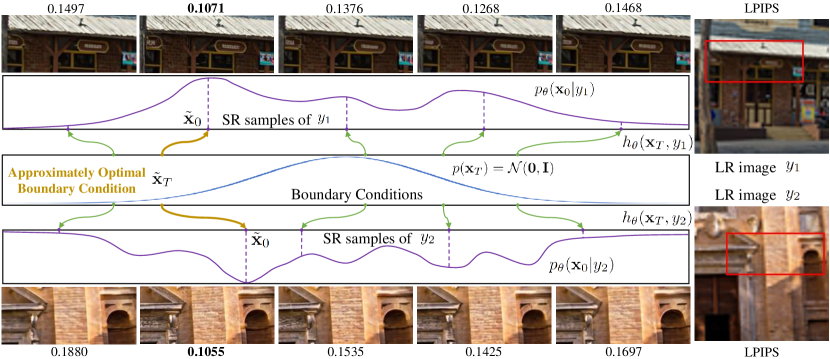
- 本手法は拡散プロセスを通常微分方程式(ODE)として定式化し、得られる高解像度画像 x̃_0 の確率密度を最大化するような初期ノイズベクトル(BC)x̃_T を最適化する。
- 最適BCの探索を支援するために、参照用のHR-LR画像ペア集合(R)を用い、BCを入力のLR画像とは独立した学習可能な事前分布として扱う。
- 候補となるランダムなBC集合(K)をサンプリングし、モデルの条件付き生成能力を用いて、平均的に最高品質のSR出力を得られるBCを同定する。
- 拡散ODEソルバー(例:DDIM-100)における高品質画像生成の尤度を最大化するように、最適BCの推定を探索的手順で行う。
- 本手法はプラグアンドプレイである。最適BCが事前に計算されれば、再学習を伴わず、任意の未知のLR入力から高品質なSR画像を生成可能である。
- 本手法は、最適BCが入力LR画像に依存しないという事実を活用しており、異なる入力に対して一般化可能である。
実験結果
リサーチクエスチョン
- RQ1拡散ODEに対して、一貫して高品質な画像超解像結果をもたらす決定的かつ最適な境界条件を特定できるか?
- RQ2最適境界条件は入力の低解像度画像に依存するのか、それとも異なる入力間で共有可能か?
- RQ3境界条件の最適化によって、微調整なしに事前学習済みの拡散ベースSRモデルのサンプリング性能を向上させられるか?
- RQ4参照集合(R)および候補集合(K)のサイズが、推定された最適BCの品質および安定性にどのように影響するか?
- RQ5最適BC選択に基づく手法は、ステップ数が少ないにもかかわらず、DDPM-100などの標準的なサンプリング戦略を凌駆できるか?
主な発見
- 本手法(DDIM-100)は、bicubic-SRベンチマークにおいて、DDPM-1000を含むすべての他のサンプリング手法を上回り、より高い画像品質と高速な推論を達成した。
- real-SRベンチマークでは、StableSRの公式サンプリング手法(DDPM-200)を上回りながらも、より高速なサンプリング速度を維持した。
- アブレーションスタディの結果、参照集合サイズ(R)および候補集合サイズ(K)を増加させることで、BC推定の安定性と品質が向上し、性能が向上するとともに分散が減少した。
- 推定された最適BC(x̃_T)は入力のLR画像に依存せず、再計算なしに異なる入力に対して再利用可能である。
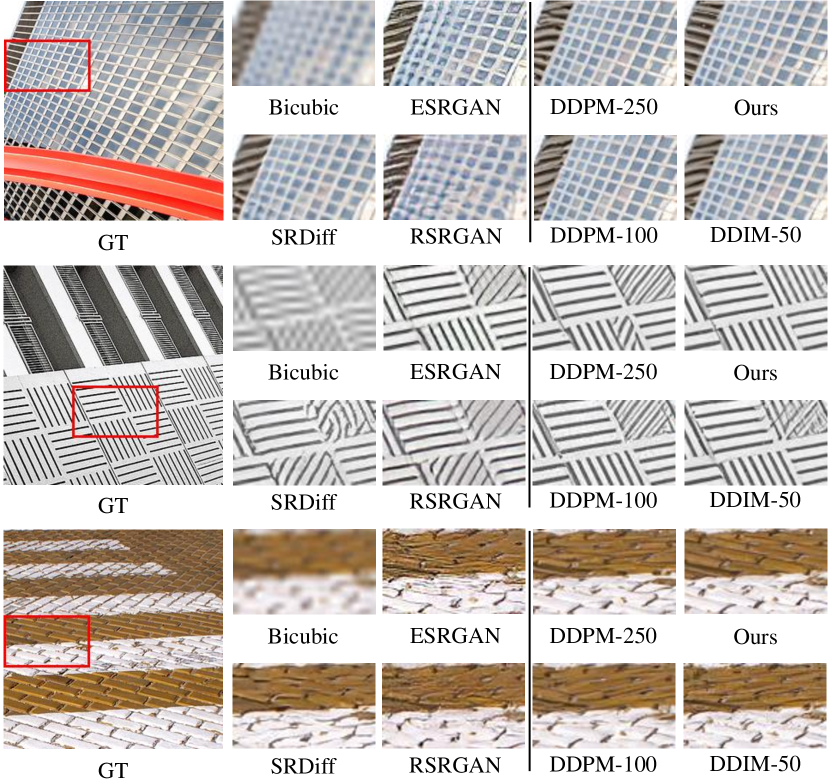
- LPIPSおよび視覚的品質の観点から、本手法は最先端の性能を達成しており、再学習を伴わず既存モデルの性能を「ブースト」できることが示された。
- 本手法は、標準的な拡散サンプリングに内在するランダム性を排除する安定的かつ決定的なサンプリング戦略を提供し、一貫した高品質な結果を保証する。
この論文を読む
Nubintのビューアで原文を開き、読みながら気になる箇所をすぐに質問できます。
Nubintでこの論文を読むこのレビューはAIが論文の原文をもとに作成しました。引用する前に原文をご確認ください。